








Síndromes mielodisplásicos (SMD)
Obtenga una atención excepcional para los síndromes mielodisplásicos (SMD) y otros tipos de cáncer de sangre y médula ósea en el Montefiore Einstein Comprehensive Cancer Center. Nuestro equipo multidisciplinario tiene amplia experiencia en la atención médica de estos cánceres raros, como la anemia refractaria y la leucemia mieloide aguda (LMA), que se desarrollan cuando la médula ósea de una persona produce grandes cantidades de células sanguíneas inmaduras, llamadas "blastos", en lugar de células sanguíneas sanas.
Nuestro equipo de SMD ha sido pionero en la identificación de tratamientos y prácticas innovadoras contra el cáncer, incluyendo investigaciones de vanguardia que facilitaron la aprobación por parte de la Administración de Alimentos y Medicamentos de los Estados Unidos (FDA) de Luspatercept (Reblozyl) para el tratamiento del SMD, el primer medicamento nuevo para esta enfermedad en más de una década.
Ofrecemos regímenes de tratamiento de los SMD con sesiones más cortas pero más frecuentes, lo que hace que, en general, la terapia sea más tolerable. A partir de 2023, ofreceremos a los pacientes con SMD la terapia con células CAR-T, un tratamiento pionero que ayuda al propio sistema inmunológico del cuerpo a combatir el cáncer de forma más eficaz. Nuestros investigadores y científicos están explorando formas de aprovechar el potencial de este poderoso tratamiento para todos los tipos de cáncer.
Nuestro Centro de Síndromes Mielodisplásicos es reconocido como un "centro de excelencia" nacional por la MDS Foundation.
Cuando necesite atención para los síndromes mielodisplásicos, recurra a nuestros proveedores, a quienes les apasiona acabar con el cáncer y abordar todas sus necesidades de salud.

El Montefiore Einstein Comprehensive Cancer Center, designado como centro integral del cáncer por el National Cancer Institute (NCI), apoya la misión y las normas del NCI. La siguiente información sobre los tipos de cáncer, prevención y tratamientos ha sido facilitada por el NCI.
Tratamiento de los síndromes mielodisplásicos (PDQ®): versión para pacientes
Información general sobre los síndromes mielodisplásicos
Puntos clave
- Los síndromes mielodisplásicos son un grupo de cánceres en los que las células sanguíneas inmaduras de la médula ósea no maduran ni se convierten en células sanguíneas sanas.
- Los diferentes tipos de síndromes mielodisplásicos se diagnostican en función de ciertos cambios en las células sanguíneas y la médula ósea.
- La edad y un tratamiento previo con quimioterapia o radioterapia afectan el riesgo de desarrollar un síndrome mielodisplásico.
- Los signos y síntomas de un síndrome mielodisplásico son dificultad para respirar y cansancio.
- Las pruebas que examinan la sangre y la médula ósea se utilizan para diagnosticar los síndromes mielodisplásicos.
- Certain factors affect prognosis (chance of recovery) and treatment options.
Los síndromes mielodisplásicos son un grupo de cánceres en los que las células sanguíneas inmaduras de la médula ósea no maduran ni se convierten en células sanguíneas sanas.
En una persona sana, la médula ósea produce células madre sanguíneas (células inmaduras) que con el tiempo se convierten en células sanguíneas maduras.

Anatomía del hueso. El hueso está formado por hueso compacto, hueso esponjoso y médula ósea. El hueso compacto constituye la capa externa del hueso. El hueso esponjoso se encuentra sobre todo en los extremos de los huesos y contiene médula roja. La médula ósea se encuentra en el centro de la mayoría de los huesos y tiene muchos vasos sanguíneos. Hay dos tipos de médula ósea: roja y amarilla. La médula roja contiene células madre sanguíneas que pueden convertirse en glóbulos rojos, glóbulos blancos o plaquetas. La médula amarilla está compuesta principalmente de grasa.
Una célula madre sanguínea puede convertirse en una célula madre linfoide o en una célula madre mieloide. Una célula madre linfoide se convierte en un glóbulo blanco, mientras que una célula madre mieloide se convierte en uno de tres tipos de células sanguíneas maduras:
- Glóbulos rojos, que transportan oxígeno y otras sustancias a todos los tejidos del cuerpo
- Plaquetas, que forman coágulos de sangre para detener las hemorragias
- Granulocitos, unos glóbulos blancos que ayudan a combatir infecciones y enfermedades
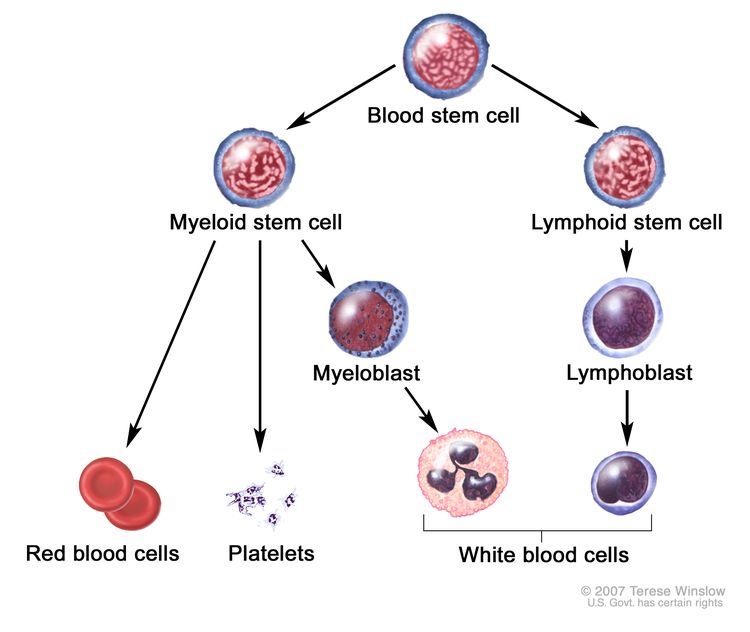
Desarrollo de las células sanguíneas. Una célula madre sanguínea pasa por varios estadios para convertirse en un glóbulo rojo, una plaqueta o un glóbulo blanco.
En un paciente con síndrome mielodisplásico, las células madre sanguíneas (células inmaduras) no se convierten en glóbulos rojos, glóbulos blancos o plaquetas maduras en la médula ósea. Estas células sanguíneas inmaduras, llamadas blastos, no funcionan como deberían y mueren en la médula ósea o poco después de pasar a la sangre. Esto deja menos espacio para que se formen glóbulos blancos, glóbulos rojos y plaquetas sanos en la médula ósea. Cuando hay menos células sanguíneas sanas, puede haber una infección, anemia o predisposición al sangrado.
Los diferentes tipos de síndromes mielodisplásicos se diagnostican en función de ciertos cambios en las células sanguíneas y la médula ósea.
- Anemia refractaria: hay muy pocos glóbulos rojos en la sangre y el paciente tiene anemia. El número de glóbulos blancos y plaquetas es normal.
- Anemia refractaria con sideroblastos en anillo: hay muy pocos glóbulos rojos en la sangre y el paciente tiene anemia. Los glóbulos rojos tienen demasiado hierro dentro de la célula. La cantidad de glóbulos blancos y plaquetas es normal.
- Anemia refractaria con exceso de blastos: hay muy pocos glóbulos rojos en la sangre y el paciente tiene anemia. Entre el 5 y el 19 % de las células de la médula ósea son blastos. También puede haber cambios en los glóbulos blancos y las plaquetas. La anemia refractaria con exceso de blastos puede progresar a leucemia mieloide aguda (LMA). Para obtener más información, consulte Tratamiento de la leucemia mieloide aguda .
- Citopenia refractaria con displasia multilinaje: hay muy pocos de al menos dos tipos de glóbulos (glóbulos rojos, plaquetas o glóbulos blancos). Menos del 5 % de las células de la médula ósea y menos del 1 % de las células de la sangre son blastos. Si los glóbulos rojos se ven afectados, es posible que tengan hierro adicional. La citopenia refractaria puede progresar a una leucemia mieloide aguda (LMA).
- Citopenia refractaria con displasia unilinaje: hay una cantidad insuficiente de algún tipo de glóbulos (glóbulos rojos, plaquetas o glóbulos blancos). Hay cambios en el 10 % o más de otros dos tipos de células sanguíneas. Menos del 5 % de las células de la médula ósea son blastos y menos del 1 % de las células de la sangre son blastos.
- Síndrome mielodisplásico inclasificable: la cantidad de blastos en la médula ósea y la sangre es normal, y la enfermedad no encaja en ninguna de las otras categorías de síndromes mielodisplásicos.
- Síndrome mielodisplásico asociado con una anomalía cromosómica del(5q) aislada: hay muy pocos glóbulos rojos en la sangre y el paciente tiene anemia. Menos del 5 % de las células de la médula ósea y de la sangre son blastos. Hay un cambio específico en el cromosoma.
- Leucemia mielomonocítica crónica (LMMC): para obtener más información, consulte el sitio web Tratamiento de neoplasias mielodisplásicas/mieloproliferativas.
La edad y un tratamiento previo con quimioterapia o radioterapia afectan el riesgo de desarrollar un síndrome mielodisplásico.
Todo lo que aumenta las posibilidades de que una persona desarrolle una enfermedad se llama factor de riesgo. No todas las personas con uno o más de estos factores de riesgo desarrollarán síndromes mielodisplásicos, mientras que sí se desarrollarán en personas que no tienen ningún factor de riesgo conocido. Hable con su médico si cree que puede estar en riesgo. Los factores de riesgo de los síndromes mielodisplásicos son los siguientes:
- Tratamiento previo con quimioterapia o radioterapia para el cáncer
- Estar expuesto a ciertas sustancias químicas, incluido el humo del tabaco, pesticidas, fertilizantes y solventes como el benceno
- Estar expuesto a metales pesados, como mercurio o plomo
Se desconoce la causa de los síndromes mielodisplásicos en la mayoría de los pacientes.
Los signos y síntomas de un síndrome mielodisplásico son dificultad para respirar y cansancio.
Los síndromes mielodisplásicos a menudo no causan signos o síntomas tempranos. Pueden detectarse durante un análisis de sangre de rutina. Los signos y síntomas pueden ser causados por síndromes mielodisplásicos u otras afecciones. Consulte con su médico si tiene alguno de los siguientes síntomas:
- Falta de aire
- Debilidad o sensación de cansancio.
- Piel más pálida de lo habitual
- Predisposición a hematomas o hemorragias
- Petequias (manchas planas y puntiformes debajo de la piel causadas por sangrado)
Las pruebas que examinan la sangre y la médula ósea se utilizan para diagnosticar los síndromes mielodisplásicos.
In addition to asking about your personal and family health history and doing a physical exam, your doctor may perform the following tests and procedures:
- Hemograma completo (CBC, por sus siglas en inglés) con diferencial: procedimiento en el que se extrae una muestra de sangre y se examina:
- El número de glóbulos rojos y plaquetas
- El número y tipo de glóbulos blancos
- La cantidad de hemoglobina (la proteína que transporta oxígeno) en los glóbulos rojos.
- La parte de la muestra de sangre compuesta por glóbulos rojos.
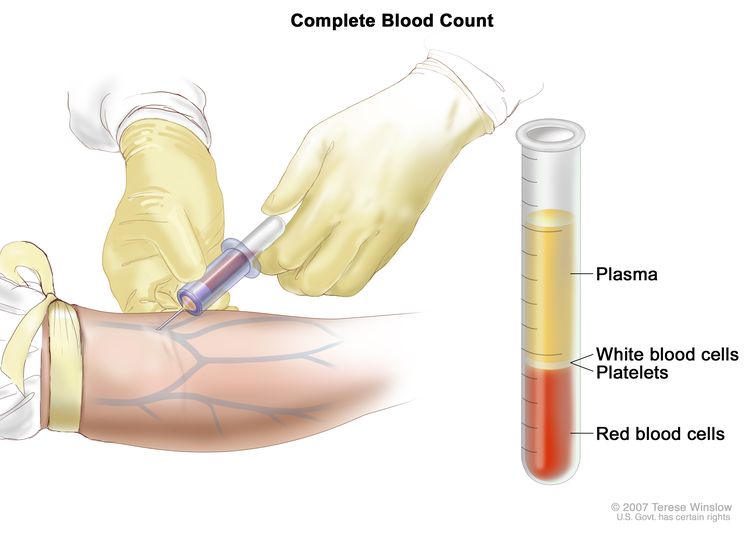
Hemograma completo (HC): la sangre se extrae insertando una aguja en una vena y dejando que fluya hacia un tubo. La muestra se envía al laboratorio y se cuentan los glóbulos rojos, los glóbulos blancos y las plaquetas. El HC se utiliza para detectar, diagnosticar y controlar diversas afecciones.
- Frotis de sangre periférica: es un procedimiento en el que se analiza una muestra de sangre para detectar cambios en la cantidad, tipo, forma y tamaño de las células sanguíneas y si hay un exceso de hierro en los glóbulos rojos.
- Análisis citogenético: es una prueba de laboratorio en la que se cuentan los cromosomas de las células de una muestra de médula ósea o de sangre y se comprueba si hay cambios, como cromosomas fragmentados, ausentes, reorganizados o adicionales. Los cambios en ciertos cromosomas pueden ser un signo de cáncer. El análisis citogenético se utiliza para diagnosticar el cáncer, planificar el tratamiento o determinar qué tan bien está funcionando el mismo.
- Estudios de química sanguínea: es un procedimiento en el que se analiza una muestra de sangre para medir las cantidades de ciertas sustancias, como vitamina B12 y folato, liberadas a la sangre por los órganos y los tejidos del cuerpo. Una cantidad inusual (mayor o menor de lo normal) de una sustancia puede ser un signo de enfermedad.
- Biopsia y aspiración de la médula ósea: consiste en la extracción de médula ósea, sangre y un pequeño fragmento de hueso mediante la inserción de una aguja hueca en el hueso de la cadera o el esternón. Un pathologist observará la médula ósea, la sangre y el hueso con un microscope en busca de anómalas células.
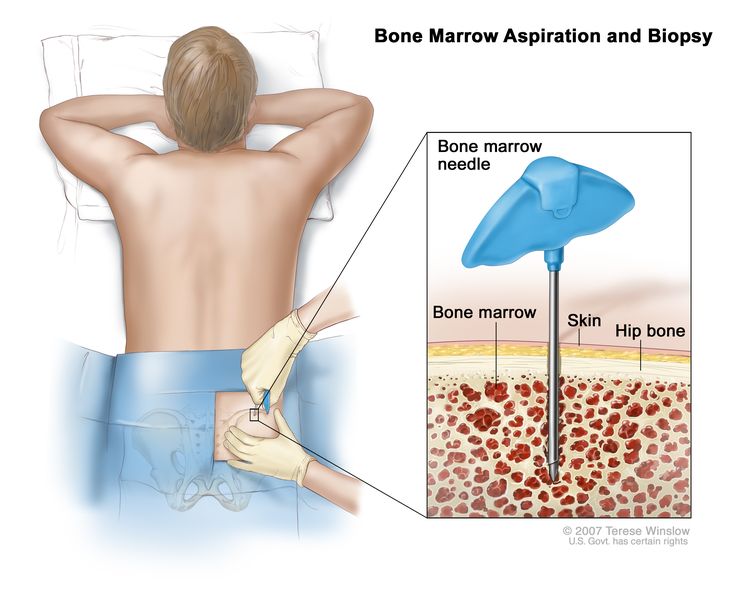
Aspiración y biopsia de médula ósea. Tras anestesiar una pequeña zona de la piel, se introduce una aguja larga y hueca a través de la piel y el hueso de la cadera del paciente hasta la médula ósea. Se extrae una muestra de médula ósea y un pequeño fragmento de hueso para su examen microscópico.
Se pueden realizar las siguientes pruebas en la muestra de tejido que se extrae:
- Inmunocitoquímica: es una prueba de laboratorio que utiliza anticuerpos para detectar determinados antígenos (marcadores) en una muestra de la médula ósea de un paciente. Los anticuerpos suelen estar unidos a una enzima o a un colorante fluorescente. Una vez que los anticuerpos se unen al antígeno en la muestra de células del paciente, se activa la enzima o el colorante y el antígeno se puede observar con un microscopio. Este tipo de prueba se utiliza para ayudar a diagnosticar el cáncer y para diferenciar entre síndromes mielodisplásicos, leucemia y otras afecciones.
- Inmunofenotipificación: es una prueba de laboratorio que utiliza anticuerpos para identificar células cancerosas según los tipos de antígenos o marcadores presentes en la superficie de las células. Esta prueba se utiliza para diagnosticar tipos específicos de leucemia y otros trastornos sanguíneos.
- Citometría de flujo: es una prueba de laboratorio que mide la cantidad de células en una muestra, el porcentaje de células vivas y ciertas características celulares, como el tamaño, la forma y la presencia de marcadores tumorales (u otros) en la superficie. Las células de una muestra de sangre, médula ósea u otro tejido de un paciente se tiñen con un tinte fluorescente, se colocan en un líquido y luego se pasan una a la vez a través de un haz de luz. Los resultados se basan en cómo reaccionan las células teñidas al haz de luz. Esta prueba se utiliza para diagnosticar y controlar ciertos tipos de cánceres, como la leucemia y el linfoma.
- Hibridación in situ con fluorescencia (FISH): prueba de laboratorio que se utiliza para observar y contar genes o cromosomas en células y tejidos. Se generan fragmentos de ADN con colorantes fluorescentes en el laboratorio y se añaden a una muestra de células o tejidos del paciente. Cuando estos fragmentos de ADN teñidos se unen a ciertos genes o zonas de cromosomas en la muestra, se iluminan al observarlos con un microscopio de fluorescencia. La prueba FISH se utiliza para diagnosticar el cáncer y planificar el tratamiento.
Certain factors affect prognosis (chance of recovery) and treatment options.
El pronóstico y las opciones de tratamiento dependen de los siguientes factores:
- La cantidad de células blásticas en la médula ósea
- Si uno o más tipos de glóbulos están afectados.
- Si el paciente tiene signos o síntomas de anemia, sangrado o infección.
- Si el paciente tiene un riesgo bajo o alto de leucemia.
- Ciertos cambios en los cromosomas
- Si el síndrome mielodisplásico se desarrolló después de la quimioterapia o la radioterapia para el cáncer.
- The patient's age and general health.
Treatment Option Overview
Puntos clave
- Existen diferentes tipos de tratamiento para pacientes con síndromes mielodisplásicos.
- El tratamiento de los síndromes mielodisplásicos consiste en atención de apoyo, administración de medicamentos y trasplante de células madre.
- The following types of treatment are used:
- Atención de apoyo
- Terapia farmacológica
- Chemotherapy with stem cell transplant
- New types of treatment are being tested in clinical trials.
- El tratamiento de los síndromes mielodisplásicos puede producir efectos secundarios.
- Patients may want to think about taking part in a clinical trial.
- Los pacientes pueden participar en los ensayos clínicos antes, durante o después de comenzar su tratamiento.
- Pueden ser necesarias pruebas de seguimiento.
Existen diferentes tipos de tratamiento para pacientes con síndromes mielodisplásicos.
Existen diferentes tipos de tratamiento disponibles para los pacientes con síndromes mielodisplásicos. Algunos tratamientos son estándar (el tratamiento que se utiliza actualmente) y otros se están probando en ensayos clínicos. Un ensayo clínico de tratamiento es un estudio de investigación cuyo objetivo es ayudar a mejorar los tratamientos actuales u obtener información sobre nuevos tratamientos para pacientes con cáncer. Cuando los ensayos clínicos muestran que un nuevo tratamiento es mejor que el que se utiliza actualmente, este puede convertirse en el estándar. Es posible que los pacientes deseen considerar participar en un ensayo clínico. Algunos ensayos clínicos están abiertos solo a pacientes que no han comenzado el tratamiento.
El tratamiento de los síndromes mielodisplásicos consiste en atención de apoyo, administración de medicamentos y trasplante de células madre.
Los pacientes con síndrome mielodisplásico que presentan síntomas causados por un recuento de células sanguíneas bajo reciben atención de apoyo para aliviar los síntomas y mejorar la calidad de vida. Se pueden administrar medicamentos para retardar la progresión de la enfermedad. Algunos pacientes se pueden curar con un tratamiento agresivo con quimioterapia seguida de un trasplante de células madre utilizando células madre de un donante.
The following types of treatment are used:
Atención de apoyo
Se ofrece atención de apoyo para disminuir los problemas causados por la enfermedad o su tratamiento. La atención de apoyo puede consistir en:
- Terapia de transfusión
La terapia de transfusión (transfusión de sangre) es un método para administrar glóbulos rojos, glóbulos blancos o plaquetas para reemplazar los glóbulos destruidos por una enfermedad o tratamiento. Una transfusión de glóbulos rojos se realiza cuando el recuento de glóbulos rojos es bajo y se presentan signos o síntomas de anemia, como dificultad para respirar o sensación de cansancio extremo. Por lo general, se administra una transfusión de plaquetas cuando el paciente está sangrando, se le está realizando un procedimiento que puede producir una hemorragia o el recuento de plaquetas es muy bajo.
Los pacientes que reciben muchas transfusiones de células sanguíneas pueden presentar daños en tejidos y órganos debido a la acumulación adicional de hierro. Estos pacientes pueden recibir tratamiento con terapia de quelación del hierro para eliminar el exceso de hierro de la sangre.
- Agentes estimulantes de la eritropoyesis
Se pueden administrar agentes estimulantes de la eritropoyesis (AEE) para aumentar la cantidad de glóbulos rojos maduros producidos por el cuerpo y disminuir los efectos de la anemia. A veces, el factor estimulante de colonias de granulocitos (G-CSF) se administra con AEE para ayudar a que el tratamiento funcione mejor.
- Terapia con antibióticos
Se pueden administrar antibióticos para combatir la infección.
Terapia farmacológica
- Lenalidomida
Los pacientes con síndrome mielodisplásico asociado con una anomalía cromosómica del(5q) aislada que necesitan transfusiones frecuentes de glóbulos rojos pueden ser tratados con lenalidomida. La lenalidomida se usa para disminuir la necesidad de transfusiones de glóbulos rojos.
- Terapia inmunosupresora
La globulina antitimocítica (ATG) actúa para suprimir o debilitar el sistema inmunológico. Se utiliza para disminuir la necesidad de realizar transfusiones de glóbulos rojos.
- Azacitidina y decitabina
La azacitidina y la decitabina se usan para tratar los síndromes mielodisplásicos al destruir las células que se dividen rápidamente. También ayudan a que los genes que participan en el crecimiento celular funcionen como deberían. El tratamiento con azacitidina y decitabina puede retardar la progresión de los síndromes mielodisplásicos a la leucemia mieloide aguda.
- Quimioterapia administrada en la leucemia mieloide aguda (LMA)
Los pacientes con síndrome mielodisplásico y una gran cantidad de blastos en la médula ósea tienen un riesgo elevado de desarrollar leucemia aguda. Pueden tratarse con el mismo régimen de quimioterapia que se utiliza en pacientes con leucemia mieloide aguda.
Chemotherapy with stem cell transplant
La quimioterapia se administra para destruir las células cancerosas. El tratamiento del cáncer también destruye las células sanas, incluidas las células productoras de sangre. El trasplante de células madre es un tratamiento para reemplazar las células productoras de sangre. Las células madre (células sanguíneas inmaduras) se extraen de la sangre o de la médula ósea del paciente o de un donante; luego se congelan y almacenan. Una vez que el paciente finaliza la quimioterapia, las células madre almacenadas se descongelan y se regresan al paciente mediante una infusión. Estas células madre reinfundidas crecen (y restauran) las células sanguíneas del cuerpo.
Es posible que este tratamiento no funcione tan bien en pacientes cuyo síndrome mielodisplásico fue causado por un tratamiento previo del cáncer.
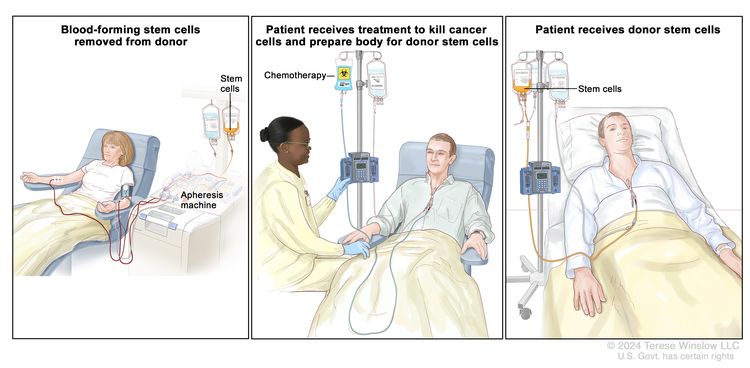
Trasplante de células madre de un donante. (Paso 1): Cuatro o cinco días antes de la recolección de células madre del donante, este recibe un medicamento para aumentar la cantidad de células madre que circulan por su torrente sanguíneo (no se muestra en la imagen). Las células madre hematopoyéticas se extraen del donante a través de una vena grande del brazo. La sangre fluye a través de una máquina de aféresis que extrae las células madre. El resto de la sangre se devuelve al donante a través de una vena del otro brazo. (Paso 2): El paciente recibe quimioterapia para destruir las células cancerosas y preparar su cuerpo para las células madre del donante. El paciente también puede recibir radioterapia (no se muestra en la imagen). (Paso 3): El paciente recibe una infusión de las células madre del donante.
New types of treatment are being tested in clinical trials.
Information about clinical trials is available from the NCI website.
El tratamiento de los síndromes mielodisplásicos puede producir efectos secundarios.
For information about side effects caused by treatment for cancer, visit our Side Effects page.
Patients may want to think about taking part in a clinical trial.
For some patients, taking part in a clinical trial may be the best treatment choice. Clinical trials are part of the cancer research process. Clinical trials are done to find out if new cancer treatments are safe and effective or better than the standard treatment.
Many of today's standard treatments for cancer are based on earlier clinical trials. Patients who take part in a clinical trial may receive the standard treatment or be among the first to receive a new treatment.
Patients who take part in clinical trials also help improve the way cancer will be treated in the future. Even when clinical trials do not lead to effective new treatments, they often answer important questions and help move research forward.
Los pacientes pueden participar en los ensayos clínicos antes, durante o después de comenzar su tratamiento.
Some clinical trials only include patients who have not yet received treatment. Other trials test treatments for patients whose cancer has not gotten better. There are also clinical trials that test new ways to stop cancer from recurring (coming back) or reduce the side effects of cancer treatment.
Clinical trials are taking place in many parts of the country. Information about clinical trials supported by NCI can be found on NCI’s clinical trials search webpage. Clinical trials supported by other organizations can be found on the ClinicalTrials.gov website.
Pueden ser necesarias pruebas de seguimiento.
A medida que avanza el tratamiento, se le realizarán pruebas o controles de seguimiento. Es posible que se repitan algunas pruebas para diagnosticar o estadificar el cáncer con el fin de evaluar cómo está funcionando el tratamiento. Las decisiones sobre si continuar, modificar o suspender el tratamiento pueden basarse en los resultados de estas pruebas.
Algunas pruebas seguirán realizándose de manera periódica después de terminar el tratamiento. Los resultados pueden indicar si su afección ha cambiado o si el cáncer ha redicivado (regresado).
Tratamiento de los síndromes mielodisplásicos
For information about the treatments listed below, see the Treatment Option Overview section.
El tratamiento de los síndromes mielodisplásicos puede consistir en:
- Atención de apoyo con uno o más de los siguientes:
- Tratamientos para frenar la evolución hacia el leucemia mieloide aguda (LMA):
- Lenalidomida.
- Terapia inmunosupresora.
- Azacitidina y decitabina
- Quimioterapia utilizada en la leucemia mieloide aguda.
- Quimioterapia con trasplante de células madre
Los pacientes que fueron tratados en el pasado con quimioterapia o radioterapia pueden desarrollar neoplasias mieloides relacionadas con esa terapia. Las opciones de tratamiento son las mismas que para otros síndromes mielodisplásicos.
Puede utilizar la búsqueda de ensayos clínicos y encontrar ensayos clínicos sobre cáncer patrocinados por el NCI que acepten participantes. La búsqueda le permite filtrar los ensayos según el tipo de cáncer, la edad y el lugar donde se realizan los ensayos. También encontrará información general sobre los ensayos clínicos.
Tratamiento de síndromes mielodisplásicos en recaída o refractarios
For information about the treatments listed below, see the Treatment Option Overview section.
No existe un tratamiento estándar para los síndromes mielodisplásicos refractarios o recidivantes. Los pacientes cuyo cáncer no responde al tratamiento o ha regresado después de este podrían considerar participar en un ensayo clínico.
Puede utilizar la búsqueda de ensayos clínicos y encontrar ensayos clínicos sobre cáncer patrocinados por el NCI que acepten participantes. La búsqueda le permite filtrar los ensayos según el tipo de cáncer, la edad y el lugar donde se realizan los ensayos. También encontrará información general sobre los ensayos clínicos.
Más información sobre los síndromes mielodisplásicos
Para obtener más información del National Cancer Institute sobre los síndromes mielodisplásicos, consulte:
For general cancer information and other resources from the National Cancer Institute, visit:
Sobre este resumen del PDQ
Acerca del PDQ
El Physician Data Query (PDQ) es la base de datos integral sobre el cáncer del National Cancer Institute (NCI). La base de datos del PDQ contiene resúmenes con la última información publicada sobre prevención, detección, genética, tratamiento, atención médica de apoyo y medicina complementaria y alternativa relacionada con el cáncer. La mayoría de los resúmenes se presentan en dos versiones. Las versiones para profesionales de la salud contienen información detallada escrita en lenguaje técnico. Las versiones para pacientes están escritas en un lenguaje fácil de entender y no tan técnico. Ambas versiones contienen información precisa y actualizada sobre el cáncer. La mayoría de las versiones también están disponibles en español.
El PDQ es un servicio del NCI. El NCI es parte de los Institutos Nacionales de Salud (NIH), que son el centro de investigación biomédica del Gobierno federal. Los resúmenes del PDQ se basan en una revisión independiente de la literatura médica. No son declaraciones de políticas del NCI ni de los NIH.
Propósito de este resumen
Este resumen del PDQ sobre el cáncer contiene información actualizada sobre el tratamiento de los síndromes mielodisplásicos. Su propósito es informar y ayudar a los pacientes, las familias y los cuidadores. No da pautas ni recomendaciones formales para tomar decisiones relacionadas con la atención médica.
Revisores y actualizaciones
Los comités editoriales escriben los resúmenes de información sobre el cáncer del PDQ y los mantienen actualizados. Estos comités están formados por equipos de especialistas en el tratamiento del cáncer y otras especialidades relacionadas con esta enfermedad. Los resúmenes se revisan periódicamente y se modifican cuando hay información nueva. La fecha de actualización al pie de cada resumen indica cuándo se realizó el cambio más reciente.
The information in this patient summary was taken from the health professional version, which is reviewed regularly and updated as needed, by the PDQ Adult Treatment Editorial Board.
Información sobre ensayos clínicos
Un ensayo clínico es un estudio para responder a una pregunta científica como, por ejemplo, si un tratamiento es mejor que otro. Los ensayos se basan en estudios anteriores y en lo aprendido en el laboratorio. Cada ensayo responde a determinadas preguntas científicas que permiten encontrar nuevas y mejores formas de ayudar a los pacientes con cáncer. Durante los ensayos clínicos de tratamiento, se recopila información sobre los efectos de un nuevo tratamiento y su eficacia. Si un ensayo clínico demuestra que un nuevo tratamiento es mejor que uno que se utiliza actualmente, el nuevo tratamiento puede convertirse en “estándar”. Los pacientes pueden valorar la posibilidad de participar en un ensayo clínico. Algunos ensayos clínicos solo están abiertos a pacientes que no hayan iniciado el tratamiento.
Los ensayos clínicos se pueden encontrar en línea en el sitio web del NCI. Para obtener más información, llame al Servicio de Información sobre el Cáncer (CIS, por sus siglas en inglés), el centro de contacto del NCI, al 1-800-4-CANCER (1-800-422-6237).
Permiso de uso de este resumen
Physician Data Query (PDQ) es una marca registrada. Se autoriza el libre uso del contenido de los documentos del PDQ como texto. Sin embargo, no se podrá identificar como un resumen de información sobre cáncer del PDQ del NCI, salvo que se reproduzca en su totalidad y se actualice con regularidad. Por otra parte, se permite que los autores incluyan una oración como “en el resumen del PDQ del NCI sobre la prevención del cáncer de mama se describen, de manera concisa, los siguientes riesgos: [incluir fragmento del resumen]”.
La forma recomendada para citar este resumen del PDQ es:
Comité editorial del PDQ® sobre el tratamiento de adultos. Tratamiento de los síndromes mielodisplásicos (PDQ). Bethesda, MD: National Cancer Institute. Actualizado el [DD/MM/AAAA]
Las imágenes de este resumen se utilizan con el permiso del autor, artista y/o editorial para uso exclusivo en los resúmenes del PDQ. Si desea usar una imagen de un resumen del PDQ sin incluir el resumen completo, debe obtener autorización del propietario. El National Cancer Institute no puede otorgar dicho permiso. Para obtener más información sobre el uso de las imágenes de este resumen o de otras ilustraciones relacionadas con el cáncer, consulte Visuals Online, una colección de más de 3,000 imágenes científicas.
Descargo de responsabilidad
La información de estos resúmenes no debe utilizarse para tomar decisiones sobre reembolsos de seguros. Puede encontrar más información sobre la cobertura de seguros en Cancer.gov en el sitio Manejo de la atención del cáncer.
Contáctenos
Puede encontrar más información sobre cómo contactarnos o recibir ayuda en el sitio web Cancer.gov en la página Comuníquese con el NCI. También puede enviar sus preguntas a Cancer.gov en el apartado Escríbanos del sitio web.
Actualizado:
URL de origen: https://www.cancer.gov/node/5795/syndication
Agencia de origen: National Cancer Institute (NCI)
Fecha de captura: 2013-09-14 09:03:05.0