
Investigación en Anestesiología
La investigación impulsa todo lo que hacemos en el Departamento de Anestesiología de Montefiore Einstein. Centramos nuestros esfuerzos en abordar cuestiones cruciales sobre los resultados perioperatorios, el acceso a la atención, el dolor y la analgesia sin opioides, así como en comprender el efecto de la anestesia en el cerebro en desarrollo. Hemos creado un programa de investigación de gran impacto clínico dedicado a apoyar la investigación iniciada por el investigador, desde el laboratorio hasta la práctica clínica. Aprovechamos nuestra base de datos líder de historias clínicas electrónicas a través de nuestro trabajo en el Laboratorio de Salud Digital de Anestesiología para analizar e informar las decisiones en las operaciones clínicas, la investigación clínica y la mejora de la calidad. Nuestra investigación va más allá de la anestesiología convencional y abarca estudios clínicos prospectivos, epidemiología e investigaciones en ciencias sociales, todo ello con el objetivo de mejorar la atención perioperatoria.
La ciencia en el corazón de la medicina
El Departamento de Anestesiología de Montefiore Einstein está a la vanguardia de la innovación y la investigación y ofrece un enfoque de atención basado en la investigación y la evidencia. Nos comprometemos a encontrar maneras novedosas y más efectivas de mejorar la seguridad del paciente e impulsar el futuro de la anestesiología, la cirugía y la medicina. Mediante colaboraciones globales y asociaciones interdisciplinarias, nuestro reconocido equipo de investigación colabora estrechamente entre disciplinas y es líder en la investigación básica, traslacional y clínica, con un énfasis especial en la investigación en salud digital, la salud poblacional, la mejora del desempeño y el control de calidad. Nuestra sofisticada base de datos de salud digital impulsa la toma de decisiones basadas en datos en las operaciones clínicas y la educación, lo que permite ofrecer una atención personalizada al paciente y obtener mejores resultados.
Lideramos el camino con investigación innovadora
Durante más de seis décadas, nuestro equipo de investigación ha transformado el panorama de la anestesiología mediante descubrimientos revolucionarios que siguen moldeando la medicina moderna. Nuestro legado de innovación abarca hitos como haber sido pioneros en el uso de la analgesia epidural para el manejo del dolor durante el parto, una técnica que desde entonces ha beneficiado a millones de madres en todo el mundo, hasta logros trascendentales como la introducción de medicamentos revolucionarios que ahora son pilares de la práctica anestesiológica. Fuimos el primer departamento en Estados Unidos en utilizar succinilcolina en la práctica clínica e introdujimos tanto la naloxona como la 2-cloroprocaína en la práctica clínica. Nuestra defensa temprana de la anestesia balanceada y el desarrollo de técnicas de óxido nitroso y oxígeno de bajo flujo revolucionaron las prácticas clínicas en todo el país. El "principio de cebado" que descubrimos, que reduce drásticamente el tiempo de inicio del efecto del relajante muscular, sigue siendo un concepto fundamental en el campo de la anestesia.
Estos logros históricos se complementan con nuestro compromiso continuo con el avance en este campo. Nuestros investigadores han revelado conocimientos cruciales sobre la fisiopatología de la unión neuromuscular y la compleja farmacología de los relajantes musculares, narcóticos y anestésicos locales. Hicimos historia al codiseñar el primer ensayo controlado aleatorizado y multicéntrico, financiado por los National Institutes of Health (NIH), dirigido por anestesiólogos y diseñado para comprender la fisiopatología de la unión neuromuscular. Recientemente, nuestro equipo desarrolló una herramienta de aprendizaje automático que predice cuando un paciente tiene un riesgo elevado de insuficiencia respiratoria posoperatoria, lo que demuestra nuestra dedicación continua a mejorar la seguridad del paciente mediante la innovación tecnológica. Desde el quirófano hasta el laboratorio de investigación, nuestro trabajo continúa ampliando los límites de lo posible en anestesiología, medicina perioperatoria y cuidados críticos, siempre con un objetivo en mente: ofrecer una atención al paciente más segura y eficaz que también optimice la comodidad y el bienestar psicológico de nuestros pacientes que se recuperan de procedimientos quirúrgicos mayores o traumatismos graves.
Laboratorio de Salud Digital de Montefiore Einstein
El Laboratorio de Salud Digital es la piedra angular de la investigación clínica y observacional en el Departamento de Anestesiología de Montefiore Einstein y cuenta con un equipo de médicos científicos, fellows de investigación y científicos de datos. Nuestros investigadores generan y analizan datos farmacofisiológicos con un alto nivel de detalle de más de un millón de pacientes operados en Montefiore Einstein o en alguna de nuestras redes de atención médica colaboradoras para comprender los efectos de los nuevos medicamentos en la recuperación de los pacientes tras una cirugía o enfermedad grave. Esta sólida base de datos permite a nuestro equipo identificar complicaciones poco frecuentes y es la base para un tratamiento perioperatorio individualizado. Al aprovechar la base de datos de Montefiore Einstein con datos demográficos únicos de los pacientes, priorizamos el acceso a la atención en nuestra investigación.
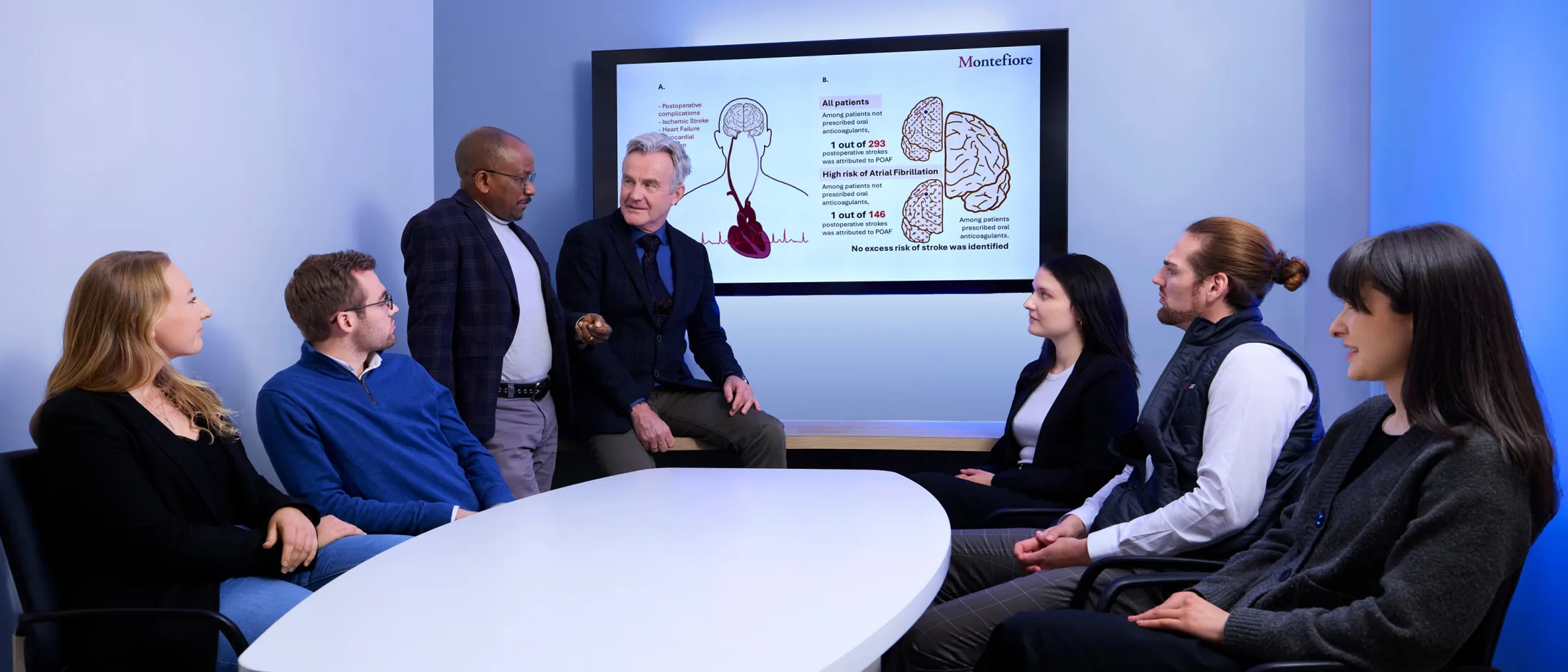
Un reciente estudio histórico de nuestro laboratorio, publicado en Nature Medicine, ejemplifica nuestro impacto. Al analizar a más de 250,000 pacientes de cirugía no cardiaca en numerosos centros, demostramos que la fibrilación auricular posoperatoria (FAP) de nueva aparición se presenta de forma predecible y aumenta el riesgo de accidente cerebrovascular isquémico. Asimismo, descubrimos que la anticoagulación oral posoperatoria redujo el riesgo de accidente cerebrovascular durante el primer año después de la cirugía.
Modificación del riesgo de accidente cerebrovascular
Los investigadores de nuestro Laboratorio de Salud Digital publicaron recientemente un artículo en Nature Medicine titulado “Role of anticoagulation therapy in modifying stroke risk associated with new-onset atrial fibrillation after non-cardiac surgery” (El papel de la terapia anticoagulante en la modificación del riesgo de accidente cerebrovascular asociado con la fibrilación auricular de nueva aparición tras cirugía no cardiaca). Vea este video para obtener más información sobre esta importante publicación, fruto de la colaboración multidisciplinaria con nuestros colegas de Cardiología y Cirugía Torácica.
Investigación clínica y observacional
Nuestra experiencia clínica en quirófanos y unidades de cuidados intensivos influye directamente en la agenda de investigación del Departamento de Anestesiología de Montefiore Einstein. Nuestra investigación abarca todo el espectro de subespecialidades de anestesiología con un enfoque sistemático: identificamos tratamientos innovadores mediante análisis retrospectivos y validamos estos hallazgos mediante estudios clínicos prospectivos.
Ensayos clínicos
Lideramos numerosos ensayos clínicos controlados aleatorizados, algunos de los cuales están financiados por los Institutos Nacionales de la Salud (NIH, por sus siglas en inglés). A través de nuestros ensayos clínicos, los pacientes pueden acceder a tecnologías emergentes y tratamientos innovadores que, de otro modo, no estarían disponibles para el público general.

Investigación, educación y capacitación
En el Departamento de Anestesiología de Montefiore Einstein ofrecemos una amplia variedad de programas de capacitación y educación para personas en todos los niveles de sus carreras científicas y biomédicas. Ofrecemos un programa de investigación dinámico y de apoyo para residentes interesados en convertirse en médicoscientíficos, con amplias oportunidades para desarrollar una carrera en la investigación. Además de la experiencia clínica, los residentes y fellows del Departamento de Anestesiología de Montefiore Einstein pueden dedicar tiempo a la investigación no clínica y mentoría personalizada. Los residentes y fellows también participan en ensayos clínicos e investigación basada en proyectos con la ayuda de un coordinador de investigación dedicado que los asesora sobre los protocolos de estudio y las directrices de la Institutional Review Board (IRB) para la investigación con seres humanos. Actualmente ofrecemos cuatro programas de investigación de residencia introductorios, avanzados e intensivos.
También ofrecemos una oportunidad de un año para que estudiantes de medicina se conviertan en investigadores asociados a tiempo completo en nuestro Laboratorio de Salud Digital, donde aprenderán teoría y estadística avanzada de la investigación observacional y contribuirán a numerosos manuscritos revisados por pares. Los estudiantes reciben mentoría de nuestros investigadores sénior y tienen la oportunidad de participar en ensayos clínicos, aprender programación en Stata y presentar su trabajo en congresos nacionales e internacionales. Para obtener más información sobre esta oferta, abierta a estudiantes de medicina estadounidenses e internacionales, contacte con nuestro especialista en ensayos clínicos, Rafi Khandaker, a rkhandaker@montefiore.org, y con nuestro vicepresidente de investigación, el Dr. Olubukola Nafiu, a onafiu@montefiore.org.
Investigación publicada
-
A Risk Assessment Model for Predicting Perioperative Venous Thromboembolism in Patients Receiving Surgery Under Anesthesia Care
3 de abril de 2025
Aline M. Grimm, Felix Borngaesser, Fran Ganz-Lord, Annika Bald, Peter Shamamian, Michael E. Kiyatkin, Maíra I. Rudolph, Greta M. Eikermann, Ankeeta Shukla, Ling Zhang, Simon T. Schaefer, Maximilian Schaefer, Sophia Riesemann, Annika Eyth, Pooja Kumar, Matthias Eikermann, Alex C. Spyropoulos, Christopher Tam, Ibraheem M. Karaye -
Association of Anaesthesia-Directed Sedation with Unplanned Discharge to a Nursing Home Following Non-Ambulatory Interventional Radiology and Endoscopic Procedures: A Retrospective Cohort Study
Marzo de 2025
Annika Eyth, Felix Borngaesser, Osamah M. Zmily, Maíra I. Rudolph, Ling Zhang, Vilma A. Joseph, Oleg V. Evgenov, Jason Oliveira, Nicholas Kolmel, Seena Dehkharghani, Irene Osborn, Michael E. Kiyatkin, Andrew D. Racine, Peter P. Semczuk, Shweta Garg, Karuna Wongtangman, Matthias Eikermann, Ibraheem M. Karaye -
Perioperative Lung Expansion and Pulmonary Outcomes After Open Abdominal Surgery Versus Usual Care in the USA (PRIME-AIR): A Multicentre, Randomised, Controlled, Phase 3 Trial
24 de febrero de 2025
Fernandez-Bustamante A, Parker R.A., Frendl G, Lee J.W., Nagrebetsky A, Grecu L, Amar D, Tanaka P, Sprung J, Gupta R.A., Subramanian B, Giquel J, Eikermann M, Musch G, Nadler J.W., Gama de Abreu M, Bartels K, Grover M, Chen L.L., Sparling J, Douin D.J., Weingarten T, Wagener G, Thompson B.T., Vidal Melo M.F. -
Optimizing Neuromuscular Block Monitoring and Reversal: A Large-Scale Quality Improvement Initiative in a Diverse Healthcare Setting
Febrero de 2025
Pavel Goriacko, Jerry Chao, Philipp Fassbender, Maíra I. Rudolph, Paul Beechner, Harshal Shukla, Vicken Yaghdjian, Curtis Choice, Frank Aroh, Mark Sinnett, Ibraheem M. Karaye, Matthias Eikermann -
The Effect of a Bundle Intervention for Ambulatory Otorhinolaryngology Procedures on Same-Day Case Cancellation Rate and Associated Costs
14 de febrero de 2024
Karuna Wongtangman, Peter Semczuk, James Freda, Randal V. Smith, Vasanth Pushparaj, Beryl Aasman, Maíra I. Rudolph, Elie Salloum, Michael E. Kiyatkin, Pratiksha Anand, Fran Ganz-Lord, Charles Himes, Philipp Fassbender, Matthias Eikermann -
Association of Dexmedetomidine Use with Haemodynamics, Postoperative Recovery, and Cost in Paediatric Anaesthesia: A Hospital Registry Study
16 de abril de 2024
Omid Azimaraghi, Maíra I. Rudolph, Can M. Luedeke, Tina Ramishvili, Giselle D. Jaconia, Flora T. Scheffenbichler, Terry-Ann Chambers, Ibraheem M. Karaye, Matthias Eikermann, Jerry Chao, William M. Jackson -
Development and Validation of an Instrument to Predict Prolonged Length of Stay in the Postanesthesia Care Unit Following Ambulatory Surgery
13 de noviembre de 2023
Stephanie Rupp, Elizabeth Ahrens, Maíra I. Rudolph, Omid Azimaraghi, Simon T. Schaefer, Philipp Fassbender, Charles P. Himes, Pratiksha Anand, Pouya Mirhaji, Randal Smith, James Freda, Matthias Eikermann, Karuna Wongtangman -
Development of an Automated, General-Purpose Prediction Tool for Postoperative Respiratory Failure Using Machine Learning: A Retrospective Cohort Study
1 de noviembre de 2023
Michael E. Kiyatkin, Boudewijn Aasman, Melissa J. Fazzari, Maíra I. Rudolph, Marcos F. Vidal Melo, Matthias Eikermann, Michelle N. Gong
Journal of Clinical Anesthesia, volumen 90, artículo 111194 -
Association of Reintubation and Hospital Costs and Its Modification by Postoperative Surveillance: A Multicenter Retrospective Cohort Study
16 de septiembre de 2023
Maíra I. Rudolph, Omid Azimaraghi, Elie Salloum, Lillian J. Wachtendorf, Ahmad Suleiman, Thomas Kammerer, Simon T. Schaefer, Matthias Eikermann, Michael E. Kiyatkin