




Nuestro enfoque ante la degeneración macular


El Departamento de Oftalmología y Ciencias Visuales de Montefiore Einstein es un líder reconocido mundialmente en la prestación de atención integral y personalizada para personas con todo el espectro de afecciones de degeneración macular, desde la degeneración macular seca relacionada con la edad (DMAE) temprana y la atrofia geográfica hasta la DMAE húmeda, las distrofias maculares hereditarias y otras degeneraciones maculares complejas y raras. Nuestro equipo multidisciplinario de médicos de renombre mundial incluye oftalmólogos certificados y con formación especializada en degeneración macular y atención retiniana, quienes colaboran estrechamente con optometristas, especialistas en baja visión, asesores genéticos y otros expertos, brindando una atención integral y coordinada para garantizar los mejores resultados posibles para cada paciente. Mediante el uso de las últimas tecnologías de diagnóstico y los tratamientos más avanzados, incluidos los sistemas de administración de fármacos de liberación sostenida, las terapias biespecíficas anti-factor de crecimiento endotelial vascular (VEGF), las terapias génicas y basadas en el complemento emergentes, los tratamientos láser y fotodinámicos dirigidos y las intervenciones quirúrgicas avanzadas, brindamos atención individualizada adaptada a las necesidades de cada paciente. Somos un centro de referencia para los casos más complejos y de alto riesgo.
Como pioneros en este campo, nuestro equipo ha contribuido a redefinir el estándar de atención para la degeneración macular. Nuestros médicos-científicos desempeñaron un papel fundamental en el desarrollo de Macugen® (pegaptanib sódico), el primer tratamiento inyectable aprobado por la Administración de Alimentos y Medicamentos de los Estados Unidos (FDA) para la DMAE húmeda y la primera terapia antiangiogénica aprobada en oftalmología. Para las personas con degeneración macular juvenil y distrofias maculares hereditarias, ofrecemos asesoramiento genético en colaboración con nuestra División de Medicina Genética Pediátrica, uno de los programas más antiguos y reconocidos del país, que ha liderado la atención de enfermedades genéticas y genómicas durante más de cincuenta años y continúa siendo un modelo a seguir en el sector. También brindamos acceso a una rehabilitación visual integral y colaboramos estrechamente con nuestro Centro de Rehabilitación Winifred Masterson Burke, clasificado entre el 1% de los mejores hospitales del país en rehabilitación, según Informe de Estados Unidos y del mundo.
Tanto si le han diagnosticado recientemente degeneración macular, como si se somete a un seguimiento rutinario, si está controlando las fases avanzadas de la enfermedad o si busca una segunda opinión, estamos comprometidos con la estabilización y la preservación de la visión, la prevención de la progresión de la enfermedad, la optimización de la agudeza visual y la mejora de la calidad de vida.
Líderes mundiales de confianza en atención oftalmológica basada en la evidencia.
Somos uno de los únicos 13 centros a nivel mundial designados como Centro Cochrane de Ojos y Visión (CEV) para la Atención Oftalmológica Basada en la Evidencia, una distinción financiada por el Instituto Nacional del Ojo/Institutos Nacionales de la Salud (NEI/NIH) que reconoce nuestro compromiso con el avance de la medicina y la atención oftalmológica basadas en la evidencia. Nuestras contribuciones a la investigación y a la determinación de los tratamientos más eficaces para la atención al paciente sirven de modelo para centros clínicos de todo el mundo.
Diagnóstico y tratamientos avanzados
Ofrecemos acceso a los diagnósticos más recientes y a los tratamientos médicos y quirúrgicos más avanzados para la prevención, la detección precoz y el manejo de todo el espectro de afecciones de degeneración macular.
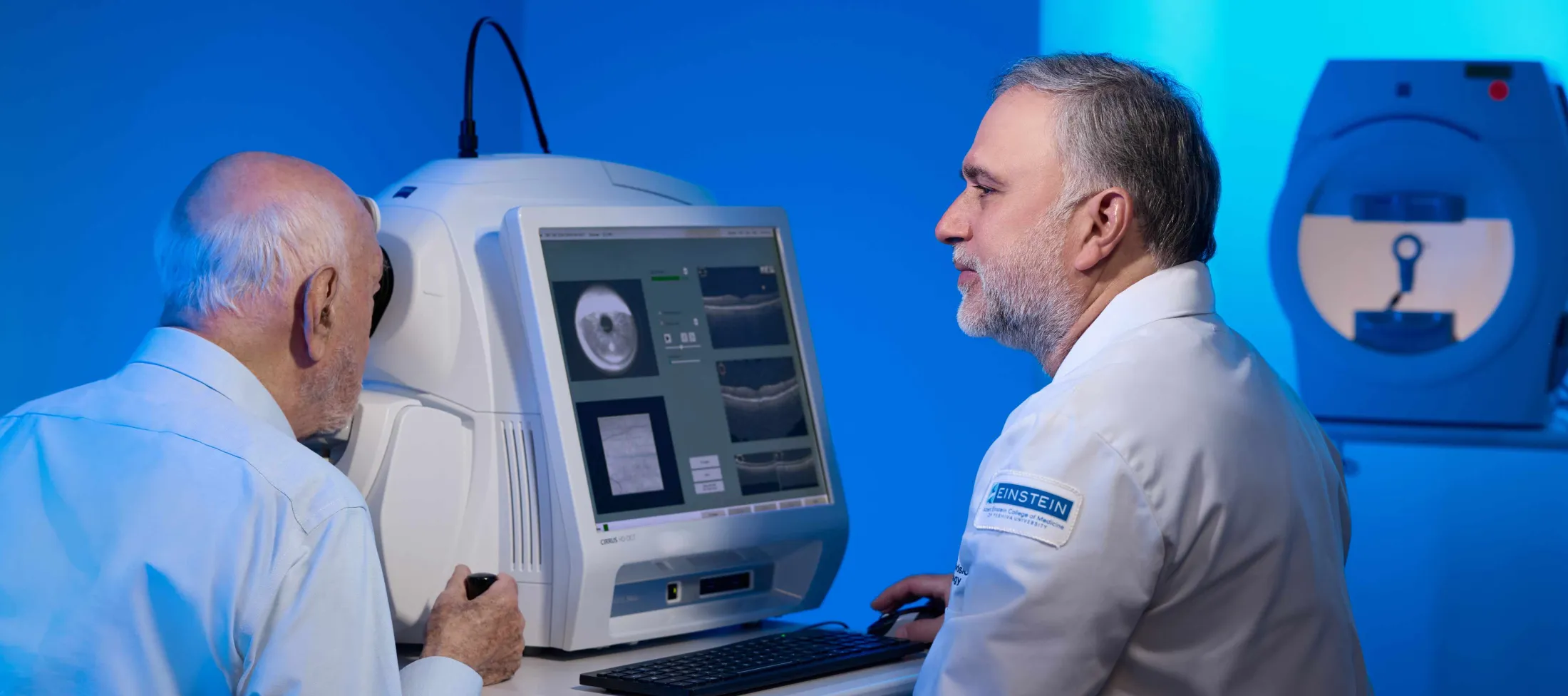
Utilizamos tecnologías de imagen de vanguardia y alta resolución, como la tomografía de coherencia óptica (OCT), la angiografía OCT (OCTA), la autofluorescencia del fondo de ojo (FAF), la angiografía con fluoresceína (FA) y la angiografía con verde de indocianina (ICGA), para detectar incluso los cambios retinianos más tempranos con una precisión excepcional. Estas herramientas de diagnóstico avanzadas nos permiten evaluar anomalías estructurales y microvasculares sutiles, individualizar las estrategias de tratamiento y monitorizar la progresión de la enfermedad a lo largo del tiempo.
Nuestro enfoque terapéutico se adapta a cada paciente, combinando las terapias médicas más novedosas con opciones quirúrgicas avanzadas cuando sea necesario. Ofrecemos una gama completa de inyecciones intravítreas anti-VEGF, incluyendo aflibercept, ranibizumab, bevacizumab y faricimab. En casos selectos de degeneración macular, también se pueden considerar tratamientos láser dirigidos como tratamiento complementario.
Ofrecemos un conjunto integral de diagnósticos y tratamientos avanzados para la degeneración macular, que incluyen:
Investigación y publicaciones
Lideramos la investigación colaborativa y dirigimos numerosos estudios y ensayos clínicos, incluyendo varios financiados por el Instituto Nacional del Ojo/Institutos Nacionales de la Salud (NEI/NIH), transformando los descubrimientos científicos más novedosos en nuevos diagnósticos y tratamientos para mejorar los resultados clínicos de las personas con degeneración macular o en riesgo de padecerla. Gracias a nuestros ensayos clínicos, nuestros pacientes pueden acceder a tecnologías emergentes y tratamientos innovadores que, de otro modo, no estarían disponibles para el público en general.
Nuestra investigación abarca la ciencia básica, traslacional y clínica, con especial atención al avance en la comprensión y el manejo del glaucoma. Las áreas clave de investigación incluyen biomarcadores de imagen para la detección temprana y la progresión de la enfermedad, nuevas estrategias terapéuticas para mejorar los resultados visuales y técnicas quirúrgicas innovadoras para afecciones maculares complejas. Estudios recientes han explorado la importancia de mantener esquemas de tratamiento consistentes para pacientes con DMAE neovascular. Asimismo, se está evaluando la imagen de reflectancia en el infrarrojo cercano para cuantificar la atrofia asociada a la DMAE. Nuestros investigadores también son pioneros en nuevas técnicas para la reparación de agujeros maculares, con el objetivo de mejorar las tasas de cierre y optimizar la recuperación visual en pacientes con presentaciones complejas.
Nuestros investigadores exploran el potencial del uso de organoides retinianos, tejidos cultivados en laboratorio que se asemejan a la retina, para generar células destinadas al trasplante en el tratamiento de enfermedades retinianas. Además, están desarrollando nuevos fármacos que activan selectivamente la autofagia mediada por chaperonas y han demostrado su eficacia para mitigar la degeneración retiniana y la progresión de la enfermedad en un modelo preclínico de retinosis pigmentaria. Estos avances podrían abrir el camino a nuevas estrategias terapéuticas para ayudar a personas con otros trastornos degenerativos de la retina, como la degeneración macular asociada a la edad (DMAE) y la retinopatía diabética.
Además de ser pioneros en la investigación clínica y de laboratorio, nuestros expertos son miembros del Comité de Patrones de Práctica Preferidos (PPPC, por sus siglas en inglés), y contribuyen al desarrollo de las directrices del Patrón de Práctica Preferida® (PPP, por sus siglas en inglés) de la Academia Estadounidense de Oftalmología para la Evaluación Médica Integral del Ojo en Adultos, que ayudan a identificar y definir las características y los componentes de una atención oftalmológica de calidad y a establecer el estándar de atención para afecciones como la DMAE.
-
Autofagia mediada por chaperonas defectuosa en el epitelio pigmentario de la retina de pacientes con degeneración macular relacionada con la edad.
Jiménez-Loygorri JI, Shang P, Bayramoglu I, Gómez-Sintes R, Martín-Segura A, Ambrosino H, Hoang J, Díaz A, Geng Z, Gavathiotis E, Dutton JR, Dengjel J, Cuervo AM, Ferrington DA, Boya P. Autofagia defectuosa mediada por acompañantes en el epitelio pigmentario de la retina de pacientes con degeneración macular relacionada con la edad. EMBO Mol Med. 2025 diciembre;17(12):3472-3495. doi: 10.1038/s44321-025-00329-w. Edición electrónica 2025
Estos hallazgos podrían explicar la vulnerabilidad específica del epitelio pigmentario de la retina durante la degeneración macular asociada a la edad (DMAE) y arrojar luz sobre la microangiopatía trombótica (MCA) como una nueva diana terapéutica para esta enfermedad, hasta ahora incurable. -
Comparación de los resultados de ensayos clínicos y revisiones sistemáticas para las 4 enfermedades oculares más prevalentes.
Saldanha IJ, Lindsley K, Do DV, Chuck RS, Meyerle C, Jones LS, Coleman AL, Jampel HD, Dickersin K, Virgili G. Comparación de los resultados de ensayos clínicos y revisiones sistemáticas para las 4 enfermedades oculares más prevalentes. JAMA Ophthalmol. 1 de septiembre de 2017;135(9):933-940. doi: 10.1001/jamaophthalmol.2017.2583. PMID: 28772305; PMCID: PMC5625342.
Este estudio examina los resultados más frecuentes utilizados en ensayos y revisiones Cochrane de enfermedades oculares prevalentes, así como la coincidencia entre los resultados de las revisiones y los ensayos incluidos en ellas.

Servicios de orientación y apoyo en la atención médica
Nuestro equipo de renombre mundial en Oftalmología y Ciencias Visuales de Montefiore Einstein se dedica a brindar atención, apoyo y recursos excepcionales, adaptados a sus necesidades individuales. Ya sea que le hayan diagnosticado recientemente degeneración macular, se someta a un seguimiento rutinario para detectar cambios retinianos tempranos, esté manejando etapas neovasculares o avanzadas de la enfermedad, explorando opciones para casos resistentes al tratamiento o buscando una segunda opinión, nuestra amplia gama de recursos nos permite ofrecer atención altamente especializada que aborda las necesidades médicas de cada persona para preservar, restaurar y mejorar la visión, prevenir la pérdida de visión y mejorar los resultados y la calidad de vida.
Nuestro equipo de atención para la degeneración macular


MD Richard M. Klein


Nuestro equipo multidisciplinario de médicos de renombre mundial incluye oftalmólogos certificados y con formación especializada en degeneración macular y retina. Nos especializamos en el diagnóstico y tratamiento de todo el espectro de la degeneración macular, utilizando los diagnósticos y tratamientos más avanzados para estabilizar y preservar la visión, prevenir la progresión de la enfermedad, optimizar la agudeza visual y mejorar la calidad de vida de cada paciente.
Programas e iniciativas comunitarias transformadoras
Nuestro programa se distingue por su enfoque colaborativo y atención clínica integral, que se extiende más allá de las instalaciones de Montefiore Einstein hacia la comunidad a través de iniciativas de alcance dirigidas a preservar la visión, ralentizar la progresión de la enfermedad, prevenir la pérdida de visión y la ceguera, y mejorar la calidad de vida, especialmente entre las poblaciones vulnerables. Entre los esfuerzos clave se incluyen la educación comunitaria, estrategias basadas en la telemedicina para la detección temprana y el manejo de la degeneración macular y otras afecciones oftálmicas, y nuestra colaboración con el programa Technology Peers for Accessible Living (Tech Pals) de Lighthouse Guild International, que conecta generaciones mediante mentoría tecnológica personalizada para personas con pérdida de visión. Esta iniciativa única vincula a jóvenes adultos ciegos o con discapacidad visual con adultos mayores para fomentar la alfabetización digital y la independencia. A través de estas y otras iniciativas, continuamos ampliando el acceso a la atención, preservando la continuidad y reduciendo las desigualdades, promoviendo así la salud ocular en las comunidades a las que servimos.
Acerca de la degeneración macular
La degeneración macular es una afección ocular progresiva que afecta principalmente a la mácula, la región central de la retina sensible a la luz, responsable de la visión nítida y detallada necesaria para actividades como leer, conducir y reconocer rostros. La forma más común es la degeneración macular asociada a la edad (DMAE), que suele presentarse en personas mayores de 50 años y es una de las principales causas de pérdida de visión y ceguera legal en adultos mayores. La DMAE se clasifica generalmente en dos tipos: seca (no exudativa) y húmeda (neovascular). La DMAE seca implica un adelgazamiento gradual de los tejidos maculares con la edad y puede progresar a atrofia geográfica, la etapa avanzada de la DMAE seca, mientras que la DMAE húmeda se caracteriza por el crecimiento de vasos sanguíneos anormales debajo de la retina, lo que provoca fuga de líquido, daño macular y pérdida rápida de la visión. Además de la DMAE, las distrofias maculares hereditarias, como la enfermedad de Stargardt y la enfermedad de Best, pueden afectar a personas más jóvenes y provocar deterioro de la visión central. Si bien la degeneración macular no suele causar ceguera total, puede afectar significativamente la visión central y la calidad de vida. La detección precoz mediante exámenes oculares completos y regulares es fundamental, ya que una intervención oportuna puede ayudar a ralentizar la progresión de la enfermedad y preservar la visión restante.