




Nuestro enfoque de la cirugía oculoplástica, orbitaria y reconstructiva





El Departamento de Oftalmología y Ciencias Visuales de Montefiore Einstein es líder mundial en la prestación de atención integral y avanzada en cirugía estética, plástica y reconstructiva para afecciones del rostro, las órbitas (cavidades óseas alrededor del ojo), los párpados y el sistema lagrimal (producción y drenaje de lágrimas) en adultos y niños de todas las edades. El equipo multidisciplinario de especialistas de renombre mundial incluye oftalmólogos certificados y con formación especializada en cirugía oculoplástica (cirugía plástica oftálmica) y reconstructiva. Estos especialistas trabajan en estrecha colaboración con expertos en dermatología, cirugía plástica facial, cirugía de cabeza y cuello, cirugía plástica y reconstructiva, oncología, cirugía oral y maxilofacial, neurocirugía y otras especialidades, brindando una atención personalizada e integral adaptada a las necesidades únicas de cada paciente.
Nuestros especialistas ofrecen conocimientos de vanguardia en tratamientos quirúrgicos y no quirúrgicos, empleando las técnicas mínimamente invasivas más novedosas y tecnologías avanzadas para preservar la visión, restaurar la forma y la función, y mejorar la comodidad, la apariencia y la calidad de vida. Montefiore Einstein es un centro de referencia para los casos oftalmológicos más complejos y se encuentra entre el 1 % de los mejores hospitales del país en atención a la diabetes, la endocrinología y el cáncer, según Informe de Estados Unidos y del mundo .
Innovación multidisciplinaria en cirugía oculoplástica y reconstructiva
A la vanguardia de la innovación, nuestros cirujanos oculoplásticos trabajan como un equipo unificado con nuestro Centro Integral de Cráneo/Base del Cráneo, uno de los primeros y pocos centros en el país que ofrece de forma rutinaria la cirugía neuroendoscópica transorbitaria (TONES), un procedimiento mínimamente invasivo y sin incisiones que se realiza a través del ojo para extirpar tumores orbitarios y cerebrales preservando la visión. También colaboramos estrechamente con nuestro Programa de Oncología Ocular, que está totalmente integrado con nuestro Centro Oncológico Integral Montefiore Einstein, designado por el Instituto Nacional del Cáncer (NCI), y que se encuentra entre el 1% de los centros oncológicos integrales designados por el NCI en los EE. UU. En estos casos, la experiencia en oculoplástica es esencial para proporcionar un acceso orbitario seguro, la extirpación del tumor y la reconstrucción para ayudar a preservar la función y la visión.
Ya sea que busque un rejuvenecimiento cosmético de párpados o facial, tratamiento para párpados caídos o conductos lagrimales obstruidos, reparación de traumatismos orbitarios, atención para enfermedades oculares tiroideas o tumores, o necesite una segunda opinión, nuestro equipo está aquí para brindarle una evaluación experta, un tratamiento avanzado y orientación personalizada en cada etapa de su proceso de atención oculoplástica.
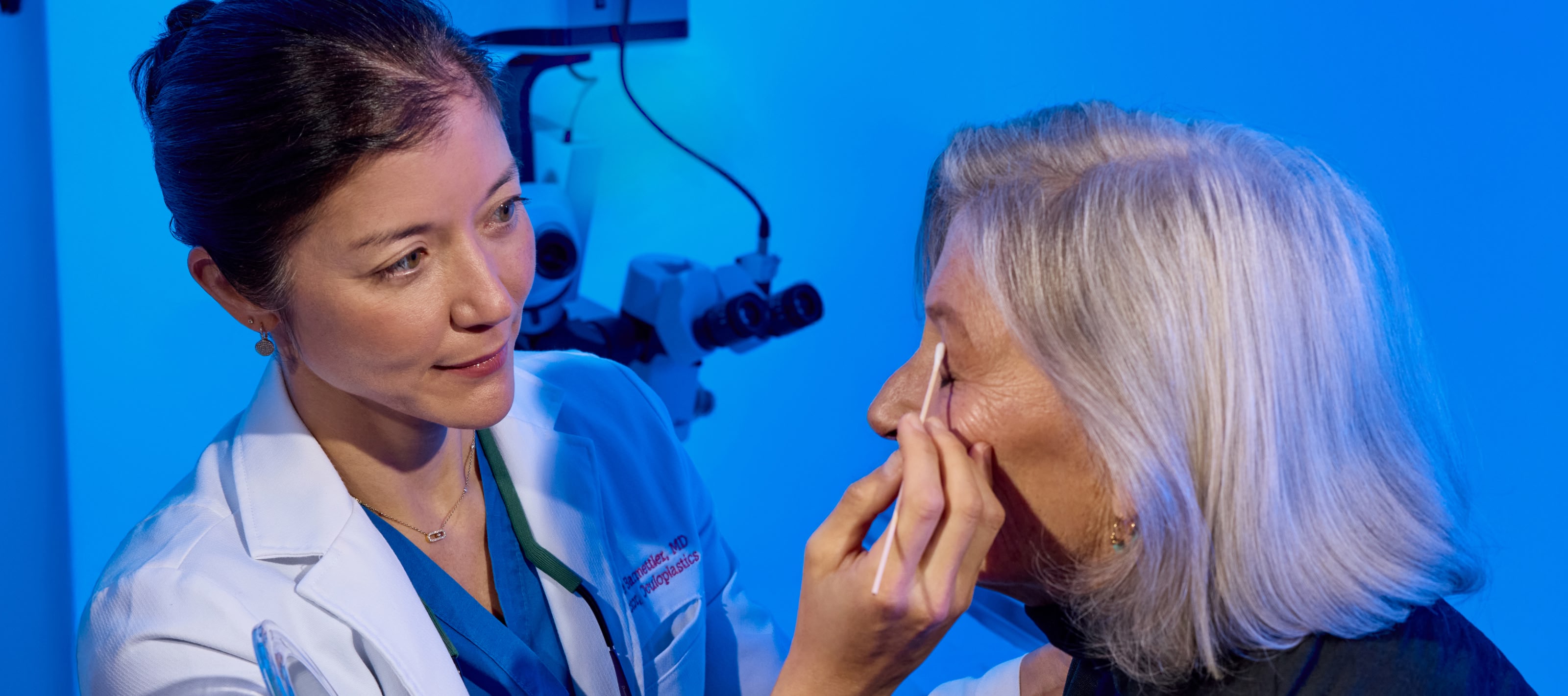
Diagnóstico y tratamientos avanzados
Ofrecemos acceso a los diagnósticos y tratamientos más avanzados para afecciones del rostro, las órbitas, los párpados y el sistema lagrimal. Nuestro programa brinda una gama completa de opciones quirúrgicas y no quirúrgicas, abordando tanto necesidades estéticas como casos reconstructivos complejos.
Nuestros especialistas utilizan los últimos inyectables, láseres y terapias cutáneas para mejorar la salud y el aspecto de los párpados, las cejas y las estructuras faciales circundantes. Las técnicas avanzadas incluyen el rejuvenecimiento cutáneo con láser, rellenos dérmicos y bioestimulantes, terapia con plasma rico en plaquetas (PRP) e inyecciones de toxina botulínica, utilizadas tanto para el rejuvenecimiento periocular como para el tratamiento de afecciones como el blefaroespasmo, el espasmo hemifacial y la oftalmopatía tiroidea. Algunos pacientes también pueden beneficiarse del aumento de pestañas con bimatoprost (Latisse®), una opción aprobada por la Administración de Alimentos y Medicamentos de EE. UU. (FDA) que promueve el crecimiento de las pestañas. Las opciones de cirugía estética incluyen la blefaroplastia (lifting de párpados), el lifting de cejas y procedimientos perioculares relacionados para restaurar el contorno de los párpados, mejorando su función y apariencia.
Los cirujanos oculoplásticos de Montefiore Einstein son reconocidos internacionalmente por su experiencia en cirugía reconstructiva y funcional de párpados, órbitas y sistema lagrimal, corrigiendo con precisión deformidades congénitas, traumáticas y posquirúrgicas. Estos especialistas brindan atención avanzada para trastornos funcionales como ptosis (párpados caídos que interfieren con la visión), dermatochalasis (exceso de piel en los párpados), ectropión (giro hacia afuera del párpado inferior) y ptosis de la ceja (cejas caídas). También se ofrecen cirugías lagrimales endoscópicas y externas mínimamente invasivas para restaurar el drenaje lagrimal y aliviar el lagrimeo crónico.
Nuestro programa ofrece reconstrucción altamente especializada tras traumatismos, anomalías congénitas o tratamientos oncológicos, incluyendo la reconstrucción de párpados y órbita tras la cirugía de Mohs y la rehabilitación orbitaria tras procedimientos de extirpación ocular como la enucleación o la exenteración. Además, somos uno de los primeros y pocos centros del país en ofrecer de forma rutinaria la técnica TONES. Mediante tecnología avanzada, técnicas mínimamente invasivas y una estrecha colaboración con especialistas multidisciplinarios, brindamos atención integral para restaurar la función, proteger la visión y mejorar la calidad de vida.
Ofrecemos una gama completa de tratamientos de diagnóstico y oculoplásticos avanzados, que incluyen:
Tratamientos avanzados

Investigación y publicaciones
Lideramos la investigación colaborativa y dirigimos numerosos estudios y ensayos clínicos, incluyendo varios financiados por el Instituto Nacional del Ojo/Institutos Nacionales de la Salud (NEI/NIH), traduciendo nuevos descubrimientos científicos en nuevos diagnósticos y tratamientos para mejorar los resultados clínicos en personas con afecciones de párpados, órbita, glándulas lagrimales y rostro. La investigación abarca la ciencia básica, traslacional y clínica, con un enfoque en el avance de la comprensión de los mecanismos, el diagnóstico y el tratamiento de las afecciones oculoplásticas. Las áreas centrales de investigación incluyen la innovación quirúrgica, la cicatrización de heridas y el manejo de cicatrices, la enfermedad ocular tiroidea, los trastornos funcionales de los párpados, los tumores orbitarios, los resultados estéticos y la toma de decisiones y enfoques de atención centrados en el paciente. Las investigaciones actuales incluyen estudios para mejorar la cicatrización, evaluar nuevos materiales y técnicas para la cirugía de párpados y órbita, avanzar en las terapias para la enfermedad ocular tiroidea y mejorar los resultados tanto en procedimientos reconstructivos como cosméticos. La investigación adicional se centra en los resultados a largo plazo en la cirugía de levantamiento de cejas, estrategias para optimizar la blefaroplastia del párpado superior y la efectividad de la toxina botulínica para la retracción palpebral y el estrabismo relacionados con la enfermedad ocular tiroidea.
Nuestro programa también aborda el impacto más amplio de la oculoplástica mediante estudios sobre rellenos dérmicos y prevención de complicaciones, la toma de decisiones compartida en oftalmología y el papel de las redes sociales en la formación quirúrgica y la participación del paciente. Los investigadores están ampliando el conocimiento sobre la oftalmopatía tiroidea en diversas poblaciones, examinando los cambios oculares y palpebrales asociados a la pérdida rápida de peso tras la cirugía bariátrica e incluso investigando la relación entre el consumo de cannabis y la oftalmopatía tiroidea en pacientes con hipertiroidismo autoinmune. En conjunto, estos esfuerzos demuestran nuestro compromiso con el avance de la ciencia y la práctica de la cirugía oculoplástica, garantizando que los pacientes se beneficien de los enfoques más seguros, eficaces y basados en la evidencia disponibles.
Líderes mundiales de confianza en atención oftalmológica basada en la evidencia.
Somos uno de los únicos 13 centros a nivel mundial designados como Centro Cochrane de Ojos y Visión (CEV) para la Atención Oftalmológica Basada en la Evidencia, una distinción financiada por el NEI/NIH que reconoce nuestro compromiso con el avance de la medicina y la atención oftalmológica basadas en la evidencia. Nuestras contribuciones a la investigación y a la identificación de los tratamientos más eficaces para la atención al paciente sirven de modelo para centros clínicos de todo el mundo.
-
Ampliar el conocimiento sobre las manifestaciones de la enfermedad ocular tiroidea para incluir a pacientes hispanos y negros.
Goldstein T, Mostowy M, Tingley J, Rand G, Moon JY, Barmettler A. Middle East Afr J Ophthalmol. 2023 Nov 21;29(4):171-180. doi: 10.4103/meajo.meajo_87_23. PMCID: PMC10754111 El estudio se diseñó para abordar una importante laguna de conocimiento: la mayor parte de la comprensión clínica de la TED se basa en datos de pacientes caucásicos. Buscamos caracterizar las manifestaciones clínicas y la gravedad de la enfermedad de la TED específicamente dentro de las poblaciones hispanas y negras en el Centro Médico Montefiore en el Bronx.
-
Cambios oculares y palpebrales asociados a la pérdida rápida de peso tras la cirugía bariátrica: un análisis de cohorte prospectivo - Hawn - 2023 - Oftalmología Clínica y Experimental - Biblioteca en línea de Wiley
V Hawn, T Cheng, N Ravel, A Shrivastiva, JY Moon, A Barmettler. Cambios oculares y palpebrales asociados con la pérdida de peso rápida después de la cirugía bariátrica: un análisis de cohorte prospectivo. Clinical and Experimental Ophthalmology. 2023, 6 de julio. doi: 10.1111/ceo.14266. El estudio se diseñó para investigar cómo la pérdida de peso rápida y significativa después de la cirugía bariátrica (como la gastrectomía en manga laparoscópica) afecta parámetros oftalmológicos específicos. Si bien se sabe que la obesidad está relacionada con afecciones como el síndrome del párpado flácido (FES) y la presión intraocular alta, evaluamos qué tan rápido estos cambios podrían revertirse o alterarse después de la cirugía bariátrica.
-
Tratamiento con toxina botulínica en la enfermedad ocular tiroidea: una revisión sistemática y metaanálisis - PubMed
Zong AM, Giannakakos VP, Delbourgo Patton C, Barmettler A. Tratamiento con toxina botulínica en la enfermedad ocular tiroidea: una revisión sistemática y metaanálisis. Ophthalmic Plast Reconstr Surg. 2025 1 de mayo-junio;41(3):250-257. doi: 10.1097/IOP.0000000000002852. Epub 19 de diciembre de 2024. PMID: 39700405. El estudio tuvo como objetivo proporcionar una evaluación integral y basada en la evidencia de la BoNT como una intervención no quirúrgica para la TED. Específicamente, examinó qué tan efectivas son las inyecciones para tratar la retracción del párpado superior, el estrabismo restrictivo (visión doble) y la quemosis conjuntival (inflamación).
-
Resultados a largo plazo del lifting de cejas: una revisión sistemática y metaanálisis - PubMed
Karanfilian T, Zong AM, Delbourgo Patton C, Gupta L, Barmettler A. Resultados a largo plazo del lifting de cejas: una revisión sistemática y metaanálisis. Ophthalmic Plast Reconstr Surg. 11 de agosto de 2025. doi: 10.1097/IOP.0000000000002989. Epub antes de la impresión. PMID: 40788666. El estudio se realizó para abordar la falta de datos comparativos a largo plazo sobre los procedimientos de lifting de cejas. Si bien muchos estudios informan éxito a corto plazo, este metaanálisis se centró específicamente en la estabilidad a largo plazo (definida como resultados medidos al menos 12 meses después de la cirugía) para determinar qué técnicas quirúrgicas ofrecen los resultados más duraderos para corregir la ptosis de la ceja (caída).
-
Rellenos dérmicos en la consulta de oculoplástica: aplicaciones y estrategias para la prevención y el tratamiento de complicaciones.
R Paramo, A Barmettler. Rellenos dérmicos en la consulta de oculoplástica: aplicaciones y estrategias para la prevención y el tratamiento de complicaciones. International Ophthalmology Clinics. 1 de julio de 2024;64(3):23-28. doi: 10.1097/IIO.0000000000000521. Epub 24 de junio de 2024. El estudio tiene como objetivo describir las mejores prácticas actuales para el uso de rellenos dérmicos en cirugía plástica oculofacial, centrándose específicamente en los matices anatómicos de los párpados y el tercio medio facial. Busca proporcionar a los cirujanos estrategias prácticas para seleccionar los tipos de relleno adecuados, aplicar técnicas de inyección seguras e implementar protocolos de rescate para el manejo de eventos adversos.

Nuestro equipo de cirugía oculoplástica, de órbita y reconstructiva
Nuestro equipo multidisciplinario de médicos de renombre mundial incluye oftalmólogos certificados y con formación especializada en cirugía oculoplástica y reconstructiva. Nos especializamos en el cuidado estético y reconstructivo de afecciones del rostro, las órbitas, los párpados y el sistema lagrimal, utilizando los diagnósticos y tratamientos más avanzados para preservar la visión, restaurar la forma y la función, y mejorar el confort, la apariencia y la calidad de vida.

MD. Anne Barmettler

Lalita Gupta, Doctora en Medicina
Acerca de las afecciones oculoplásticas
La oculoplástica es una especialidad altamente especializada que combina la precisión microquirúrgica de la oftalmología con los principios reconstructivos y estéticos de la cirugía plástica para restaurar tanto la forma como la función. Dado que los ojos y las estructuras circundantes son esenciales para la visión, la comodidad y la expresión facial, los cirujanos oculoplásticos cuentan con una formación única para diagnosticar y tratar afecciones que afectan la cara, los párpados, las órbitas (cavidades oculares) y el sistema lagrimal (producción y drenaje de lágrimas).
Las afecciones oculoplásticas abarcan desde trastornos funcionales como la caída de los párpados (ptosis), el exceso de piel en los párpados (dermatochalasis), las malposiciones palpebrales, los trastornos lagrimales (como la obstrucción de los conductos lagrimales) y el traumatismo orbitario, hasta la oftalmopatía tiroidea, los tumores, las anomalías congénitas y las complicaciones de cirugías previas. Este campo también incluye la cirugía reconstructiva compleja tras la extirpación de un cáncer o una lesión, así como procedimientos avanzados para mejorar la salud, la simetría y el aspecto de los párpados y la región periocular. Al abordar tanto las necesidades funcionales como las estéticas, la oculoplástica desempeña un papel fundamental en la preservación de la visión, el restablecimiento del confort y la mejora de la calidad de vida.