



Programa de Residencia en Oftalmología y Ciencias Visuales
Programa de residencia
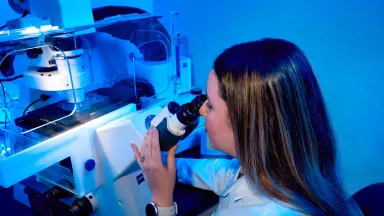
El Departamento de Oftalmología y Ciencias Visuales de Montefiore Einstein, sede de uno de los programas de residencia en oftalmología acreditados por el Consejo de Acreditación para la Educación Médica de Posgrado (ACGME) más grandes del estado de Nueva York, es líder en educación médica de posgrado innovadora. El Departamento ofrece una formación de residencia de renombre mundial, dirigida por un equipo de médicos reconocidos internacionalmente con experiencia en todas las áreas y subespecialidades principales de la oftalmología. Impulsado por la misión de formar profesionales tanto en el ámbito académico como en la práctica privada de la oftalmología, nuestro Programa de Residencia en Oftalmología y Ciencias Visuales está dirigido por un sólido cuerpo docente que imparte formación a los residentes a través de clínicas, cirugía, prácticas de laboratorio y clases teóricas.
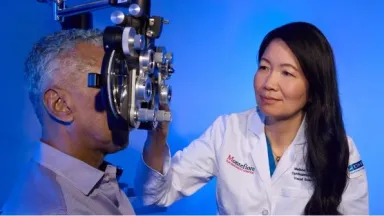
Dirigido por el Dr. Roy S. Chuck, destacado cirujano refractivo e investigador líder en células madre y ojo seco, el Departamento es reconocido a nivel nacional como uno de los más grandes del área metropolitana de Nueva York. Nuestro equipo de oftalmólogos, optometristas, ortoptistas, cirujanos oculoplásticos, neurooftalmólogos, cirujanos de glaucoma, cirujanos de córnea y de queratomileusis in situ asistida por láser (LASIK), cirujanos de retina y cirujanos pediátricos ofrece servicios clínicos integrales, incluyendo atención para baja visión y lentes de contacto.
Plan de estudios
Durante su rotación en medicina interna, los internos pasan 12 semanas en el servicio de oftalmología, donde adquieren una valiosa experiencia trabajando en clínicas, asistiendo en quirófano y colaborando en interconsultas. Esta experiencia les permite comenzar su primer año de la residencia en Oftalmología y Ciencias Visuales con una sólida base en evaluaciones oculares y enfermedades oculares.
Primer año
Durante el primer año de nuestro programa, los residentes desarrollan habilidades básicas de exploración oftalmológica y fluidez en la identificación y el tratamiento de afecciones oftalmológicas comunes. La mayor parte del primer año se realiza en la clínica general de Montefiore Einstein y NYC Health + Hospitals | Jacobi, donde los pacientes están bajo la atención directa de un médico especialista en todo momento. Los residentes de primer año que rotan por el servicio de córnea observan y asisten en cirugías de alto volumen. Nuestro programa también implementa un sistema de guardias nocturnas y de acompañamiento para limitar la fatiga de los residentes y permitir una supervisión adecuada de las consultas.
Segundo año
Los residentes de segundo año profundizan su formación en subespecialidades oftalmológicas, con especial énfasis en córnea, glaucoma, retina, estrabismo pediátrico, neurooftalmología y oculoplástica. Este segundo año de formación también les permite adquirir destreza e independencia en el uso de láseres retinianos, inyecciones intravítreas y láseres para el glaucoma. Dependiendo de la clínica, los residentes de segundo año también realizan consultas diurnas para su hospital.
Tercer año
El tercer año de nuestro programa se dedica a la formación quirúrgica en entornos de alto volumen, donde los residentes de último año dividen su tiempo entre clínicas especializadas, la programación de casos y el quirófano. El personal de planificación quirúrgica y el equipo perioperatorio están dedicados a los residentes de tercer año, lo que permite una enseñanza y eficiencia óptimas. Entre sus funciones adicionales se incluyen actuar como residente de último año y supervisar la formación de los residentes de primer año y los flujos de trabajo clínicos bajo la supervisión de un médico adjunto. Los residentes de tercer año también realizan guardias entre semana y los fines de semana.
Oportunidades de investigación para residentes
Montefiore Einstein es una institución líder en investigación médica, con un profesorado que abarca una amplia gama de intereses. Dentro del Departamento de Oftalmología y Ciencias Visuales, la investigación clínica se centra en Montefiore Einstein, mientras que la investigación básica se lleva a cabo en diversos laboratorios del Albert Einstein College of Medicine. Hemos recibido múltiples premios del Instituto Nacional del Ojo (NEI) y de los Institutos Nacionales de la Salud (NIH), entre otras instituciones.
Durante su residencia, los residentes participan activamente en actividades de investigación supervisadas por el profesorado y tienen la oportunidad de presentar sus investigaciones en el simposio anual del Día de Paul Henkind. Nuestro departamento fomenta las presentaciones de investigación en congresos nacionales y proporciona a cada residente una beca anual para cubrir los gastos de viaje y alojamiento.
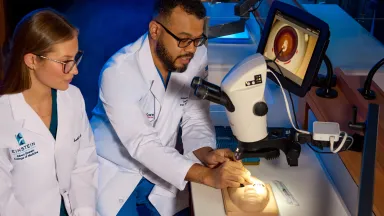
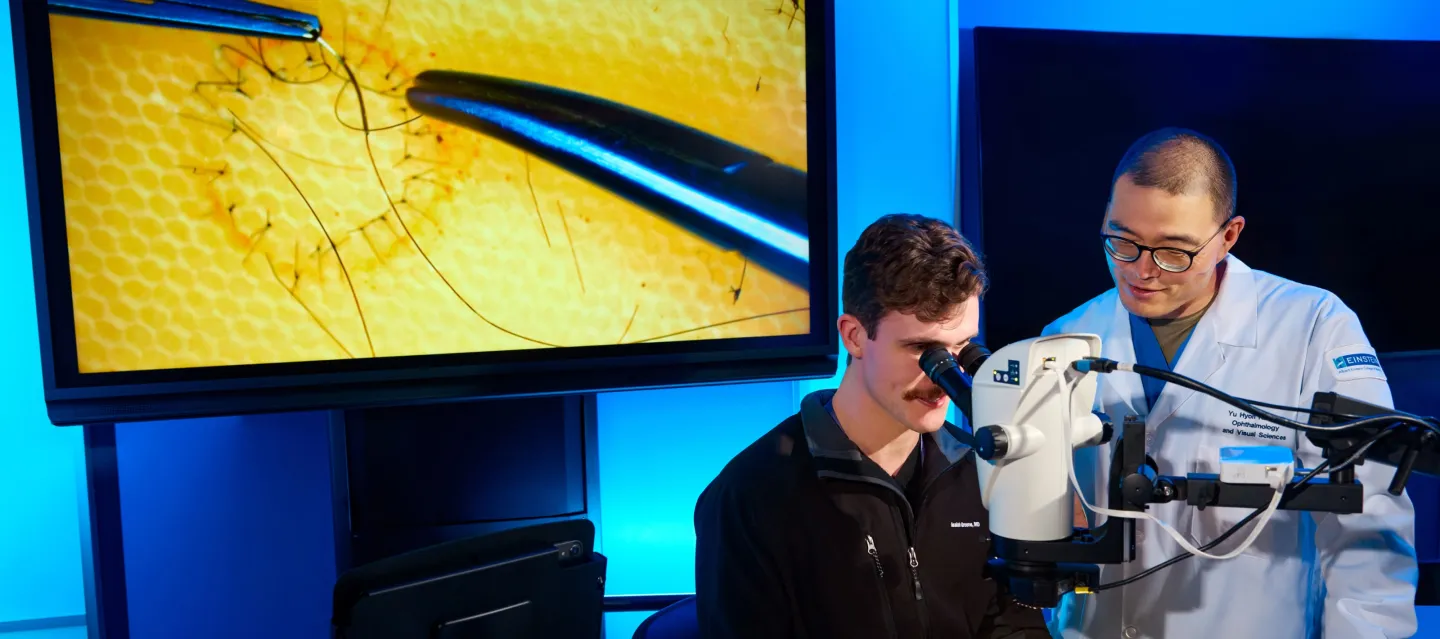
Además de la investigación clínica y de laboratorio, hemos invertido importantes recursos en el desarrollo del Centro de Innovación Oftalmológica (COIN) y el Laboratorio de Simulación Microquirúrgica Ronald M. Burde, MD. El COIN está diseñado para fomentar la exploración por parte de residentes y profesores en el desarrollo y el avance de las técnicas microquirúrgicas.
Publicaciones
-
Acceso nacional a la simulación EyeSi: un estudio comparativo entre los programas de residencia en oftalmología de EE. UU.
Oseni J, Adebayo A, Raval N, Moon JY, Juthani V, Chuck RS, Shrivastava A. Acceso nacional a la simulación EyeSi: un estudio comparativo entre los programas de residencia en oftalmología de EE. UU. J Acad Ophthalmol (2017). 17 de mayo de 2023;15(1):e112-e118. doi: 10.1055/s-0043-1768933. PMID: 38737163; PMCID: PMC10804742.
Objetivo El objetivo de este estudio fue evaluar las disparidades regionales en el acceso a la capacitación en simulación quirúrgica EyeSi entre los programas de residencia en oftalmología de EE. UU. Métodos El acceso a la simulación EyeSi se determinó a partir de los datos de ventas (2021) proporcionados por VRMagic. -
El impacto de la complejidad del caso en la cirugía de cataratas realizada por residentes.
Park SS, Tseng M, Mian Z, Moon JY, Shrivastava A. El impacto de la complejidad del caso en la cirugía de cataratas realizada por residentes. Graefes Arch Clin Exp Ophthalmol. 2023 agosto;261(8):2307-2314. doi: 10.1007/s00417-023-06027-y. Epub 2023 16 de marzo. PMID: 36929055; PMCID: PMC10018582.
El estudio tuvo como objetivo cuantificar la relación entre la complejidad de los casos quirúrgicos —definida por factores como pupilas pequeñas, cataratas densas (brunescentes) o pseudoexfoliación— y los resultados quirúrgicos. Los investigadores buscaron determinar si los niveles más altos de complejidad aumentaban significativamente la tasa de complicaciones, como la ruptura de la cápsula posterior, o prolongaban la duración de la cirugía para los residentes. -
La situación de la mujer en la oftalmología académica: autoría de artículos, presentaciones y ascensos académicos.
Giannakakos VP, Syed M, Culican SM, Rosenberg JB. Clin Exp Ophthalmol. 2024 Mar;52(2):137-147. doi: 10.1111/ceo.14333. Epub 2024 Jan 12. PMID: 38214049 Revisión.
El estudio tuvo como objetivo caracterizar el panorama actual de las mujeres en la oftalmología académica mediante la revisión de las tendencias en publicaciones, presentaciones en congresos, participación en consejos editoriales, subvenciones para investigación y promoción profesional. Además, evaluamos si el creciente número de mujeres que ingresan al campo se ha traducido en una representación proporcional en puestos de liderazgo sénior y roles académicos de alto impacto. -
Continuos avances en la ciencia y la tecnología de la visión traslacional: ¿Qué sigue?
Chuck RS. Avances continuos en la ciencia y tecnología de la visión traslacional: ¿Hacia dónde vamos ahora? Transl Vis Sci Technol. 3 de enero de 2023;12(1):1. doi: 10.1167/tvst.12.1.1. PMID: 36595280; PMCID: PMC9819679
Como editor jefe, el Dr. Roy Chuck escribió este artículo para reflexionar sobre el crecimiento de la revista y definir su trayectoria futura. El objetivo era destacar la importancia de la investigación traslacional, definida como el proceso de convertir los descubrimientos de laboratorio y la ciencia básica en aplicaciones clínicas prácticas que beneficien directamente a los pacientes. -
Consideraciones clínicas y científicas para el trasplante de ojo completo: una perspectiva oftalmológica
Gokoffski KK, Washington KM, Chuck RS. Consideraciones clínicas y científicas para el trasplante de ojo completo: una perspectiva oftalmológica. Transl Vis Sci Technol. 3 de febrero de 2025;14(2):13. doi: 10.1167/tvst.14.2.13. PMID: 39918461; PMCID: PMC11809445.
Este artículo tiene como objetivo definir la trayectoria futura de la revista, haciendo hincapié en el puente "traslacional": llevar los descubrimientos científicos del laboratorio a la aplicación clínica. Busca alentar a los investigadores a centrarse en innovaciones que tengan un impacto directo y medible en la atención al paciente y los resultados clínicos. -
La evolución de la formación en cirugía refractiva - PubMed
Arboleda N, Yi J, Kang JJ. La evolución de la formación en cirugía refractiva. Curr Opin Ophthalmol. 1 de julio de 2023;34(4):275-279. PMID: 37070524
El estudio se diseñó para revisar la historia y el estado actual de la formación en cirugía refractiva (por ejemplo, LASIK, PRK, SMILE) en programas académicos. Los autores buscaron identificar las barreras para una formación integral y evaluar las herramientas pedagógicas modernas —como simuladores y planes de estudio estructurados— que ayudan a los residentes a alcanzar la competencia y la confianza quirúrgicas en un campo históricamente dominado por la práctica privada. -
Evaluación de simuladores quirúrgicos oftálmicos para el entrenamiento continuo en capsulorrexis curvilínea - PubMed
Raval N, Hawn V, Kim M, Xie X, Shrivastava A. Evaluación de simuladores quirúrgicos oftálmicos para el entrenamiento continuo en capsulorrexis curvilínea. J Cataract Refract Surg. 1 de mayo de 2022;48(5):611-615. doi: 10.1097/j.jcrs.0000000000000820. Publicado en línea el 21 de septiembre de 2021. PMID: 34561362; PMCID: PMC9018214
El estudio tuvo como objetivo comparar objetiva y subjetivamente tres simuladores de tejido disponibles comercialmente —Bioniko, Kitaro y SimulEYE— en cuanto a su capacidad para imitar la cápsula del cristalino humano. Cirujanos expertos (cada uno con más de 1000 casos realizados) fueron los encargados de crear una capsulorrexis estándar de 5,5 mm para determinar qué modelo ofrecía el mejor realismo, precisión y rendimiento general para la formación de residentes.
Cómo solicitar
Buscamos residentes que marquen el futuro de la atención médica. Si desea postularse para ser residente de Oftalmología y Ciencias Visuales en Montefiore Einstein, todas las solicitudes al programa se realizan a través de SF Match. Comuníquese con nuestro coordinador de residencias si tiene alguna pregunta.