

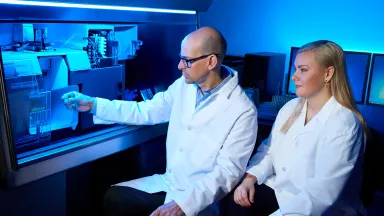


Why Choose Montefiore Einstein for Thrombosis Care?
The Montefiore Einstein Thrombosis Prevention and Treatment Program is one of the largest programs of its kind in the nation, specializing in the prevention and management of the full range of thromboembolic conditions and addressing the needs of all patients who require anticoagulation management. We use an evidence-based and personalized care approach tailored to address the unique needs and characteristics of each patient, from the prophylaxis or treatment of deep venous thrombosis (DVT), pulmonary embolism, or an inherited or acquired hypercoagulable state to the prevention of stroke in atrial fibrillation or the management of bridging or perioperative anticoagulation.
Our multidisciplinary team of world-renowned hematologists, vascular and orthopedic surgeons, cardiologists, neurologists, obstetricians, primary care physicians and other specialists provide seamless coordinated care at locations in the Bronx, and the broader New York metropolitan area, including Westchester County and Hudson Valley. Our team of specialists has unparalleled expertise in anticoagulation management using the latest available anticoagulants, hemostatic (reversal) agents and monitoring technologies. We conduct more than 5,000 patient visits annually and are an international referral site for the most complex cases.
Our program was among the first in the country to manage bridging parenteral anticoagulation as an outpatient therapy for patients with thrombosis. Today, new oral anticoagulants have fewer overall bleeding complications, require less monitoring and eliminate or reduce the need for parenteral therapy. We work closely with our multidisciplinary Hemostasis and Thrombosis Center, one of the nation’s premier destinations for clotting disorders.
Our program offers both inpatient and outpatient services at our Moses Campus and Jack D. Weiler Hospital, monitoring anticoagulation therapy and individual variability in treatment responses, maintaining therapeutic anticoagulation and dose optimization, creating personalized treatment plans that balance thrombosis prevention with bleeding risks and providing education and support to improve medication adherence. As a result of the safety and quality improvements added by the oversight and management of our program, we have decreased emergency department visits and hospital admissions and shortened hospital stays for many patients with venous thromboembolic events. We are committed to providing the highest-quality care, enhancing patient safety, reducing or eliminating potentially life-threatening bleeding or clotting complications and improving outcomes and quality of life.
Your Thrombosis Prevention & Treatment Program Team
Our multidisciplinary team of world-renowned hematologists and specialized advanced care providers specializes in the prevention and management of the full range of thromboembolic conditions and addresses the needs of all patients who require anticoagulation management, delivering comprehensive, personalized care focused on optimizing outcomes and improving the quality of life for each patient. We collaborate closely with vascular and orthopedic surgeons, cardiologists, neurologists, obstetricians, primary care physicians and other specialists to provide seamless coordinated care.

Henny H. Billett, MD


Advanced Diagnostics & Treatments for Thrombosis
We use the latest available anticoagulation, antithrombotic and hemostatic (reversal) therapies and monitoring technologies for the prevention, diagnosis and management of the full range of clotting disorders and conditions requiring anticoagulation and for perioperative management of anticoagulation. Our team offers comprehensive, personalized anticoagulation care focused on optimizing outcomes and enhancing quality of life.
We offer the most advanced testing and anticoagulation monitoring techniques, including pharmacogenomic testing to predict a patient’s response to warfarin and to help with initial dosing, improved monitoring techniques to help manage chronic therapy, and point-of-care testing for rapid and convenient monitoring of anticoagulation status. We also offer assistance with home monitoring devices. Our specialists conduct thorough prothrombotic risk-factor assessments and use advanced hypercoagulability testing for thrombophilia disorders.
For patients treated with vitamin K antagonists (such as warfarin) and unfractionated heparin, we provide careful, personalized monitoring, including routine laboratory testing and dose titration. Adjustments are often needed to maintain effective anticoagulation and minimize bleeding risks. For direct oral anticoagulants, routine monitoring and dose adjustments are usually required less frequently. However, monitoring can be beneficial in certain cases, with severe bleeding; abnormal absorption, clearance or metabolism; and residual anticoagulant effects before surgery.
To support the comprehensive diagnosis and management of clotting disorders, we offer a wide range of specialized anticoagulation monitoring and imaging services.
We specialize in using the latest available antithrombotics, which include the following:
We also specialize in using the latest reversal agents for bleeding among patients using anticoagulants and for preoperative optimization for urgent or emergent surgery, which include the following:
Emerging anticoagulation therapies with new targets, including investigational factor XI/XIa inhibitors, are also being studied in clinical trials for patients with a variety of prothrombotic conditions.

Research & Clinical Trials for Thrombosis
We are leading collaborative hemostasis and thrombosis research and actively participating in studies sponsored by the Centers for Disease Control and Prevention, Maternal and Child Health Bureau, American Thrombosis and Hemostasis Network (ATHN) and National Institutes of Health, as well as other investigator-initiated and industry-funded clinical trials. Through our clinical trials, our patients can access emerging technologies and innovative treatments that are otherwise unavailable to the general public.
Our patients can access the ATHNdataset, a national database used to support research and improve care. We were recently involved in an ATHN study using this database to characterize the use of anticoagulants (direct oral anticoagulants) in children. Our research team is also studying the efficacy of bridging therapy to provide optimal management for patients with contraindications to anticoagulation.
Among our active clinical trials, we are participating in a longitudinal, natural history observational cohort study being conducted at ATHN-affiliated sites to determine the safety, effectiveness and practice of therapies used in the treatment of a variety of bleeding and clotting disorders, congenital platelet disorders, thrombosis/thrombophilia and non-neoplastic hematologic conditions. In collaboration with cardiology, we are also investigating new anticoagulation therapies with new targets and are participating in phase 3 randomized controlled clinical trials evaluating the safety and efficacy of milvexian, an oral factor XIa inhibitor, after a recent acute coronary syndrome and versus apixaban in participants with atrial fibrillation.
We also reported the clinical and laboratory coagulation characteristics of pediatric and young-adult patients treated for symptomatic COVID‐19 and were instrumental in developing the American Society of Hematology guidelines on the use of anticoagulation for thromboprophylaxis in patients with COVID-19.
Our researchers are also investigating the treatment outcomes of using antithrombotics for various medical and surgical conditions. We recently published data that did not demonstrate a significant difference in incidence of recurrent thromboembolism or bleeding events in patients treated with direct oral anticoagulants and vitamin K antagonists for myeloproliferative neoplasm‐associated thrombosis, as well as data on the efficacy of direct oral anticoagulants in patients with body mass index of more than 35 and after bariatric surgery.
In collaboration with the Department of Anesthesiology, a recent landmark study from the Montefiore Einstein Digital Health Lab analyzed more than 250,000 patients who underwent noncardiac surgical procedures across multiple centers. The study demonstrated that new-onset postoperative atrial fibrillation occurs predictably and increases ischemic stroke risk. The findings suggested that postoperative oral anticoagulation reduced stroke risk during the first year after surgery.

Care Navigation & Support Services for Thrombosis
If you or your child is newly diagnosed with a clotting disorder requiring anticoagulation therapy or is currently receiving anticoagulation treatment, our world-renowned team at Montefiore Einstein Hematology is here to provide you with exceptional support, care and resources. Our full-service center offers a comprehensive range of traditional and holistic care, from screening, prevention and diagnosis to treatment and recovery, including social and support services, genetic counseling and education. Our expansive breadth of resources enables us to deliver highly specialized and coordinated care that takes into account the whole person, addressing each individual’s complex medical needs and improving quality of life. Our team of compassionate and deeply knowledgeable doctors, nurses, specialists and support staff is dedicated to helping you at every step of your care journey.
Patients and caregivers are counseled and educated regarding the safe use and importance of anticoagulation therapy, adherence to medications, lifestyle and dietary considerations, and signs of complications. We are also committed to coordinating seamless care with primary care providers and other specialists.
Learn More About Thrombosis Screening, Prevention & Treatment
-
Trombosis
-
Problemas hematológicos durante el embarazo
-
Antiphospholipid Syndrome
-
Trastornos hemorrágicos y hemofilia