




Nuestro enfoque ante la enfermedad ocular diabética



El Departamento de Oftalmología y Ciencias Visuales de Montefiore Einstein es un líder reconocido internacionalmente que brinda atención integral y personalizada a adultos y niños con todo el espectro de afecciones oculares diabéticas, desde cambios retinianos tempranos hasta complicaciones avanzadas como retinopatía diabética, edema macular diabético y glaucoma neovascular. Nuestro equipo multidisciplinario de médicos de renombre mundial incluye oftalmólogos certificados con experiencia subespecializada en enfermedades oculares diabéticas y atención retiniana, quienes colaboran estrechamente con optometristas, endocrinólogos, educadores en diabetes, especialistas en baja visión y otros expertos. Juntos, brindan una atención integral y coordinada, que incluye el manejo sistémico de la diabetes y la atención ocular, para estabilizar y preservar la visión, mejorar la salud general y garantizar los mejores resultados posibles para cada paciente. Somos un centro de referencia para los casos más complejos y de alto riesgo, y estamos clasificados en el 1% superior de todos los hospitales del país en atención de diabetes y endocrinología, según Informe de Estados Unidos y del mundo .
Ofrecemos los diagnósticos y tratamientos más avanzados, con una experiencia inigualable en la prevención y el manejo de la pérdida de visión relacionada con la diabetes. Nuestro enfoque personalizado integra imágenes de última generación, desde tomografía de coherencia óptica (OCT) y angiografía OCT, con las terapias médicas, láser y quirúrgicas más avanzadas disponibles, adaptadas para abordar la retinopatía diabética en cada etapa. Para personas con discapacidad visual significativa, colaboramos estrechamente con nuestro Hospital de Rehabilitación Burke, clasificado entre el 1% de los mejores hospitales del país en rehabilitación, según US News & World Report. Nos comprometemos a preservar la visión mediante la detección temprana, el tratamiento avanzado y el manejo proactivo de la enfermedad. Ya sea que le hayan diagnosticado diabetes recientemente, se someta a exámenes de rutina, experimente cambios retinianos tempranos, esté manejando una retinopatía diabética avanzada o que amenaza la visión, o esté buscando una segunda opinión, nuestro equipo está aquí para brindarle atención y orientación expertas en cada etapa de su cuidado ocular diabético.
Mejorar el estándar de atención de la retinopatía diabética para prevenir la ceguera relacionada con la diabetes.
Como parte de nuestro compromiso para mejorar los resultados de los pacientes con diabetes, hemos ampliado nuestro programa de telemedicina (teleretinología) para acelerar el diagnóstico de la retinopatía diabética y mejorar el acceso a la atención médica. Nuestro equipo especializado en oftalmología diabética incluye líderes en el cuidado de la vista en pacientes diabéticos, enfermedades de la retina y oftalmología pediátrica, quienes brindan diagnóstico experto, tratamiento, asesoramiento y manejo a largo plazo de la enfermedad.
También realizamos un seguimiento exhaustivo de las personas con retinopatía diabética o en riesgo de padecerla, mediante evaluaciones de riesgo personalizadas y terapias basadas en la evidencia para ralentizar o prevenir la progresión de la enfermedad. Al integrar tecnologías de imagen avanzadas con estrategias de tratamiento individualizadas y aprovechar las herramientas de detección remota, ayudamos a las personas a preservar la visión y la calidad de vida, a menudo mucho antes de que sea necesaria una intervención quirúrgica.
Como miembros del Comité de Patrones de Práctica Preferidos (PPPC) de la Academia Estadounidense de Oftalmología (AAO), nuestros oftalmólogos contribuyen a la elaboración de las guías nacionales para la atención oftalmológica integral en adultos, incluyendo la retinopatía diabética. Seguimos comprometidos con el avance de la atención oftalmológica diabética mediante la detección temprana, el tratamiento personalizado y la atención integral, mejorando así los resultados para nuestras comunidades y más allá.
Líderes mundiales de confianza en atención oftalmológica basada en la evidencia.
Somos uno de los únicos 13 centros en todo el mundo designados como Centro Cochrane de Ojos y Visión (CEV) para la Atención Oftalmológica Basada en la Evidencia, una distinción financiada por el Instituto Nacional del Ojo/Institutos Nacionales de la Salud (NEI/NIH) que reconoce nuestro compromiso con el avance de la medicina y la atención oftalmológica basadas en la evidencia. Nuestras contribuciones a la investigación y a la determinación de los tratamientos más eficaces para la atención al paciente sirven de modelo para centros clínicos de todo el mundo.
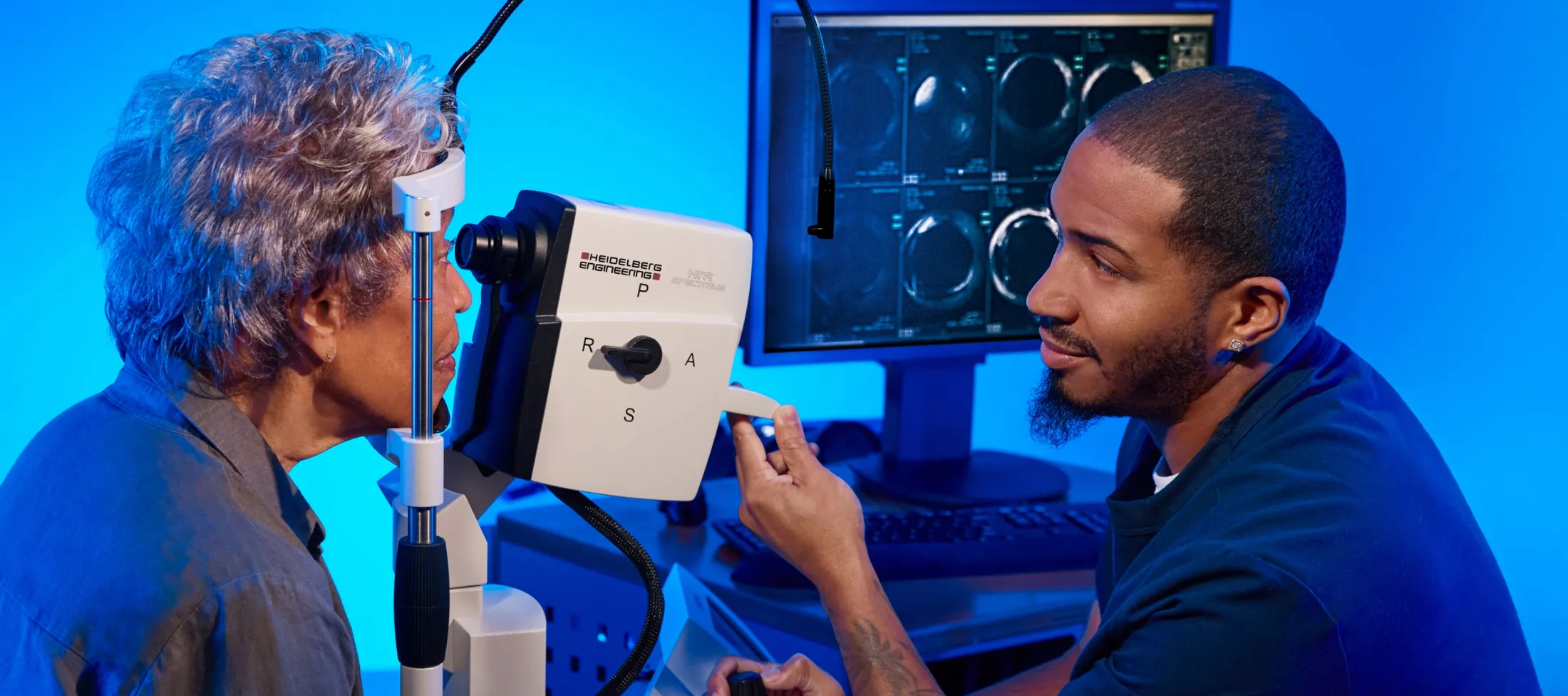
Diagnóstico y tratamientos avanzados
Ofrecemos acceso a los diagnósticos más recientes y a los tratamientos médicos, láser y quirúrgicos más avanzados para la prevención, la detección precoz y el tratamiento de todo el espectro de afecciones oculares diabéticas.
Nuestro programa, a la vanguardia de la innovación, utiliza tecnologías de imagen avanzadas de alta resolución, como OCT, OCTA, fotografía de fondo de ojo de campo amplio y angiografía con fluoresceína, para detectar incluso los primeros signos de retinopatía diabética. Estas herramientas nos permiten evaluar cambios vasculares sutiles, como la isquemia macular y la falta de perfusión capilar, a menudo antes de que aparezcan los síntomas o se vea afectada la visión.
Ofrecemos una gama completa de terapias médicas adaptadas a la condición y respuesta al tratamiento de cada paciente. Estas incluyen inyecciones intravítreas de factor de crecimiento endotelial anti-vascular (VEGF) e implantes de corticosteroides para el edema macular diabético crónico. Para pacientes con enfermedad avanzada, brindamos terapias láser de precisión, como la fotocoagulación panretiniana para la retinopatía diabética proliferativa, así como intervenciones quirúrgicas avanzadas, como vitrectomía, pelado de membrana y cirugía de glaucoma. Nuestros especialistas en retina tienen experiencia en la realización de procedimientos combinados para abordar múltiples afecciones oculares en una sola intervención quirúrgica.
Para favorecer los resultados a largo plazo, ofrecemos servicios personalizados de rehabilitación y cuidados de apoyo para ayudar a los pacientes a adaptarse a los cambios en la visión, optimizar la visión restante y mantener la calidad de vida.
Ofrecemos un conjunto integral de diagnósticos y tratamientos avanzados para la enfermedad ocular diabética, que incluyen:
Tratamientos avanzados
Ofrecemos las terapias médicas, láser y quirúrgicas más avanzadas para proteger y restaurar la visión en pacientes con retinopatía diabética.

Investigación y publicaciones
Como parte de la Red de Retina DRCR, patrocinada por los NIH, Montefiore Einstein ha contribuido a importantes avances en la atención clínica de la retinopatía diabética. Nuestra investigación colaborativa abarca múltiples ensayos clínicos, incluidos estudios financiados por el NEI/NIH, que traducen los nuevos descubrimientos científicos en mejores diagnósticos y tratamientos para personas con retinopatía diabética o en riesgo de padecerla.
Montefiore Einstein desempeñó un papel fundamental en el histórico ensayo clínico DCCT (Diabetes Control and Complications Trial), financiado por el NIDDK, que transformó la atención de la diabetes al demostrar que el control temprano e intensivo de la glucosa en sangre reduce significativamente el riesgo de retinopatía diabética y otras complicaciones que amenazan la visión. Nuestra investigación integra la ciencia básica, traslacional y clínica para avanzar en la comprensión, el diagnóstico y el tratamiento de la enfermedad ocular diabética, con esfuerzos clave en los mecanismos moleculares de la retinopatía, los resultados de salud, la detección mediante telemedicina, la rentabilidad de la detección y las terapias, y el desarrollo de nuevos diagnósticos y tratamientos.
Un programa de triaje telerretiniano en Montefiore Einstein demostró que la telemedicina y las herramientas de salud digital pueden aumentar la detección, ampliar el acceso a la atención médica para preservar la vista y mejorar la adherencia a los exámenes oculares anuales en comunidades desatendidas con altas tasas de diabetes tipo 2 y retinopatía. Nuestros científicos también están definiendo los factores moleculares que impulsan la enfermedad, incluyendo el trabajo sobre la molécula 1A relacionada con el ligando del factor de necrosis tumoral, que puede ayudar a explicar la progresión de la retinopatía diabética proliferativa después de la vitrectomía primaria. Además, nuestros oftalmólogos contribuyen a definir los estándares nacionales mediante roles de liderazgo en el Comité de Patrones de Práctica Preferidos de la Academia Estadounidense de Oftalmología, lo que garantiza que las guías basadas en la evidencia para la detección y el manejo de la enfermedad ocular diabética guíen la atención a nivel local y global.
-
En un gran sistema de atención médica en el Bronx, se descubrió que la telemedicina para la clasificación de pacientes con retinopatía aumentaba la detección temprana y el acceso a la atención médica para una población desatendida con una alta incidencia de diabetes tipo 2 y retinopatía.
Dahlan K, Suman P, Rubaltelli D, Shrivastava A, Chuck R, Mian U. En un gran sistema de atención médica en el Bronx, se encontró que la teledetección de retinopatía aumentó el acceso a la atención médica y a la detección precoz para una población desatendida con alta incidencia de diabetes tipo 2 y retinopatía. Int J Environ Res Public Health. 31 de marzo de 2023;20(7):5349. doi: 10.3390/ijerph20075349. PMID: 37047964; PMCID: PMC10094588.
El estudio tuvo como objetivo evaluar la efectividad de un programa de teledetección de retinopatía, en el que se toman fotografías digitales de la retina en centros de atención primaria y son interpretadas a distancia por especialistas de Montefiore. El objetivo era superar las barreras tradicionales de acceso a la atención médica y mejorar las tasas de detección de la retinopatía diabética (RD), una de las principales causas de ceguera prevenible. -
Aplicaciones de la inteligencia artificial en el diagnóstico por imagen de la retinopatía falciforme: avances actuales, desafíos y perspectivas futuras.
Shah P, Farah HA, Wisotsky DJ, Nawani P, Kovrizhkin K, Muir ER, Mian U, Duong TQ. Aplicaciones de inteligencia artificial en imágenes de retinopatía de células falciformes: progreso actual, desafíos y direcciones futuras. J Ophthalmol. 20 de febrero de 2026;2026:5579203. doi: 10.1155/joph/5579203. PMID: 41727523; PMCID: PMC12921631.
Esta revisión resume los avances recientes en inteligencia artificial aplicados a la obtención de imágenes de la región capsular y destaca las futuras oportunidades para su aplicación clínica. -
Resultados retinianos en la diabetes: terapia antihiperglucémica, EWDR y consideraciones perioperatorias.
Wang T, Zeng J, Tan M, Zhong M, Zhou H, Dai Y, Song S. Resultados retinianos en la diabetes: terapia antihiperglucémica, EWDR y consideraciones perioperatorias. Biomedicines. 23 de abril de 2026;14(5):963. doi: 10.3390/biomedicines14050963. PMID: 42193290; PMCID: PMC13203953.
Esta revisión resume la evidencia actual que vincula la biología de la unidad neurovascular (UNV), el riesgo de retinopatía diabética generalizada (RDG) y los factores perioperatorios relacionados con la diabetes. Analiza cómo estos factores pueden interactuar en pacientes con diabetes y cómo pueden influir en los resultados retinianos. El objetivo de esta revisión es sintetizar la evidencia actual y las interpretaciones mecanicistas, más que proporcionar recomendaciones formales para la práctica clínica. -
Los bebés prematuros con edad gestacional menor de 25 semanas requieren mayores recursos oftalmológicos para la retinopatía del prematuro
Hawn VS, Muhtadi R, Suman P, Latuga MS, Quinn G, Mian U. Los lactantes prematuros con una edad gestacional inferior a 25 semanas requieren mayores recursos oftalmológicos para la retinopatía del prematuro. J AAPOS. 2022 dic;26(6):307.e1-307.e5. doi: 10.1016/j.jaapos.2022.09.007. Publicado en línea el 28 de octubre de 2022. PMID: 36404441.
Este estudio comparó las tasas de examen y tratamiento de los lactantes nacidos con una edad gestacional inferior a 25 semanas y de aquellos nacidos con una edad gestacional de al menos 25 semanas. -
Patrones de utilización de la atención sanitaria en pacientes con anemia falciforme y su asociación con la retinopatía falciforme
Minniti CP, Suman PD, Dahlan K, Crouch A, Goodman M, Mian UK. Patrones de utilización de la atención médica en pacientes con anemia falciforme y su asociación con la retinopatía falciforme. Eur J Haematol. 2025 abr;114(4):615-619. doi: 10.1111/ejh.14369. Epub 2024 dic 23. PMID: 39711322.
Este estudio evalúa los patrones de utilización de los servicios de salud entre pacientes con enfermedad de células falciformes (ECF) y retinopatía. -
Impacto de los niveles de ansiedad y los patrones de sueño en el dolor percibido durante las inyecciones intravítreas de bevacizumab.
Wieder MS, Szlechter M, Fischman N, Inker S, Rusu I, Mbekeani JN. Impacto de los niveles de ansiedad y los patrones de sueño en el dolor percibido durante las inyecciones intravítreas de bevacizumab. Ophthalmic Surg Lasers Imaging Retina. 2021 Sep;52(9):498-504. doi: 10.3928/23258160-20210819-02. Epub 2021 Sep 1. PMID: 34505802.
Este estudio evalúa el impacto de la ansiedad y los patrones de sueño en el dolor de la inyección intravítrea.

Nuestro equipo de atención oftalmológica para diabéticos


MD Richard M. Klein


Nuestro equipo multidisciplinario de médicos de renombre mundial incluye oftalmólogos certificados y con formación especializada en enfermedades oculares diabéticas y retina. Nos especializamos en el diagnóstico y tratamiento de todo el espectro de afecciones oculares diabéticas, utilizando los diagnósticos y tratamientos más avanzados para estabilizar y preservar la visión, prevenir la progresión de la enfermedad, mejorar la salud general y la calidad de vida de cada paciente.
Programas e iniciativas comunitarias transformadoras
Nuestro programa es reconocido por su enfoque colaborativo y atención clínica integral, que se extiende más allá de los muros de Montefiore Einstein hacia la comunidad a través de iniciativas de alcance dirigidas diseñadas para preservar la visión, retrasar la progresión de la enfermedad, prevenir tanto la pérdida de visión como la ceguera y mejorar la calidad de vida, particularmente entre las poblaciones vulnerables. Los esfuerzos clave incluyen educación comunitaria, estrategias basadas en telemedicina para la detección temprana y el manejo de la enfermedad ocular diabética y otras afecciones oftalmológicas y nuestra asociación con Programa de Compañeros Tecnológicos para una Vida Accesible (Tech Pals) de Lighthouse GuildEste programa conecta generaciones mediante mentoría tecnológica personalizada para personas con discapacidad visual. Esta iniciativa única vincula a jóvenes adultos ciegos o con discapacidad visual con adultos mayores para fomentar la alfabetización digital y la independencia. A través de estas y otras iniciativas, seguimos ampliando el acceso a la atención médica, preservando la continuidad y reduciendo las desigualdades, promoviendo así la salud ocular en las comunidades a las que servimos.
Acerca de la enfermedad ocular diabética
La enfermedad ocular diabética se refiere a un grupo de afecciones que pueden poner en riesgo la visión y que afectan a las personas con diabetes, incluyendo la retinopatía diabética no proliferativa y proliferativa, el edema macular diabético (EMD), la isquemia macular, las cataratas y el glaucoma. En sus etapas iniciales, la retinopatía diabética puede no causar síntomas perceptibles, pero a medida que la enfermedad progresa, puede provocar pérdida de visión y ceguera si no se trata.
La retinopatía diabética, la forma más común, se produce cuando los niveles crónicamente elevados de azúcar en sangre dañan los pequeños vasos sanguíneos de la retina, el tejido sensible a la luz situado en la parte posterior del ojo. El edema macular diabético, una complicación de la retinopatía, consiste en la inflamación de la mácula, la zona central de la retina responsable de la visión nítida, y puede afectar significativamente la visión central. Otras complicaciones de la retinopatía diabética avanzada incluyen el glaucoma neovascular, la hemorragia vítrea y el desprendimiento de retina por tracción. Las personas con diabetes también tienen un mayor riesgo de desarrollar cataratas a una edad más temprana. El diagnóstico suele implicar un examen ocular completo con dilatación de las pupilas, y el tratamiento puede incluir medicamentos, terapia láser o cirugía, según la gravedad y el tipo de afección. Los exámenes oculares completos periódicos son esenciales para la detección y el tratamiento precoces. Mantener un control óptimo de los niveles de azúcar en sangre, la presión arterial y el colesterol puede reducir significativamente el riesgo y la progresión de la enfermedad ocular diabética.