



About Our Program
Montefiore Einstein’s family-centered philosophy is central to speech-language pathology patient care at the Department of Physical Medicine and Rehabilitation. We strive to help our patients regain their speaking, listening, writing and comprehension abilities and enjoy greater independence and an enhanced quality of life.
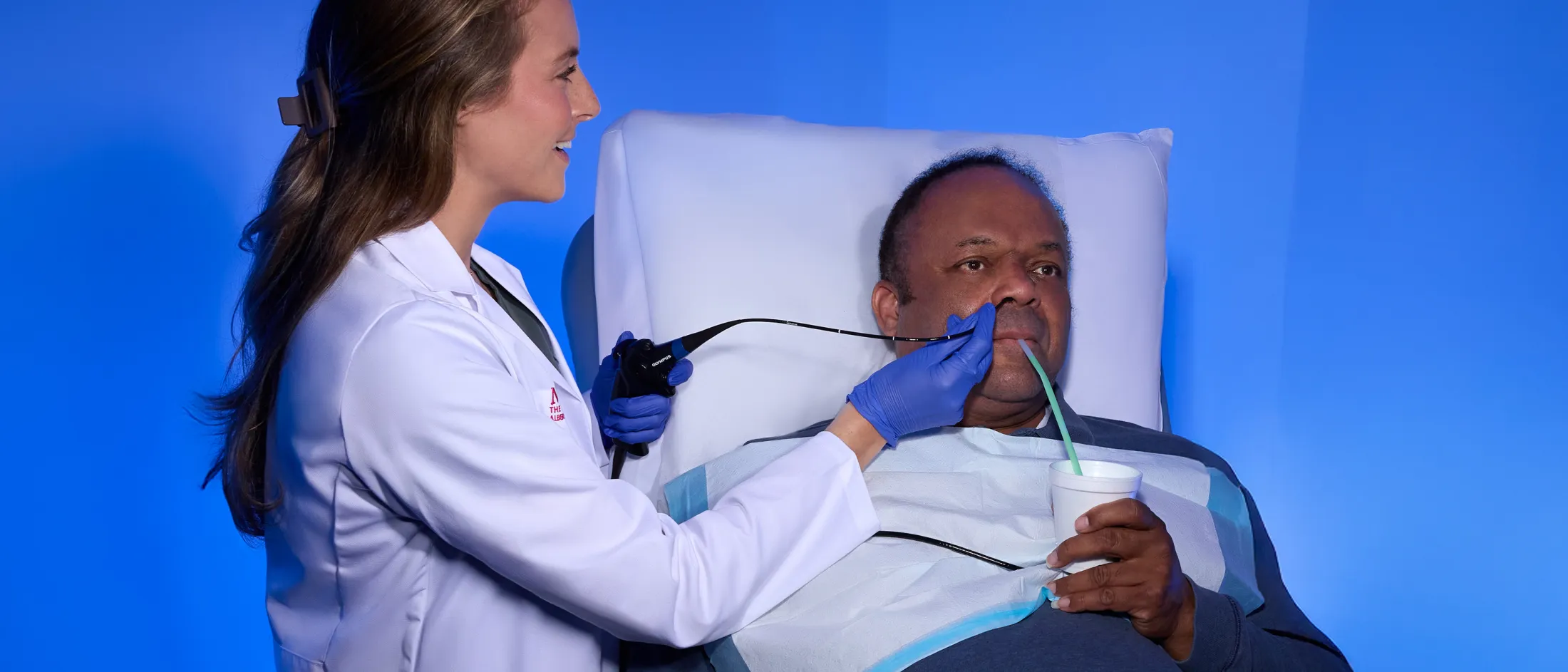
We remain committed to consistently delivering extraordinary clinical outcomes through the use of state-of-the-art diagnostic equipment and modalities, including videofluoroscopic swallow studies (VFSS), fiberoptic endoscopic evaluation of swallow (FEES) studies, aerodynamic and acoustic voice assessments, video stroboscopy and nasopharyngoscopy.
Our speech-language pathologists (SLPs) are all nationally certified by the American Speech-Language-Hearing Association (ASHA), hold master’s degrees and are licensed by the state of New York. Our SLPs evaluate and treat premature infants through geriatrics for all voice, communication, airway and swallowing disorders. Some of our therapists have specialized skill sets and hold advanced certifications, including Board Certified Specialty Recognition in Swallowing and Swallowing Disorders, Lee Silverman’s voice treatment LOUD certification, International Board Certified Lactation Consultant (IBCLC) and neonatal therapist certification.
Our Speech-Language Pathology Services
Our SLPs are skilled at managing diverse conditions related to speech, language, communication and swallowing. In partnership with the expansive Montefiore Einstein academic health system and a broad network of physicians and specialists, we design individualized treatment plans to meet every patient’s unique recovery and rehabilitation needs.
Our multidisciplinary team approach optimizes the overall patient experience, coordinating multiple levels of specialized treatment and enabling our patients to receive care from experts in various disciplines during a single session. Expert opinions, patient feedback, diagnosis and treatment options are reviewed immediately. Our specialists can be found at the following clinics:
- Velopharyngeal Insufficiency (VPI) Clinic
- Fiberoptic Evaluation of Swallow (FEES) Clinic
- Aerodigestive at Montefiore Einstein (ADAM) Clinic
- Craniofacial Clinic
- Muscular Dystrophy (MD) Clinic
Cognitive disorders may result in impaired mental processes, potentially stemming from traumatic brain injury (TBI), stroke, dementia, Parkinson’s disease, multiple sclerosis, aphasia or developmental disorders. Speech therapy can also help you recover lost cognitive abilities, including memory, processing, problem-solving, social skills, judgment and safety awareness. Learn more about the conditions we treat that can affect speech below:
Aphasia is a language disorder that affects a person’s ability to communicate. It can impact various aspects of communication, including speaking, understanding spoken language, reading and writing. Aphasia typically occurs after brain injury, most commonly due to a stroke, but it can also result from head trauma, brain tumors, infections or other neurological conditions. SLPs play a crucial role in diagnosing and treating aphasia, helping individuals regain their communication abilities.
Apraxia of speech (AOS), referred to as childhood apraxia of speech (CAS) in children, is a motor speech disorder that impacts the ability to plan and coordinate the movements necessary for speech. Unlike speech disorders resulting from muscle weakness (such as dysarthria), apraxia arises because the brain has difficulty sending the correct signals to the muscles that control speech. Individuals with AOS understand what they want to express but struggle to coordinate the movements required to articulate those words. SLPs play a crucial role in diagnosing and treating apraxia of speech, assisting individuals’ ability to produce clear and accurate speech.
A chronic cough is defined as a cough that lasts more than eight weeks in adults or more than four weeks in children and involves the vocal cords. While many causes of chronic cough relate to conditions such as asthma, allergies, gastroesophageal reflux disease (GERD) or postnasal drip, SLPs play a particularly important role when the cough results from vocal misuse, irritation of the vocal cords or psychogenic factors. In cases where a chronic cough is associated with voice or swallowing issues, an SLP can assist by evaluating and treating any underlying problems that contribute to the cough.
Cognitive dysfunction is impairment in various cognitive abilities that affects a person’s thinking, memory, attention, problem-solving and executive function. It can result from a variety of causes, including neurological conditions like stroke, dementia, traumatic brain injury (TBI) or neurodevelopmental disorders, as well as aging, mental health conditions and substance abuse. While SLPs are primarily known for treating speech and language disorders, they are also highly skilled in addressing cognitive communication issues, which often accompany cognitive dysfunction.
Dysarthria is a motor speech disorder caused by weakness, paralysis or incoordination of the muscles used for speaking. It can impact the clarity, strength and speed of speech, making it challenging for an individual to produce intelligible words. Dysarthria may result from damage to the nervous system, including the brain, brain stem or peripheral nerves. It can affect various aspects of speech, such as volume, pitch, articulation and prosody (the rhythm and flow of speech). Through targeted therapies, SLPs help individuals improve their speech and communication abilities, collaborating with patients to help them regain as much function as possible.
Head and neck cancer (HNC) refers to cancers that affect the mouth, throat, voice box (larynx), sinuses and other structures in the head and neck region. These cancers and their treatments can significantly impact speech, swallowing, breathing and communication. SLPs play a crucial role in the care and rehabilitation of individuals with HNC by assessing and treating the communication and swallowing disorders that often arise from the cancer itself or its treatments. Through thorough assessment, targeted therapy and ongoing support, SLPs empower individuals with HNC to regain functional communication and enhance their overall well-being.
Parkinson’s disease (PD) is a progressive neurodegenerative disorder that primarily affects movement control, but it can also lead to various speech and swallowing disorders. The motor symptoms of PD—such as tremors, rigidity and bradykinesia (slow movement)—can impact the muscles used for speaking and swallowing. SLPs play a crucial role in managing and treating the speech and swallowing difficulties associated with PD, using treatments designed to enhance communication and swallowing function, thereby improving the quality of life for individuals with PD.
Pediatric feeding disorders refer to the difficulties children experience with eating, drinking and swallowing. These disorders can range from issues with food intake to more complex challenges like trouble swallowing or choking. Feeding disorders in children can profoundly impact their nutrition, growth, development and overall well-being. Although SLPs are primarily recognized for addressing speech and language disorders, they are also trained in oral-motor functions, which involve the muscles and movements necessary for eating and swallowing.
Right Hemisphere Disorder (RHD) refers to damage or disruption in the brain’s right hemisphere, which can lead to various cognitive, communication and emotional challenges. While the left hemisphere is more commonly associated with language production and comprehension, the right hemisphere plays a vital role in spatial awareness, attention, nonverbal communication and emotional regulation. Our team of SLPs can help assess, diagnose and treat RHD by improving communication and cognitive-communication abilities, while assisting individuals in coping with the social, emotional and functional impacts of their condition.
Stuttering is a speech disorder characterized by disruptions in the normal flow of speech. These disruptions may include repetition of sounds, syllables or words, as well as prolonged sounds or pauses that interrupt the normal rhythm of speech. Stuttering can make communication challenging, affecting a person’s ability to express themselves clearly and fluently. Through therapy, SLPs assist individuals with stuttering in improving their communication skills, boosting their confidence and developing strategies to manage speech disorders.
Swallowing disorders, known as dysphagia, are conditions that impact a person’s ability to swallow food, liquids or saliva effectively. These disorders can arise from various causes, including neurological conditions, structural abnormalities or muscle weakness. They can influence eating, drinking and sometimes even breathing, leading to complications such as malnutrition, dehydration and aspiration (when food or liquids enter the airway). SLPs diagnose and treat swallowing disorders, typically specializing in communication and language rehabilitation.
Velopharyngeal insufficiency (VPI) is a resonance disorder that results in the velopharyngeal mechanism—the soft palate and the structures at the back of the throat—being unable to close properly during speech. This condition leads to abnormal airflow between the mouth and nasal passages, causing speech to sound hypernasal (excessive nasal sound) or hyponasal (lack of nasal sound), depending on the severity of the insufficiency. Our team of SLPs employs various assessments and therapeutic techniques to assist individuals in improving their speech, resonance and overall communication. Some individuals may require surgical or prosthetic interventions as part of their treatment plan. SLPs aid those with VPI in achieving better communication outcomes and an enhanced quality of life.
Voice disorders affect a person’s voice quality, pitch or volume, making effective communication challenging. These disorders can impact individuals of all ages and may occur suddenly or develop gradually. They can arise from various causes, including physical, neurological, psychological and environmental factors, and certain surgeries. SLPs evaluate voice quality and collaborate with individuals to enhance vocal health, manage symptoms and address underlying causes.