

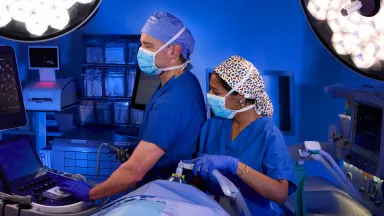

Investigación en anestesiología y
medicina de atención crítica
El Departamento de Anestesiología y Medicina de Atención Crítica de Montefiore Einstein está mejorando la atención al paciente mediante el análisis predictivo, la investigación en salud digital y herramientas innovadoras de aprendizaje automático que optimizan los resultados de la unidad de cuidados intensivos quirúrgicos (SICU, por sus siglas en inglés) y reducen las complicaciones respiratorias posoperatorias. Reconocido por su excelencia en la seguridad del paciente, nuestro equipo ha mejorado los protocolos de sedación, ha optimizado la terapia de movilización para pacientes en estado crítico y ha implementado un código de vía aérea difícil en todo el sistema. Además, nuestras investigaciones sobre farmacología anestésica, incluido el impacto de la ketamina en las funciones respiratorias y neurológicas, contribuyen a una comprensión más profunda de la medicina perioperatoria y los enfoques anestésicos personalizados.
Investigación pionera y análisis predictivo
El Departamento de Medicina de Atención Crítica de Anestesiología de Montefiore Einstein ha creado una sólida base de datos para garantizar una atención óptima al paciente en las unidades de cuidados intensivos quirúrgicos (UCIC). Esta iniciativa se basa en datos quirúrgicos y de la UCI, actualizados continuamente y extraídos directamente de los historiales clínicos electrónicos de nuestro hospital, lo que nos permite evaluar la evolución de los pacientes y modificar las políticas de la UCI para garantizar una mejor atención. Nuestro análisis de datos de salud digitales ha mejorado la atención en la UCI de Moses al acortar la duración de la ventilación invasiva, utilizar analgesia que minimiza el uso de opioides, reducir la incidencia de insuficiencia respiratoria y la proporción de sedación profunda en pacientes intubados.
Las investigaciones actuales se centran en optimizar los protocolos de sedación para pacientes con ventilación mecánica, evaluar el impacto de la terapia de movilización en la recuperación de enfermedades críticas y desarrollar estrategias de predicción y prevención de la insuficiencia respiratoria. En particular, hemos creado una innovadora herramienta de aprendizaje automático que predice la cancelación de casos y la insuficiencia respiratoria postoperatoria en pacientes con alto riesgo. Este sofisticado modelo incorpora datos fisiológicos y de procedimientos, y se está implementando en todo el sistema a través del Centro Montefiore Einstein para la Innovación en Datos de Salud.
Departamento de Anestesiología y Medicina de Atención Crítica de Montefiore Einstein es líder nacional en movilización temprana en la UCI quirúrgica. En un estudio observacional en curso, nuestros investigadores están evaluando la profundidad de la sedación en pacientes de la UCI con ventilación mecánica y el impacto de la terapia de movilización en la recuperación de pacientes en estado crítico. Nuestro equipo de Investigación en Salud Digital descubrió que, entre los adultos con ventilación mecánica en la UCI, la proporción de tiempo que los pacientes estaban profundamente sedados se asociaba de forma independiente con el alta adversa. Los pacientes que recibieron una sedación más ligera tenían un menor riesgo de alta adversa debido a una mayor movilidad del paciente y a una evaluación y tratamiento más activos de los síntomas de los pacientes, en particular, el dolor, la ansiedad y la agitación. Esta investigación sirve de base para nuestra estrategia multimodal de control de los síntomas centrada en el paciente para mejorar los resultados de los pacientes.
Nuestro Departamento está a la vanguardia en la investigación de las complicaciones respiratorias postoperatorias, una preocupación crucial en la medicina perioperatoria. Exploramos cómo la potencia mecánica durante la anestesia general influye en la insuficiencia respiratoria postoperatoria e investigamos la importancia de optimizar la mecánica respiratoria durante la cirugía para mejorar los resultados del paciente y reducir la carga en el sistema de salud. Estos conocimientos fundamentan las prácticas clínicas y sientan las bases para enfoques anestésicos personalizados que mejoren la recuperación postoperatoria.
Paralelamente, en nuestro Laboratorio de Salud Digital estamos analizando los efectos multifacéticos de la ketamina, un potente anestésico y analgésico, en las funciones respiratorias y neurológicas. Hemos estudiado cómo la administración de ketamina por vía intravenosa afecta a los patrones respiratorios y a la actividad cerebral de los pacientes ingresados en la UCI, lo que nos ha permitido descubrir sus posibles aplicaciones terapéuticas. También examinamos los efectos neuroanatómicos y fisiológicos de la hipoxia y la esketamina, y hemos descubierto que influyen en la respiración, el sistema nervioso simpático y la función cortical. Al analizar el papel de la ketamina en la sedación procedimental, incluida su relación con la desaturación de oxígeno y el uso de los servicios sanitarios, contribuimos a una comprensión más matizada de su seguridad y eficacia. En conjunto, esta investigación tiene como objetivo optimizar la atención al paciente y avanzar en nuestro conocimiento de la farmacología anestésica.

Publicaciones recientes
-
Role of anticoagulation therapy in modifying stroke risk associated with new-onset atrial fibrillation after non-cardiac surgery
-
Asociación entre el uso de ketamina durante la sedación para procedimientos y la desaturación de oxígeno y la utilización de servicios de salud: un estudio retrospectivo multicéntrico basado en un registro hospitalario.
-
Desarrollo de una herramienta de predicción automatizada y de propósito general para la insuficiencia respiratoria postoperatoria mediante aprendizaje automático: un estudio de cohorte retrospectivo.
-
Asociación de la apnea obstructiva del sueño con el delirio postoperatorio en procedimientos de complejidad moderada a alta: un estudio de registro hospitalario.
-
Control multimodal de los síntomas centrado en el paciente: una estrategia para reemplazar la sedación en la UCI.
-
Potencia mecánica durante la anestesia general e insuficiencia respiratoria postoperatoria: un estudio de cohorte retrospectivo multicéntrico.
-
La asociación entre la ventilación intraoperatoria con baja presión de conducción y el alta a un centro distinto del domicilio: un estudio de cohorte histórico.
-
Asociación entre la reintubación y los costos hospitalarios y su modificación mediante la vigilancia postoperatoria: un estudio de cohorte retrospectivo multicéntrico.
-
Debilidad muscular, polineuropatía y miopatía: diagnóstico, tratamiento y resultados a largo plazo.
-
Pérdida de la capacidad de vivir de forma independiente en pacientes sometidos a reemplazo de válvula aórtica transcatéter o quirúrgico: un estudio de cohorte retrospectivo.
-
Mantenimiento de la anestesia con propofol y/o anestésicos volátiles durante la reparación de aneurismas intracraneales: un análisis comparativo de los resultados neurológicos.