





Leucemia mieloide aguda (LMA)
Acceda a una atención excepcional para la leucemia mieloide aguda y otros tipos de cáncer de sangre y médula ósea en el Centro Oncológico Integral Montefiore Einstein. Nuestro equipo multidisciplinario cuenta con amplia experiencia en el tratamiento de este tipo de cáncer. Como uno de los primeros centros oncológicos designados por el NCI durante más de 50 años, hemos sido líderes en la investigación, el diagnóstico y el tratamiento de más de 200 tipos de cáncer.
Estamos a la vanguardia del tratamiento y la investigación de la leucemia mieloide aguda y otros cánceres de la sangre y la médula ósea. El Centro de Síndromes Mielodisplásicos del Montefiore Einstein Comprehensive Cancer Center está reconocido como «centro de excelencia» nacional por la Multiple Myelodysplastic Syndromes (MDS) Foundation y cuenta con numerosos ensayos clínicos nuevos e innovadores para la leucemia mieloide aguda.
Si necesita atención para la leucemia mieloide aguda, confíe en nuestros proveedores, cuyo objetivo es combatir el cáncer y atender todas sus necesidades de salud.

El Montefiore Einstein Comprehensive Cancer Center, designado como centro integral del cáncer por el National Cancer Institute (NCI), apoya la misión y las normas del NCI. La siguiente información sobre los tipos de cáncer, prevención y tratamientos ha sido facilitada por el NCI.
Tratamiento de la leucemia mieloide aguda (PDQ®): versión para pacientes
Información general sobre la leucemia mieloide aguda
Puntos clave
- La leucemia mieloide aguda (LMA) en adultos es un tipo de cáncer en el que la médula ósea produce una gran cantidad de células sanguíneas anómalas.
- La leucemia puede afectar los glóbulos rojos, los glóbulos blancos y las plaquetas.
- Hay diferentes subtipos de LMA.
- Fumar, un tratamiento previo con quimioterapia y la exposición a la radiación pueden aumentar el riesgo de LMA.
- Los signos y síntomas de la LMA incluyen fiebre, sensación de cansancio y tendencia a la aparición de hematomas o hemorragias.
- Para diagnosticar la LMA se utilizan pruebas que examinan la sangre y la médula ósea.
- Tras diagnosticar LMA, se realizan pruebas para determinar si el cáncer se ha extendido a otras partes del cuerpo.
- Some people decide to get a second opinion.
- Certain factors affect prognosis (chance of recovery) and treatment options.
La leucemia mieloide aguda (LMA) en adultos es un tipo de cáncer en el que la médula ósea produce una gran cantidad de células sanguíneas anómalas.
La LMA es un cáncer de la sangre y la médula ósea . Es el tipo más común de leucemia aguda en adultos. Este tipo de cáncer suele empeorar rápidamente si no se trata. La LMA también se conoce como leucemia mielógena aguda y leucemia no linfocítica aguda.
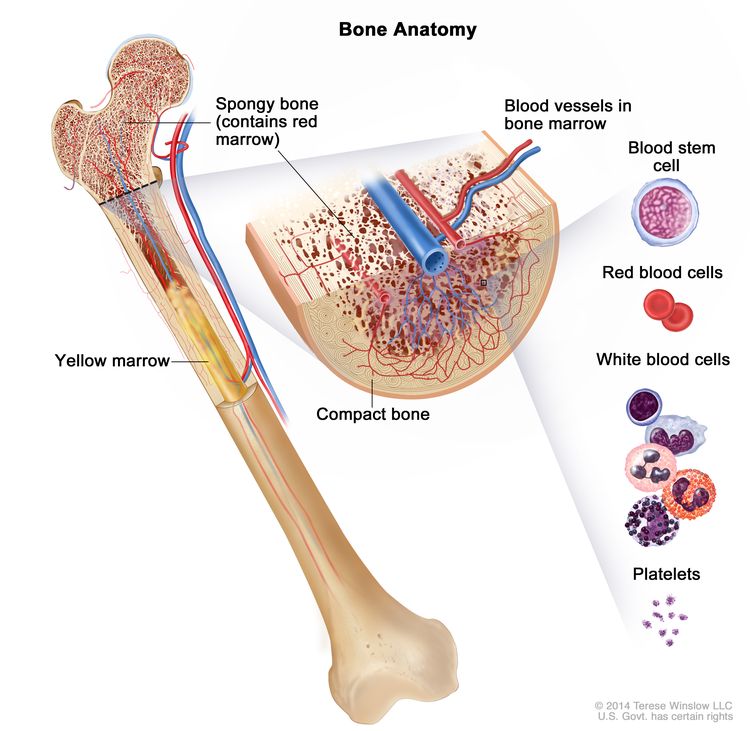
Anatomía del hueso. El hueso está formado por hueso compacto, hueso esponjoso y médula ósea. El hueso compacto constituye la capa externa del hueso. El hueso esponjoso se encuentra sobre todo en los extremos de los huesos y contiene médula roja. La médula ósea se encuentra en el centro de la mayoría de los huesos y tiene muchos vasos sanguíneos. Hay dos tipos de médula ósea: roja y amarilla. La médula roja contiene células madre sanguíneas que pueden convertirse en glóbulos rojos, glóbulos blancos o plaquetas. La médula amarilla está compuesta principalmente de grasa.
La leucemia puede afectar los glóbulos rojos, los glóbulos blancos y las plaquetas.
The bone marrow makes blood stem cells (immature cells) that become mature blood cells over time. A blood stem cell may become a myeloid stem cell or a lymphoid stem cell.
Las células madre mieloides pasan por varios estadios de desarrollo en la médula ósea antes de madurar completamente y convertirse en:
- Glóbulos rojos que transportan oxígeno y otras sustancias a todos los tejidos del cuerpo
- granulocitos y otros tipos de glóbulos blancos que ayudan al sistema inmunitario del cuerpo a responder a infecciones, alérgenos e inflamación.
- Plaquetas que ayudan a detener el sangrado formando coágulos
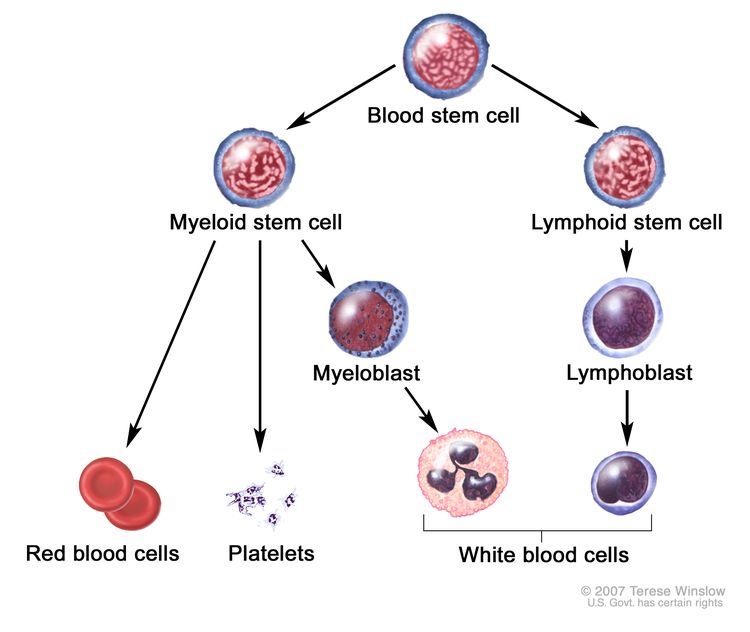
Desarrollo de las células sanguíneas. Una célula madre sanguínea pasa por varios estadios para convertirse en un glóbulo rojo, una plaqueta o un glóbulo blanco.
En la LMA, hay un incremento en la cantidad de glóbulos blancos inmaduros, llamados mieloblastos (o blastos mieloides). Los mieloblastos en la LMA son anómalos y no se convierten en glóbulos blancos sanos. A medida que aumenta la cantidad de estas células, también llamadas células leucémicas, en la sangre y la médula ósea, va quedando menos espacio para plaquetas, glóbulos rojos y otros glóbulos blancos sanos. Esto puede provocar sangrado fácil, anemia e infección.
Las células leucémicas pueden extenderse fuera de la sangre a otras partes del cuerpo, incluido el sistema nervioso central (SNC; cerebro y médula espinal), la piel y las encías. En ocasiones, las células leucémicas forman un tumor sólido denominado sarcoma mieloide. El sarcoma mieloide también se denomina tumor mieloide extramedular, sarcoma granulocítico o cloroma.
Hay diferentes subtipos de LMA.
La mayoría de los subtipos de LMA se basan en el grado de madurez (desarrollo) de las células cancerosas en el momento del diagnóstico y en lo diferentes que son de las células normales.
La leucemia promielocítica aguda (LPA) es un subtipo de LMA. Esta leucemia se produce cuando los genes del cromosoma 15 se intercambian de lugar con algunos genes del cromosoma 17 y se produce un gen anómalo llamado PML::RARA. El gen PML::RARA envía un mensaje que detiene la maduración de los promielocitos (un tipo de glóbulo blanco). Pueden darse problemas con sangrado severo y coágulos de sangre. Este es un problema de salud grave que necesita tratamiento lo antes posible. La LPA suele darse en adultos de mediana edad.
Fumar, un tratamiento previo con quimioterapia y la exposición a la radiación pueden aumentar el riesgo de LMA.
La LMA está causada por ciertos cambios en el funcionamiento de las células madre sanguíneas, especialmente en su crecimiento y división en células nuevas. Un factor de riesgo es todo aquello que aumenta las probabilidades de contraer una enfermedad. Algunos factores de riesgo de la LMA, como fumar, pueden modificarse. Sin embargo, los factores de riesgo también incluyen factores que las personas no pueden cambiar, como la genética, el envejecimiento y el historial médico.
Hay muchos factores de riesgo de LMA, pero muchos no causan cáncer directamente. En cambio, aumentan la probabilidad de que se produzcan daños en el ADN en las células que pueden provocar LMA. Más información sobre cómo se desarrolla el cáncer en ¿Qué es el cáncer?
Tener uno o más de estos factores de riesgo no significa que vaya a padecer LMA. Muchas personas con factores de riesgo nunca desarrollan LMA, mientras que otras sin factores de riesgo conocidos sí lo hacen.
Los posibles factores de riesgo de LMA incluyen:
- being male
- Edad avanzada
- smoking
- haber recibido tratamiento con quimioterapia o radioterapia en el pasado
- estar expuesto a la radiación en el ambiente (como la radiación nuclear) o al benceno químico
- Tener un historial personal de un trastorno sanguíneo como el síndrome mielodisplásico
- tener ciertos síndromes o trastornos hereditarios
Talk with your doctor if you think you may be at risk.
Los signos y síntomas de la LMA incluyen fiebre, sensación de cansancio y tendencia a la aparición de hematomas o hemorragias.
Los primeros signos y síntomas de la leucemia mieloide aguda (LMA) pueden ser similares a los causados por la gripe u otras enfermedades comunes. Consulte a su médico si presenta alguno de los siguientes síntomas:
- Debilidad o sensación de cansancio
- fever
- Infección
- Palidez o pérdida del color normal de la piel
- Sangrado
Los signos o síntomas menos comunes pueden ser causados por cúmulos de células leucémicas en el SNC o los testículos, o por un tumor de células mieloides llamado cloroma .
Los síntomas de la leucemia aguda a menudo se desarrollan entre cuatro y seis semanas antes del diagnóstico.
Para diagnosticar la LMA se utilizan pruebas que examinan la sangre y la médula ósea.
In addition to asking about your personal and family health history and doing a physical exam, your doctor may perform the following tests and procedures:
- Biometría hemática analiza una muestra de sangre para detectar:
- El número de glóbulos rojos y plaquetas
- El número y tipo de glóbulos blancos
- La cantidad de hemoglobina (la proteína que transporta el oxígeno) en los glóbulos rojos
- the amount of hematocrit (whole blood that is made up of red blood cells)
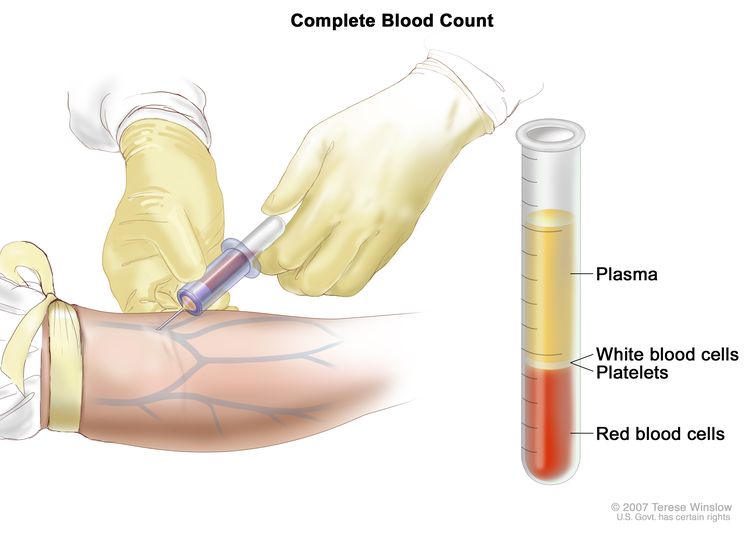
Hemograma completo (HC): la sangre se extrae insertando una aguja en una vena y dejando que fluya hacia un tubo. La muestra se envía al laboratorio y se cuentan los glóbulos rojos, los glóbulos blancos y las plaquetas. El HC se utiliza para detectar, diagnosticar y controlar diversas afecciones.
- El frotis de sangre periférica analiza una muestra de sangre para detectar células blásticas, el número y los tipos de glóbulos blancos, el número de plaquetas y los cambios en la forma de las células sanguíneas.
- La citometría de flujo mide la cantidad de células en una muestra, el porcentaje de células vivas y ciertas características de las células, como el tamaño, la forma y la presencia de marcadores tumorales (u otros) en la superficie celular. Las células de una muestra de sangre, médula ósea u otro tejido de un paciente se tiñen con un tinte fluorescente, se colocan en un líquido y luego se pasan una a una a través de un haz de luz. Los resultados de la prueba se basan en cómo reaccionan las células teñidas con el tinte fluorescente al haz de luz. Esta prueba se utiliza para ayudar a diagnosticar y tratar ciertos tipos de cáncer, como la leucemia y el linfoma.
- Aspiración y biopsia de médula ósea is the removal of bone marrow, blood, and a small piece of bone by inserting a hollow needle into the hipbone or esternón. Un pathologist examina la médula ósea, la sangre y el hueso con microscopio para buscar signos de cáncer.
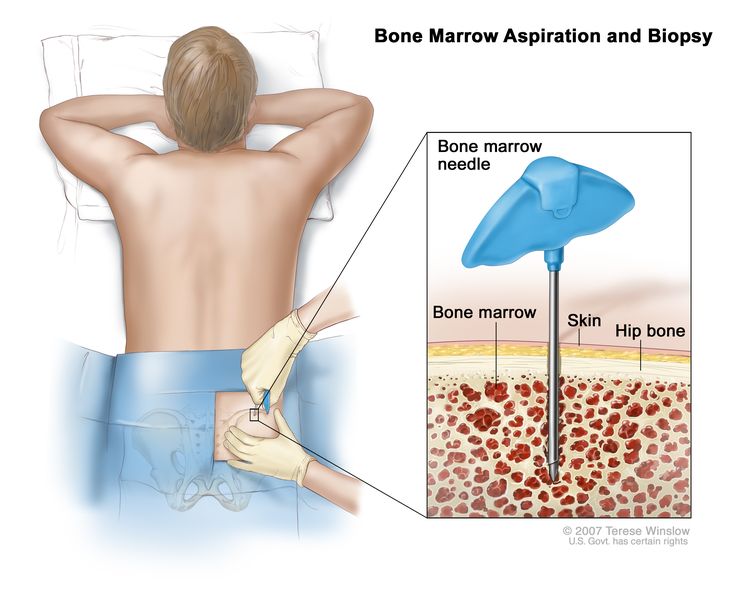
Aspiración y biopsia de médula ósea. Tras anestesiar una pequeña zona de la piel, se introduce una aguja larga y hueca a través de la piel y el hueso de la cadera del paciente hasta la médula ósea. Se extrae una muestra de médula ósea y un pequeño fragmento de hueso para su examen microscópico.
- La biopsia tumoral consiste en la extracción de células o tejidos de un nódulo mediante una aguja. Este procedimiento se realiza si el médico sospecha que las células leucémicas pueden haber formado un tumor sólido llamado sarcoma mieloide (también conocido como cloroma).
- El análisis citogenético comprueba los cromosomas de las células de una muestra de sangre o de médula ósea en busca de cambios, como cromosomas rotos, ausentes, reordenados o sobrantes. Los cambios en determinados cromosomas pueden ser un signo de cáncer. El análisis citogenético se utiliza para ayudar a diagnosticar el cáncer, planificar el tratamiento o determinar su eficacia. También se pueden realizar otras pruebas, como la hibridación fluorescente in situ (FISH, por sus siglas en inglés), para detectar ciertas alteraciones en los cromosomas.
- Las pruebas moleculares detectan ciertos genes, proteínas u otras moléculas en una muestra de sangre o médula ósea. También detectan cambios en un gen o cromosoma que puedan causar o afectar la probabilidad de desarrollar LMA. Una prueba molecular puede utilizarse para planificar el tratamiento, determinar su eficacia o elaborar un pronóstico.
- La inmunofenotipificación utiliza anticuerpos para identificar células cancerosas basándose en los tipos de antígenos o marcadores en la superficie de las células. Esta prueba se utiliza para ayudar a diagnosticar tipos específicos de leucemia. Por ejemplo, un estudio citoquímico puede analizar las células de una muestra de tejido utilizando sustancias químicas (colorantes) para buscar ciertos cambios en la muestra. Una sustancia química puede provocar un cambio de color en un tipo de célula leucémica pero no en otro tipo de célula leucémica.
- La prueba de reacción en cadena de la polimerasa con transcripción inversa (RT-PCR) mide la cantidad de una sustancia genética llamada ARNm producida por un gen específico. Se utiliza una enzima llamada transcriptasa inversa para convertir un fragmento específico de ARN en un fragmento coincidente de ADN, que puede ser amplificado (producido en grandes cantidades) por otra enzima llamada ADN polimerasa. Las copias de ADN amplificadas ayudan a determinar si un ARNm específico está siendo producido por un gen. La RT-PCR se puede utilizar para verificar la activación de ciertos genes que pueden indicar la presencia de células cancerosas. Esta prueba puede utilizarse para buscar ciertos cambios en un gen o cromosoma, lo que puede ayudar a diagnosticar el cáncer. Esta prueba se utiliza para diagnosticar ciertos tipos de LMA, incluida la leucemia promielocítica aguda (LPA).
Tras diagnosticar LMA, se realizan pruebas para determinar si el cáncer se ha extendido a otras partes del cuerpo.
Las siguientes pruebas y procedimientos pueden utilizarse para determinar si la leucemia se ha diseminado fuera de la sangre y la médula ósea:
- Lumbar puncture is a procedure used to collect a sample of cerebrospinal fluid (CSF) from the spinal column. This is done by placing a needle between two bones in the columna vertebral and into the lining around the spinal cord para extraer una muestra de LCR. La muestra de LCR se examina bajo un microscopio para signos eso células leucémicas se han extendido al cerebro y la médula espinal. Este procedimiento también se llama LP o punción lumbar.
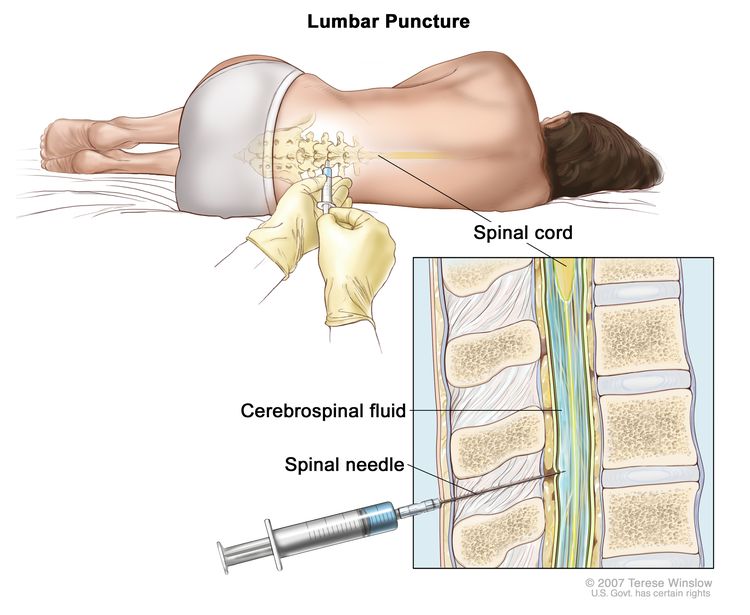
Lumbar puncture. A patient lies in a curled position on a table. After a small area on the lower back is numbed, a spinal needle (a long, thin needle) is inserted into the lower part of the spinal column to remove cerebrospinal fluid (CSF, shown in blue). The fluid may be sent to a laboratory for testing.
- La tomografía computarizada (TC) utiliza una computadora conectada a un equipo de rayos X para generar una serie de imágenes detalladas de áreas internas del cuerpo, como el abdomen. Las imágenes se toman desde diferentes ángulos y se utilizan para crear vistas tridimensionales de tejidos y órganos. Se puede inyectar un tinte en una vena o ingerir para que los órganos o tejidos se visualicen con mayor claridad. Este procedimiento también se denomina tomografía computarizada, tomografía computerizada o tomografía axial computarizada. Más información sobre la tomografía computarizada para el cáncer.
Some people decide to get a second opinion.
Es posible que desee obtener una segunda opinión para confirmar su diagnóstico de LMA y su plan de tratamiento. Si busca una segunda opinión, deberá obtener los resultados de las pruebas médicas y los informes del primer médico para compartirlos con el segundo. El segundo médico revisará el informe patológico, los cortes y las exploraciones. Puede estar de acuerdo con el primer médico, sugerir cambios u otro enfoque de tratamiento, o aportar más información sobre su cáncer.
To learn more about choosing a doctor and getting a second opinion, visit Finding Cancer Care. You can contact NCI’s Cancer Information Service via chat, email, or phone (both in English and Spanish) for help finding a doctor, hospital, or getting a second opinion. For questions you might want to ask at your appointments, visit Questions to Ask Your Doctor about Cancer.
Certain factors affect prognosis (chance of recovery) and treatment options.
El pronóstico y las opciones de tratamiento para la leucemia mieloide aguda dependen de:
- the person's age
- Si la leucemia se ha extendido al SNC
- Si el paciente tiene una infección sistémica en el momento del diagnóstico
- Si el paciente tiene un recuento muy elevado de glóbulos blancos en el momento del diagnóstico
- El subtipo de leucemia mieloide aguda
- Si el paciente recibió quimioterapia o radioterapia en el pasado para tratar otro cáncer
- Si hay antecedentes de un trastorno sanguíneo como el síndrome mielodisplásico
- Si el cáncer ha sido tratado anteriormente o ha reaparecido (regresado)
Es importante tratar la LMA de inmediato. Una edad avanzada en el momento del diagnóstico puede estar asociada a tasas de remisión más bajas y más complicaciones.
Estadios de la leucemia mieloide aguda
Puntos clave
- No existe un sistema de estadificación estándar para la leucemia mieloide aguda (LMA).
No existe un sistema de estadificación estándar para la leucemia mieloide aguda (LMA).
La extensión o propagación del cáncer generalmente se describe como estadios. En lugar de estadios, el tratamiento de la LMA se basa en uno o más de los siguientes factores:
- El subtipo de LMA
- Si la leucemia se ha extendido fuera de la sangre y la médula ósea
- ya sea que la leucemia sea de diagnóstico reciente, esté en remisión, sea refractaria o recurrente.
LMA recién diagnosticada (no tratada)
En la LMA no tratada, la enfermedad se diagnostica recientemente. No se ha tratado excepto para aliviar signos y síntomas como fiebre, sangrado o dolor, y se cumplen las siguientes condiciones:
- The complete blood count (CBC) is abnormal.
- Al menos el 20 % de las células de la médula ósea son blastos (células leucémicas) o existen ciertos cambios genéticos.
- Hay signos o síntomas de leucemia.
LMA en remisión
En la LMA en remisión, la enfermedad ha sido tratada y se cumplen las siguientes condiciones:
- The CBC is normal.
- Menos del 5 % de las células de la médula ósea son blastos (células leucémicas).
- No hay signos ni síntomas de leucemia en el cerebro y la médula espinal ni en ninguna otra parte del cuerpo.
LMA refractaria o recurrente
Tras el tratamiento con quimioterapia, algunas personas con leucemia mieloide aguda (LMA) recién diagnosticada no entran en remisión. Esto se denomina cáncer refractario . En cambio, la LMA recurrente es un cáncer que ha reaparecido tras la remisión. La LMA puede reaparecer en la sangre o la médula ósea.
Learn more in Recurrent Cancer: When Cancer Comes Back.
Treatment Option Overview
Puntos clave
- Existen diferentes tipos de tratamiento para personas con leucemia mieloide aguda (LMA).
- El tratamiento de la LMA suele tener dos fases.
- Los pacientes reciben atención de apoyo para los efectos secundarios del tratamiento.
- The following types of treatment are used:
- Quimioterapia
- Radioterapia
- Chemotherapy with stem cell transplant
- Terapia dirigida
- Otras terapias farmacológicas
- New types of treatment are being tested in clinical trials.
- El tratamiento de la leucemia mieloide aguda puede causar efectos secundarios.
- Es posible que se necesiten cuidados de seguimiento.
Existen diferentes tipos de tratamiento para personas con leucemia mieloide aguda (LMA).
Existen diferentes tipos de tratamientos para las personas con LMA. Usted y su equipo de atención médica del cáncer trabajarán juntos para determinar su plan de tratamiento, que puede incluir más de un tipo. Se considerarán diversos factores, como la fase del cáncer, su estado de salud general y sus preferencias. Su plan incluirá información sobre su cáncer, los objetivos del tratamiento, sus opciones de tratamiento, los posibles efectos secundarios y la duración prevista del mismo.
Antes de iniciar el tratamiento, le resultará útil hablar con su equipo de atención médica del cáncer sobre lo que puede esperar. Querrá saber qué tiene que hacer antes de empezar el tratamiento, cómo se sentirá durante el mismo y qué tipo de ayuda necesitará. Obtenga más información en Preguntas para el médico sobre el tratamiento .
El tratamiento de la LMA suele tener dos fases.
Existen dos fases de tratamiento de la LMA:
- La terapia de inducción a la remisión es la primera fase del tratamiento. El objetivo es eliminar las células leucémicas de la sangre y la médula ósea . Esto provoca la remisión de la leucemia.
- La terapia de consolidación es la segunda fase del tratamiento. Comienza una vez que la leucemia está en remisión. El objetivo de la terapia de consolidación es eliminar las células leucémicas restantes que, aunque no estén activas, podrían regenerarse y provocar una recaída . Esta fase también se conoce como terapia de continuación de la remisión.
Los pacientes reciben atención de apoyo para los efectos secundarios del tratamiento.
Los pacientes deben ser monitoreados de cerca durante el tratamiento de la LMA. La mielosupresión, un trastorno que provoca una disminución de glóbulos rojos, glóbulos blancos y plaquetas, es un efecto secundario tanto de la LMA como del tratamiento con quimioterapia. Los cuidados de apoyo durante la terapia de inducción a la remisión pueden incluir:
- Transfusiones de glóbulos rojos y plaquetas para reemplazar las células sanguíneas destruidas por el cáncer o su tratamiento
- antibióticos y antifúngicos para prevenir o tratar infecciones
The following types of treatment are used:
Quimioterapia
La quimioterapia (también llamada quimio) utiliza medicamentos para detener el crecimiento de las células cancerosas, ya sea matándolas o impidiendo que se dividan. La forma en que se administra la quimioterapia depende del subtipo de LMA que se está tratando y de si las células leucémicas se han extendido al sistema nervioso central (SNC; cerebro y médula espinal).
Systemic chemotherapy is when chemotherapy drugs are taken by mouth or injected into a vein or muscle. When given this way, the drugs enter the bloodstream and can reach cancer cells throughout the body.
Los medicamentos de quimioterapia sistémica utilizados para tratar la leucemia mieloide aguda incluyen:
- Azacitidina
- Citarabina
- daunorrubicina
- daunorrubicina y citarabina
- Decitabina
- idarubicina
- Midostaurina
- mitoxantrona
Combinations of these drugs may be used. Other chemotherapy drugs not listed here may also be used.
La quimioterapia intratecal se puede usar para tratar la LMA que se ha extendido al SNC (cerebro y médula espinal). La quimioterapia intratecal es un método para colocar la quimioterapia directamente en el líquido cefalorraquídeo, que es el líquido que rodea el cerebro y la médula espinal. Este enfoque se utiliza porque la barrera hematoencefálica, una capa protectora que rodea el cerebro, puede impedir que los medicamentos de quimioterapia administrados por vía oral o intravenosa lleguen al SNC.
La citarabina y el metotrexato son dos fármacos de quimioterapia que se administran como quimioterapia intratecal para tratar la LMA. Estos medicamentos también se pueden administrar por vía sistémica.
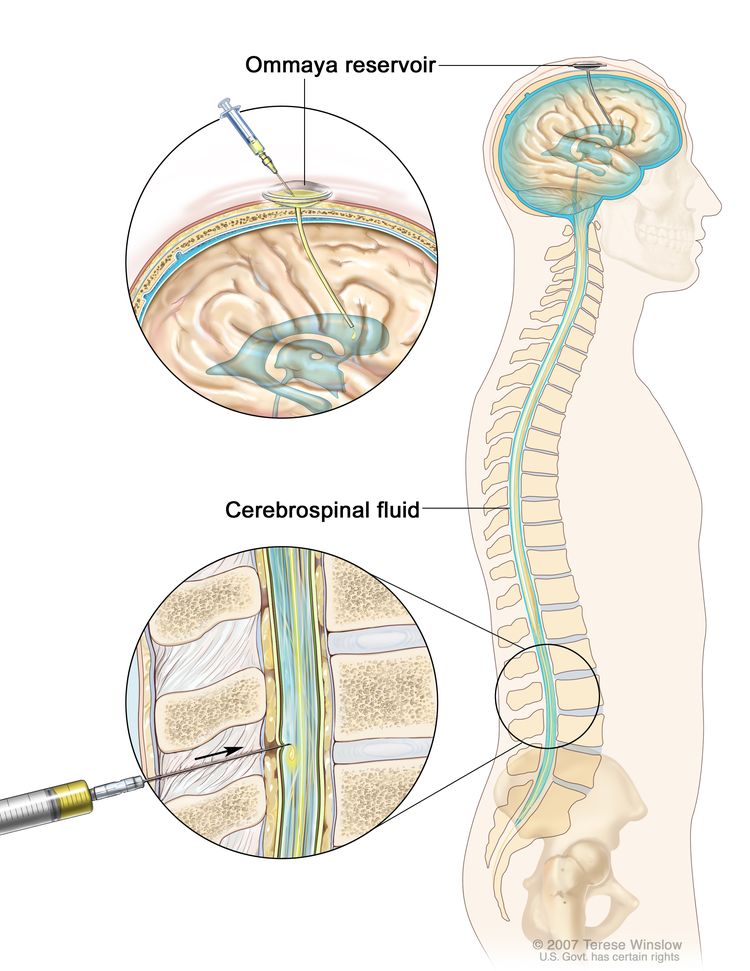
Intrathecal chemotherapy. Anticancer drugs are injected into the intrathecal space, which is the space that holds the cerebrospinal fluid (CSF, shown in blue). There are two different ways to do this. One way, shown in the top part of the figure, is to inject the drugs into an Ommaya reservoir (a dome-shaped container that is placed under the scalp during surgery; it holds the drugs as they flow through a small tube into the brain). The other way, shown in the bottom part of the figure, is to inject the drugs directly into the CSF in the lower part of the spinal column, after a small area on the lower back is numbed.
Para obtener más información sobre cómo funciona la quimioterapia, cómo se administra, los efectos secundarios comunes y mucho más, visite Quimioterapia para tratar el cáncer y Quimioterapia y usted: Apoyo para personas con cáncer .
Radioterapia
La radioterapia utiliza rayos X de alta energía u otros tipos de radiación para destruir las células cancerosas o impedir su crecimiento. La leucemia mieloide aguda (LMA) a veces se trata con radioterapia externa . Este tipo de radioterapia utiliza una máquina externa para enviar radiación hacia la zona afectada por el cáncer. La irradiación corporal total envía radiación a todo el cuerpo. Es un tipo de radiación externa que puede utilizarse para preparar el cuerpo para un trasplante de células madre cuando la leucemia ha reaparecido .
Learn more about External Beam Radiation Therapy for Cancer and Radiation Therapy Side Effects.
Chemotherapy with stem cell transplant
Se administran altas dosis de quimioterapia para eliminar las células cancerosas. Las células sanas, incluidas las hematopoyéticas, también se destruyen durante el tratamiento. El trasplante de células madre es un tratamiento para reemplazar las células hematopoyéticas. Las células madre (células sanguíneas inmaduras) se extraen de la sangre o la médula ósea del paciente o de un donante, se congelan y se almacenan. Una vez que el paciente completa la quimioterapia o la radioterapia corporal total, las células madre almacenadas se descongelan y se le reinfunden mediante una infusión . Estas células madre reinfundidas se desarrollan y regeneran las células sanguíneas del cuerpo.
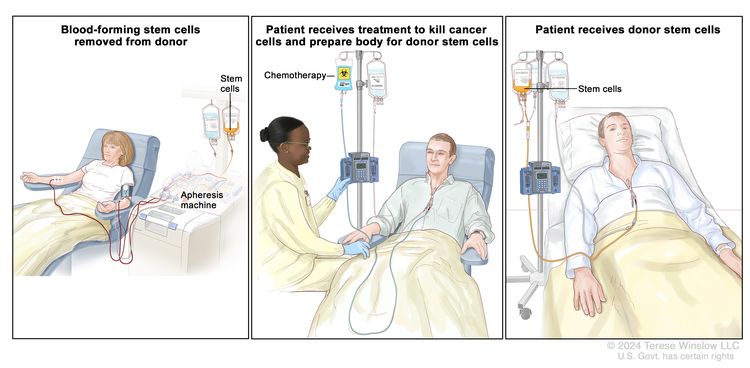
Trasplante de células madre de un donante. (Paso 1): Cuatro o cinco días antes de la recolección de células madre del donante, este recibe un medicamento para aumentar la cantidad de células madre que circulan por su torrente sanguíneo (no se muestra en la imagen). Las células madre hematopoyéticas se extraen del donante a través de una vena grande del brazo. La sangre fluye a través de una máquina de aféresis que extrae las células madre. El resto de la sangre se devuelve al donante a través de una vena del otro brazo. (Paso 2): El paciente recibe quimioterapia para destruir las células cancerosas y preparar su cuerpo para las células madre del donante. El paciente también puede recibir radioterapia (no se muestra en la imagen). (Paso 3): El paciente recibe una infusión de las células madre del donante.
Obtenga más información sobre los trasplantes de células madre en el tratamiento del cáncer .
Terapia dirigida
Targeted therapy uses drugs or other substances to identify and attack specific cancer cells. Your doctor may suggest biomarker tests to help predict your response to certain targeted therapy drugs. Learn more about Biomarker Testing for Cancer Treatment.
Las terapias dirigidas utilizadas para tratar la LMA incluyen:
Las terapias dirigidas menos intensivas en personas que no pueden o no quieren recibir otros tratamientos incluyen:
Obtenga más información en Terapia dirigida para tratar el cáncer.
Otras terapias farmacológicas
El trióxido de arsénico y el ácido retinoico totalmente trans (ATRA) son fármacos anticancerígenos que destruyen las células leucémicas, impiden su división o favorecen su maduración hasta convertirse en glóbulos blancos. Estos fármacos se utilizan en el tratamiento de un subtipo de LMA denominado leucemia promielocítica aguda .
New types of treatment are being tested in clinical trials.
For some people, joining a clinical trial may be an option. There are different types of clinical trials for people with cancer. For example, a treatment trial tests new treatments or new ways of using current treatments. Supportive care and palliative care trials look at ways to improve quality of life, especially for those who have side effects from cancer and its treatment.
You can use the clinical trial search to find NCI-supported cancer clinical trials accepting participants. The search allows you to filter trials based on the type of cancer, your age, and where the trials are being done. Clinical trials supported by other organizations can be found on the ClinicalTrials.gov website.
Para más información sobre ensayos clínicos, cómo encontrarlos y participar en uno de ellos, visite la web Información sobre estudios clínicos para pacientes y cuidadores.
El tratamiento de la leucemia mieloide aguda puede causar efectos secundarios.
For information about side effects caused by treatment for cancer, visit our Side Effects page.
Es posible que se necesiten cuidados de seguimiento.
A medida que avanza el tratamiento, se le realizarán pruebas o controles de seguimiento. Es posible que se repitan algunas pruebas para diagnosticar o estadificar el cáncer con el fin de evaluar cómo está funcionando el tratamiento. Las decisiones sobre si continuar, modificar o suspender el tratamiento pueden basarse en los resultados de estas pruebas.
Algunas pruebas seguirán realizándose de manera periódica después de terminar el tratamiento. Los resultados pueden indicar si su afección ha cambiado o si el cáncer ha redicivado (regresado).
Tratamiento de la leucemia mieloide aguda no tratada
El tratamiento estándar de la leucemia mieloide aguda (LMA) no tratada durante la fase de {{2}inducción de la remisión{{/2}} depende del subtipo de LMA y puede incluir:
- quimioterapia combinada que incluye citarabina
- Quimioterapia combinada con terapia dirigida ( midostaurina o quizartinib ), para personas cuya LMA tiene una mutación en el gen FLT3.
- Quimioterapia combinada con el medicamento de terapia dirigida gemtuzumab ozogamicina
- Quimioterapia intratecal (citarabina o metotrexato), para la leucemia del sistema nervioso central (SNC)
- Atención de apoyo
Para los adultos mayores o las personas que no pueden o no desean recibir quimioterapia intensiva, se puede continuar con lo siguiente mientras la persona se beneficie o hasta que aparezcan efectos tóxicos:
- terapia dirigida ( enasidenib, gilteritinib, glasdegib, ivosidenib o venetoclax)
- quimioterapia a dosis bajas ( azacitidina, citarabina a dosis bajas o decitabina )
- Terapia dirigida con quimioterapia de dosis baja
- Quimioterapia intratecal, para la leucemia del SNC
- Atención de apoyo
Learn more about these treatments in the Treatment Option Overview.
Puede utilizar la búsqueda de ensayos clínicos y encontrar ensayos clínicos sobre cáncer patrocinados por el NCI que acepten participantes. La búsqueda le permite filtrar los ensayos según el tipo de cáncer, la edad y el lugar donde se realizan los ensayos. También encontrará información general sobre los ensayos clínicos.
Tratamiento de la leucemia mieloide aguda en remisión
El tratamiento de la leucemia mieloide aguda (LMA) durante la fase de remisión depende del subtipo de LMA y puede incluir:
- quimioterapia combinada que incluye citarabina
- Terapia de mantenimiento con midostaurina, para personas cuya LMA tiene una mutación en el gen FLT3.
- terapia de mantenimiento con quimioterapia
- quimioterapia de alta dosis y trasplante de células madre utilizando las células madre del paciente.
- quimioterapia de alta dosis, con o sin radioterapia, o terapia de intensidad reducida, seguida de un trasplante de células madre utilizando células madre de un donante.
Más información sobre estos tratamientos en Aspectos generales de las opciones de tratamiento.
Puede utilizar la búsqueda de ensayos clínicos y encontrar ensayos clínicos sobre cáncer patrocinados por el NCI que acepten participantes. La búsqueda le permite filtrar los ensayos según el tipo de cáncer, la edad y el lugar donde se realizan los ensayos. También encontrará información general sobre los ensayos clínicos.
Tratamiento de la leucemia mieloide aguda refractaria o recurrente
No existe un tratamiento estándar para la leucemia mieloide aguda (LMA) refractaria o recurrente . El tratamiento depende del subtipo de LMA y puede incluir:
- Quimioterapia combinada
- Terapia dirigida con enasidenib, gemtuzumab ozogamicina, gilteritinib, ivosidenib o revumenib
- Trasplante de células madre utilizando células madre de donante
Learn more about these treatments in the Treatment Option Overview.
Puede utilizar la búsqueda de ensayos clínicos y encontrar ensayos clínicos sobre cáncer patrocinados por el NCI que acepten participantes. La búsqueda le permite filtrar los ensayos según el tipo de cáncer, la edad y el lugar donde se realizan los ensayos. También encontrará información general sobre los ensayos clínicos.
Tratamiento de la leucemia promielocítica aguda
El tratamiento de la leucemia promielocítica aguda (LPA) recién diagnosticada puede incluir:
- ácido retinoico totalmente trans (ATRA) más trióxido de arsénico (ATO), para enfermedades de bajo riesgo a riesgo intermedio
- ATRA más quimioterapia combinada, seguida de ATO, para enfermedades de alto riesgo .
Learn more about these treatments in the Treatment Option Overview.
Puede utilizar la búsqueda de ensayos clínicos y encontrar ensayos clínicos sobre cáncer patrocinados por el NCI que acepten participantes. La búsqueda le permite filtrar los ensayos según el tipo de cáncer, la edad y el lugar donde se realizan los ensayos. También encontrará información general sobre los ensayos clínicos.
Tratamiento de la leucemia promielocítica aguda recurrente
El tratamiento de la leucemia promielocítica aguda (LPA) recurrente puede incluir:
- trióxido de arsénico (ATO) con o sin quimioterapia
- trasplante de células madre utilizando células madre del paciente o células madre de un donante
Learn more about these treatments in the Treatment Option Overview.
Más información sobre la leucemia
Para obtener más información del National Cancer Institute sobre la leucemia, visite la página de inicio sobre leucemia.
For general cancer information and other resources from the National Cancer Institute, visit:
Sobre este resumen del PDQ
Acerca del PDQ
El Physician Data Query (PDQ) es la base de datos integral sobre el cáncer del National Cancer Institute (NCI). La base de datos del PDQ contiene resúmenes con la última información publicada sobre prevención, detección, genética, tratamiento, atención médica de apoyo y medicina complementaria y alternativa relacionada con el cáncer. La mayoría de los resúmenes se presentan en dos versiones. Las versiones para profesionales de la salud contienen información detallada escrita en lenguaje técnico. Las versiones para pacientes están escritas en un lenguaje fácil de entender y no tan técnico. Ambas versiones contienen información precisa y actualizada sobre el cáncer. La mayoría de las versiones también están disponibles en español.
El PDQ es un servicio del NCI. El NCI es parte de los Institutos Nacionales de Salud (NIH), que son el centro de investigación biomédica del Gobierno federal. Los resúmenes del PDQ se basan en una revisión independiente de la literatura médica. No son declaraciones de políticas del NCI ni de los NIH.
Propósito de este resumen
Este sumario del PDQ sobre el cáncer contiene información actualizada sobre el tratamiento de la leucemia mieloide aguda en adultos. El propósito es informar y ayudar a los pacientes, las familias y los cuidadores. No provee pautas ni recomendaciones formales para tomar decisiones relacionadas con la atención médica.
Revisores y actualizaciones
Los comités editoriales escriben los resúmenes de información sobre el cáncer del PDQ y los mantienen actualizados. Estos comités están formados por equipos de especialistas en el tratamiento del cáncer y otras especialidades relacionadas con esta enfermedad. Los resúmenes se revisan periódicamente y se modifican cuando hay información nueva. La fecha de actualización al pie de cada resumen indica cuándo se realizó el cambio más reciente.
The information in this patient summary was taken from the health professional version, which is reviewed regularly and updated as needed, by the PDQ Adult Treatment Editorial Board.
Información sobre ensayos clínicos
Un ensayo clínico es un estudio para responder a una pregunta científica como, por ejemplo, si un tratamiento es mejor que otro. Los ensayos se basan en estudios anteriores y en lo aprendido en el laboratorio. Cada ensayo responde a determinadas preguntas científicas que permiten encontrar nuevas y mejores formas de ayudar a los pacientes con cáncer. Durante los ensayos clínicos de tratamiento, se recopila información sobre los efectos de un nuevo tratamiento y su eficacia. Si un ensayo clínico demuestra que un nuevo tratamiento es mejor que uno que se utiliza actualmente, el nuevo tratamiento puede convertirse en “estándar”. Los pacientes pueden valorar la posibilidad de participar en un ensayo clínico. Algunos ensayos clínicos solo están abiertos a pacientes que no hayan iniciado el tratamiento.
Los ensayos clínicos se pueden encontrar en línea en el sitio web del NCI. Para obtener más información, llame al Servicio de Información sobre el Cáncer (CIS, por sus siglas en inglés), el centro de contacto del NCI, al 1-800-4-CANCER (1-800-422-6237).
Permiso de uso de este resumen
Physician Data Query (PDQ) es una marca registrada. Se autoriza el libre uso del contenido de los documentos del PDQ como texto. Sin embargo, no se podrá identificar como un resumen de información sobre cáncer del PDQ del NCI, salvo que se reproduzca en su totalidad y se actualice con regularidad. Por otra parte, se permite que los autores incluyan una oración como “en el resumen del PDQ del NCI sobre la prevención del cáncer de mama se describen, de manera concisa, los siguientes riesgos: [incluir fragmento del resumen]”.
La forma recomendada para citar este resumen del PDQ es:
Comité editorial de tratamiento de adultos de PDQ®. PDQ Tratamiento de la leucemia mieloide aguda. Bethesda, MD: Instituto Nacional del Cáncer. Actualizado
Las imágenes de este resumen se utilizan con el permiso del autor, artista y/o editorial para uso exclusivo en los resúmenes del PDQ. Si desea usar una imagen de un resumen del PDQ sin incluir el resumen completo, debe obtener autorización del propietario. El National Cancer Institute no puede otorgar dicho permiso. Para obtener más información sobre el uso de las imágenes de este resumen o de otras ilustraciones relacionadas con el cáncer, consulte Visuals Online, una colección de más de 3,000 imágenes científicas.
Descargo de responsabilidad
La información de estos resúmenes no debe utilizarse para tomar decisiones sobre reembolsos de seguros. Puede encontrar más información sobre la cobertura de seguros en Cancer.gov en el sitio Manejo de la atención del cáncer.
Contáctenos
Puede encontrar más información sobre cómo contactarnos o recibir ayuda en el sitio web Cancer.gov en la página Comuníquese con el NCI. También puede enviar sus preguntas a Cancer.gov en el apartado Escríbanos del sitio web.
Actualizado:
URL de origen: https://www.cancer.gov/node/4645/syndication
Agencia de origen: National Cancer Institute (NCI)
Fecha de captura: 2013-09-14 09:02:21.0