






Metastatic Squamous Neck Cancer
Access exceptional care for metastatic squamous neck cancer and other types of head and neck cancers at Montefiore Einstein Comprehensive Cancer Center. Our multidisciplinary team has extensive experience caring for this cancer. As one of the first NCI-designated cancer centers, for more than 50 years, we’ve been a leader in the research, diagnosis and treatment of over 200 types of cancer.
The Montefiore Einstein Comprehensive Cancer Center team has a skilled approach to the diagnosis and treatment of metastatic squamous neck cancer and other types of Cánceres de cabeza y cuello. Employing a multidisciplinary approach, medical experts from various disciplines collaborate to provide patients with the most effective, individualized treatment plan possible.
When it comes to ensayos clínicos, the head and neck cancer clinical research team brings trials for all types of head and neck cancer. Whatever the stage of your cancer, they can connect you to innovative therapies that hold the promise of being effective and preserving your quality of life.
If you need metastatic squamous neck cancer care, turn to our providers, who are passionate about ending cancer and addressing your whole health needs.

El Montefiore Einstein Comprehensive Cancer Center, designado como centro integral del cáncer por el National Cancer Institute (NCI), apoya la misión y las normas del NCI. La siguiente información sobre los tipos de cáncer, prevención y tratamientos ha sido facilitada por el NCI.
Cáncer escamoso de cuello metastásico con tratamiento primario oculto (PDQ®): versión para pacientes
Información general sobre el cáncer de cuello escamoso metastásico con tumor primario oculto
Puntos clave
- El cáncer de cuello escamoso metastásico con tumor primario oculto es una enfermedad en la que el cáncer de células escamosas se propaga a los ganglios linfáticos del cuello y no se sabe dónde se originó el cáncer que envió esas células, es decir, el tumor primario.
- Los signos y síntomas del cáncer de cuello escamoso metastásico con tumor primario oculto pueden ser un bulto o dolor en el cuello o la garganta.
- Las pruebas que examinan los tejidos del cuello, las vías respiratorias y la parte superior del tubo digestivo se utilizan para detectar (encontrar) y diagnosticar el cáncer de cuello escamoso metastásico y el tumor primario.
- Certain factors affect prognosis (chance of recovery) and treatment options.
El cáncer de cuello escamoso metastásico con tumor primario oculto es una enfermedad en la que el cáncer de células escamosas se propaga a los ganglios linfáticos del cuello y no se sabe dónde se originó el cáncer que envió esas células, es decir, el tumor primario.
Las células escamosas son células delgadas y planas que se encuentran en los tejidos que forman la superficie de la piel y el revestimiento de las cavidades corporales como la boca, los órganos huecos como el útero y los vasos sanguíneos, y el revestimiento de los tractos respiratorio (respiración) y digestivo. Algunos órganos con células escamosas son el esófago, los pulmones, los riñones y el útero. El cáncer puede comenzar en las células escamosas de cualquier parte del cuerpo y metastatizarse (diseminarse) a través de la sangre o el sistema linfático a otras partes del cuerpo.
Cuando el cáncer escamocelular se disemina a los ganglios linfáticos del cuello o alrededor de la clavícula, se denomina cáncer escamoso de cuello metastásico. El médico intentará encontrar el tumor primario (el cáncer que se formó por primera vez en el cuerpo), porque el tratamiento del cáncer metastásico es el mismo que el tratamiento del tumor primario. Por ejemplo, cuando el cáncer de pulmón se propaga al cuello, las células cancerosas del cuello son células cancerosas de pulmón y se tratan de la misma manera que el cáncer de pulmón. A veces los médicos no pueden encontrar en qué parte del cuerpo comenzó a crecer el cáncer. Cuando las pruebas no pueden encontrar un tumor primario, se le llama tumor primario oculto (oculto). En muchos casos, el tumor primario nunca se encuentra.
Los signos y síntomas del cáncer de cuello escamoso metastásico con tumor primario oculto pueden ser un bulto o dolor en el cuello o la garganta.
Consulte con su médico si tiene un bulto o dolor en el cuello o la garganta que no desaparece. Estos y otros signos y síntomas pueden ser causados por cáncer de cuello escamoso metastásico con tumor primario oculto. Otras afecciones pueden causar los mismos signos y síntomas.
Las pruebas que examinan los tejidos del cuello, las vías respiratorias y la parte superior del tubo digestivo se utilizan para detectar (encontrar) y diagnosticar el cáncer de cuello escamoso metastásico y el tumor primario.
Las pruebas incluirán la detección de un tumor primario en los órganos y tejidos del tracto respiratorio (parte de la tráquea), la parte superior del tracto digestivo (incluidos los labios, la boca, la lengua, la nariz, la garganta, las cuerdas vocales y parte del esófago) y el sistema genitourinario. Además de preguntarle sobre su historial de salud personal y familiar y realizarle un reconocimiento físico, su médico puede realizar las siguientes pruebas y procedimientos:
- Biopsy: The removal of cells or tissues so they can be viewed under a microscope por un pathologist o probado en el laboratorio para detectar signos de cáncer.
Se pueden hacer tres tipos de biopsia:
- Biopsia mediante punción aspiración con aguja fina (PAAF): extracción de tejido o líquido mediante una aguja fina
- Biopsia con aguja gruesa: extracción de tejido con una aguja ancha.
- Biopsia escisional: extirpación de un bulto completo de tejido
Los siguientes procedimientos se utilizan para extraer muestras de células o tejido:
- Amigdalectomía: cirugía para extirpar ambas amígdalas.
- Endoscopia: procedimiento para observar órganos y tejidos dentro del cuerpo para detectar áreas anómalas. Un endoscopio se inserta a través de una incisión (corte) en la piel o una abertura en el cuerpo, como la boca o la nariz. Un endoscopio es un instrumento delgado en forma de tubo con una luz y una lente para observar. También puede tener una herramienta para extraer muestras de tejido anormal o de ganglios linfáticos, que se examinan bajo un microscopio para detectar signos de enfermedad. Se revisarán la nariz, la garganta, la parte posterior de la lengua, el esófago, el estómago, la laringe, la tráquea y las vías respiratorias grandes.
Se pueden realizar una o más de las siguientes pruebas de laboratorio para estudiar las muestras de tejido:
- Inmunohistoquímica: prueba de laboratorio que utiliza anticuerpos para detectar ciertos antígenos (marcadores) en una muestra de sangre o médula ósea de un paciente. Los anticuerpos suelen estar unidos a una enzima o un tinte fluorescente. Después de que los anticuerpos se unen a un antígeno específico en la sangre o la médula ósea, se activa la enzima o el tinte y luego se puede observar el antígeno con un microscopio. Este tipo de prueba se usa para ayudar a diagnosticar el cáncer y ayudar a distinguir un tipo de cáncer de otro tipo de cáncer.
- Microscopía óptica y electrónica: prueba en la que las células de una muestra de tejido se observan con microscopios regulares y de alta potencia para buscar ciertos cambios en las células.
- Prueba del virus de Epstein-Barr (VEB) y del virus del papiloma humano (VPH): prueba que examina las células de una muestra de tejido para detectar el VEB y el ADN del VPH.
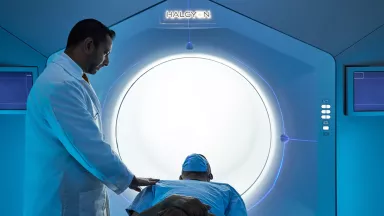
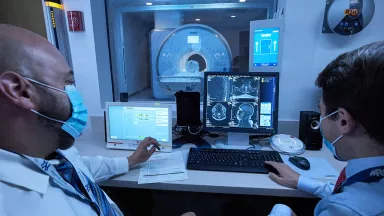
- Resonancia magnética (magnetic resonance imaging): A procedure that uses a magnet, radio waves, and a computer to make a series of detailed pictures of areas inside the body. This procedure is also called nuclear magnetic resonance imaging (NMRI).
- CT scan (CAT scan): A procedure that makes a series of detailed pictures of areas inside the body, taken from different angles. The pictures are made by a computer linked to an x-ray machine. A dye may be inyecta into a vena o ser ingerido a fin de que los órganos o los tejidos se destaquen de forma más clara. Este procedimiento también se llama tomografía computadorizada, tomografía axial computarizada (TAC) o exploración por TAC.
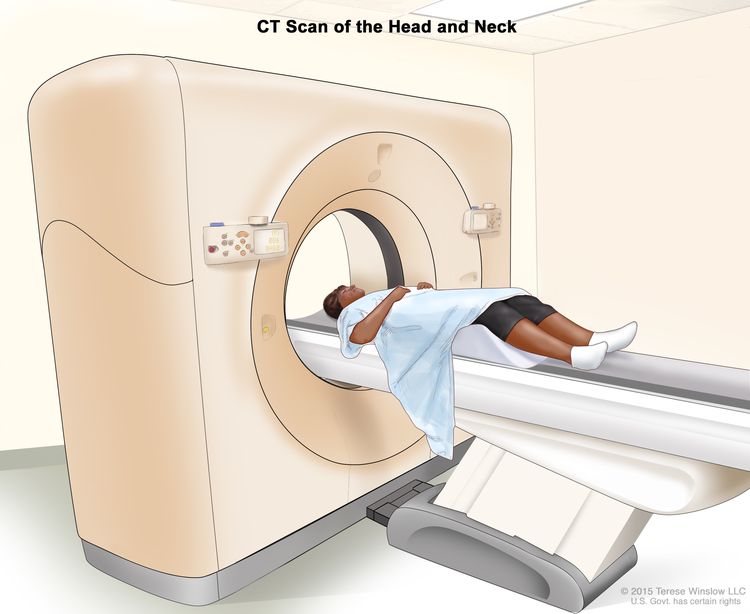
Computed tomography (CT) scan of the head and neck. The patient lies on a table that slides through the CT scanner, which takes x-ray pictures of the inside of the head and neck.
- Tomografía por emisión de positrones (PET): procedimiento para detectar células tumorales malignas en el cuerpo. Se inyecta una pequeña cantidad de glucosa radiactiva (azúcar) en una vena. El escáner PET gira alrededor del cuerpo y genera una imagen de las zonas donde se utiliza la glucosa. Las células tumorales malignas se ven más brillantes en la imagen porque son más activas y absorben más glucosa que las células normales. Se realizan simultáneamente una PET de cuerpo entero y una tomografía computarizada para identificar el lugar donde se formó el cáncer. Si hay cáncer, aumenta la probabilidad de detectarlo.
Se realiza un diagnóstico de tumor primario oculto si no se encuentra el tumor primario durante las pruebas o el tratamiento.
Certain factors affect prognosis (chance of recovery) and treatment options.
The prognosis and treatment options depend on:
- La cantidad y el tamaño de los ganglios linfáticos que tienen cáncer.
- Si el cáncer ha respondido al tratamiento o ha recidivado (regresado).
- Cuán diferentes de las células cancerosas normales se ven bajo un microscopio.
- The patient's age and general health.
Las opciones de tratamiento también dependen de:
- En qué parte del cuello está el cáncer.
- Si se encuentran ciertos marcadores tumorales.
Estadios del cáncer de cuello escamoso metastásico con tumor oculto
primario
Puntos clave
- Después de que se diagnostica el cáncer de cuello escamoso metastásico con tumor primario oculto, se realizan pruebas para determinar si las células cancerosas se diseminaron a otras partes del cuerpo.
- There are three ways that cancer spreads in the body.
- El cáncer de cuello escamoso metastásico con tumor primario oculto puede recidivar (regresar) después de haber sido tratado.
Después de que se diagnostica el cáncer de cuello escamoso metastásico con tumor primario oculto, se realizan pruebas para determinar si las células cancerosas se diseminaron a otras partes del cuerpo.
El proceso utilizado para determinar si el cáncer se ha propagado a otras partes del cuerpo se denomina estadificación. No existe un sistema de estadificación estándar para el cáncer de cuello escamoso metastásico con tumor primario oculto. Dependiendo de si el cáncer fue causado por el virus del papiloma humano 16 o el virus de Epstein-Barr, se puede utilizar la estadificación orofaríngea o nasofaríngea. Para obtener más información, visite la sección Información sobre los estadios del cáncer de cuello escamoso metastásico con tumor primario oculto en la versión para profesionales de la salud de esta página.
Los resultados de las pruebas y procedimientos utilizados para detectar y diagnosticar el tumor primario también se utilizan para determinar si el cáncer se ha diseminado a otras partes del cuerpo.
There are three ways that cancer spreads in the body.
Cancer can spread through tissue, the lymph system, and the blood:
- Tissue. The cancer spreads from where it began by growing into nearby areas.
- Lymph system. The cancer spreads from where it began by getting into the lymph system. The cancer travels through the lymph vessels to other parts of the body.
- Blood. The cancer spreads from where it began by getting into the blood. The cancer travels through the blood vessels to other parts of the body.
El cáncer de cuello escamoso metastásico con tumor primario oculto puede recidivar (regresar) después de haber sido tratado.
El cáncer puede volver al cuello o a otras partes del cuerpo.
Treatment Option Overview
Puntos clave
- Existen diferentes tipos de tratamiento para pacientes con cáncer de cuello escamoso metastásico con tumor primario oculto.
- The following types of treatment are used:
- Cirugía
- Radioterapia
- New types of treatment are being tested in clinical trials.
- Quimioterapia
- Radioterapia hiperfraccionada
- El tratamiento del cáncer de cuello escamoso metastásico con tumor primario oculto puede causar efectos secundarios.
- Patients may want to think about taking part in a clinical trial.
- Patients can enter clinical trials before, during, or after starting their cancer treatment.
- Es posible que se necesiten cuidados de seguimiento.
Existen diferentes tipos de tratamiento para pacientes con cáncer de cuello escamoso metastásico con tumor primario oculto.
Existen diferentes tipos de tratamiento disponibles para pacientes con cáncer de cuello escamoso metastásico con tumor primario oculto. Algunos tratamientos son estándar (el tratamiento que se utiliza actualmente) y otros se están probando en ensayos clínicos. Un ensayo clínico de tratamiento es un estudio de investigación cuyo objetivo es mejorar los tratamientos actuales u obtener información sobre nuevos tratamientos para pacientes con cáncer. Cuando los ensayos clínicos demuestran que un nuevo tratamiento es mejor que el tratamiento estándar, este puede convertirse en el estándar. Los pacientes podrían considerar participar en un ensayo clínico. Algunos ensayos clínicos están abiertos solo a pacientes que no han comenzado el tratamiento.
The following types of treatment are used:
Cirugía
La cirugía puede incluir disección del cuello. Existen diferentes tipos de disección del cuello, según la cantidad de tejido que se extrae.
- Disección radical del cuello: cirugía para extirpar tejidos en uno o ambos lados del cuello entre la mandíbula y la clavícula, incluidos:
- Todos los ganglios linfáticos
- La vena yugular
- Músculos y nervios que se utilizan para el movimiento, de la cara, el cuello y los hombros, el habla y la deglución.
- Disección radical modificada del cuello: cirugía para extirpar todos los ganglios linfáticos de uno o ambos lados del cuello sin extirpar los músculos del cuello. Se pueden extirpar los nervios y/o la vena yugular.
- Disección parcial del cuello: cirugía para extirpar algunos de los ganglios linfáticos del cuello. Esto también se llama disección selectiva del cuello.
Después de que el médico extirpa todo el cáncer que se puede observar en el momento de la cirugía, es posible que a algunos pacientes se les administre radioterapia después de la cirugía para destruir las células cancerosas que queden. El tratamiento administrado después de la cirugía, para reducir el riesgo de que el cáncer regrese, se llama terapia adyuvante.
Radioterapia
La radioterapia es un tratamiento contra el cáncer que utiliza rayos X de alta energía u otros tipos de radiación para matar las células cancerosas o evitar que crezcan. La radioterapia externa utiliza una máquina fuera del cuerpo para enviar radiación hacia el área del cuerpo con cáncer. La radioterapia de intensidad modulada (IMRT) es un tipo de radioterapia externa tridimensional (3-D) que utiliza una computadora para generar imágenes del tamaño y la forma del tumor. Se dirigen rayos finos de radiación de diferentes intensidades (fuerzas) al tumor desde muchos ángulos. Es menos probable que este tipo de radioterapia cause sequedad en la boca, dificultad para tragar y daño a la piel.
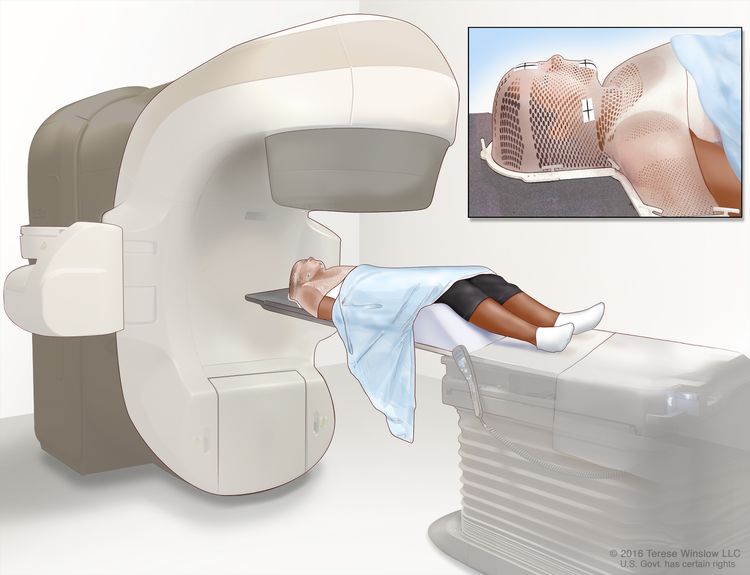
Radioterapia externa de cabeza y cuello. Se utiliza una máquina para dirigir radiación de alta energía hacia el cáncer. La máquina puede girar alrededor del paciente y administrar la radiación desde muchos ángulos diferentes para lograr un tratamiento altamente conformado. Una máscara de malla ayuda a mantener la cabeza y el cuello del paciente inmóviles durante el tratamiento. Se colocan pequeñas marcas de tinta en la máscara. Las marcas de tinta se utilizan para alinear la máquina de radiación en la misma posición antes de cada tratamiento.
La radioterapia dirigida al cuello puede cambiar la forma en que funciona la glándula tiroides . Se pueden realizar análisis de sangre para verificar el nivel de la hormona tiroidea en el cuerpo antes del tratamiento y en controles regulares después del tratamiento.
New types of treatment are being tested in clinical trials.
En esta sección se resumen los tratamientos que se están estudiando en ensayos clínicos. Es posible que no se mencionen todos los tratamientos nuevos que se están estudiando. La información sobre los ensayos clínicos está disponible en el sitio web del NCI.
Quimioterapia
La quimioterapia es un tratamiento contra el cáncer que utiliza medicamentos para detener el crecimiento de las células cancerosas, ya sea matándolas o impidiendo que se dividan. Cuando la quimioterapia se toma por vía oral o se inyecta en una vena o músculo, los medicamentos ingresan al torrente sanguíneo y pueden llegar a las células cancerosas de todo el cuerpo (quimioterapia sistémica).
Radioterapia hiperfraccionada
La radioterapia hiperfraccionada es un tipo de tratamiento de radiación externa en el que una dosis diaria total de radiación menor que la habitual se divide en dos dosis y los tratamientos se administran dos veces al día. La radioterapia hiperfraccionada se administra durante el mismo período de tiempo (días o semanas) que la radioterapia estándar.
El tratamiento del cáncer de cuello escamoso metastásico con tumor primario oculto puede causar efectos secundarios.
For information about side effects caused by treatment for cancer, visit our Side Effects page.
Patients may want to think about taking part in a clinical trial.
For some patients, taking part in a clinical trial may be the best treatment choice. Clinical trials are part of the cancer research process. Clinical trials are done to find out if new cancer treatments are safe and effective or better than the standard treatment.
Many of today's standard treatments for cancer are based on earlier clinical trials. Patients who take part in a clinical trial may receive the standard treatment or be among the first to receive a new treatment.
Patients who take part in clinical trials also help improve the way cancer will be treated in the future. Even when clinical trials do not lead to effective new treatments, they often answer important questions and help move research forward.
Patients can enter clinical trials before, during, or after starting their cancer treatment.
Some clinical trials only include patients who have not yet received treatment. Other trials test treatments for patients whose cancer has not gotten better. There are also clinical trials that test new ways to stop cancer from recurring (coming back) or reduce the side effects of cancer treatment.
Clinical trials are taking place in many parts of the country. Information about clinical trials supported by NCI can be found on NCI’s clinical trials search webpage. Clinical trials supported by other organizations can be found on the ClinicalTrials.gov website.
Es posible que se necesiten cuidados de seguimiento.
A medida que avanza el tratamiento, se le realizarán pruebas o controles de seguimiento. Es posible que se repitan algunas pruebas para diagnosticar o estadificar el cáncer con el fin de evaluar cómo está funcionando el tratamiento. Las decisiones sobre si continuar, modificar o suspender el tratamiento pueden basarse en los resultados de estas pruebas.
Algunas pruebas seguirán realizándose de manera periódica después de terminar el tratamiento. Los resultados pueden indicar si su afección ha cambiado o si el cáncer ha redicivado (regresado).
Tratamiento del cáncer de cuello escamoso metastásico no tratado con tumor primario oculto
Los pacientes con cáncer de cuello escamoso metastásico con tumor primario oculto no tratado no han recibido tratamiento, salvo para aliviar los signos y síntomas causados por el cáncer. Para obtener información sobre los tratamientos que se enumeran a continuación, visite la sección Resumen de opciones de tratamiento.
El tratamiento del cáncer de cuello escamoso metastásico no tratado con tumor primario oculto puede incluir:
- Radioterapia.
- Cirugía
- Radioterapia seguida de cirugía
- Un ensayo clínico de quimioterapia seguida de radioterapia.
- Un ensayo clínico de quimioterapia administrada al mismo tiempo que la radioterapia hiperfraccionada
- Ensayos clínicos de nuevos tratamientos
Puede utilizar la búsqueda de ensayos clínicos y encontrar ensayos clínicos sobre cáncer patrocinados por el NCI que acepten participantes. La búsqueda le permite filtrar los ensayos según el tipo de cáncer, la edad y el lugar donde se realizan los ensayos. También encontrará información general sobre los ensayos clínicos.
Tratamiento del cáncer de cuello escamoso metastásico recidivante con tumor primario oculto
For information about the treatments listed below, visit the Treatment Option Overview section.
El tratamiento del cáncer escamoso de cuello metastásico con primario oculto que recidiva (regresa) después del tratamiento generalmente se realiza dentro de un ensayo clínico.
Puede utilizar la búsqueda de ensayos clínicos y encontrar ensayos clínicos sobre cáncer patrocinados por el NCI que acepten participantes. La búsqueda le permite filtrar los ensayos según el tipo de cáncer, la edad y el lugar donde se realizan los ensayos. También encontrará información general sobre los ensayos clínicos.
Más información sobre el cáncer de cuello escamoso metastásico con tumor primario oculto
Para obtener más información del National Cancer Institute sobre el cáncer de cuello escamoso metastásico con tumor primario oculto, visite:
- Carcinoma de página de inicio primaria desconocida
- Página de inicio sobre el cáncer de cabeza y cuello
- Oral Complications of Cancer Therapies
- Cáncer metastásico: cuando el cáncer se propaga
For general cancer information and other resources from the National Cancer Institute, visit:
Sobre este resumen del PDQ
Acerca del PDQ
El Physician Data Query (PDQ) es la base de datos integral sobre el cáncer del National Cancer Institute (NCI). La base de datos del PDQ contiene resúmenes con la última información publicada sobre prevención, detección, genética, tratamiento, atención médica de apoyo y medicina complementaria y alternativa relacionada con el cáncer. La mayoría de los resúmenes se presentan en dos versiones. Las versiones para profesionales de la salud contienen información detallada escrita en lenguaje técnico. Las versiones para pacientes están escritas en un lenguaje fácil de entender y no tan técnico. Ambas versiones contienen información precisa y actualizada sobre el cáncer. La mayoría de las versiones también están disponibles en español.
El PDQ es un servicio del NCI. El NCI es parte de los Institutos Nacionales de Salud (NIH), que son el centro de investigación biomédica del Gobierno federal. Los resúmenes del PDQ se basan en una revisión independiente de la literatura médica. No son declaraciones de políticas del NCI ni de los NIH.
Propósito de este resumen
Este resumen del PDQ sobre el cáncer contiene información actualizada sobre el tratamiento del cáncer escamoso metastásico de cuello con tumor primario oculto. El propósito es informar y ayudar a los pacientes, las familias y los cuidadores. No da pautas ni recomendaciones formales para tomar decisiones relacionadas con la atención médica.
Revisores y actualizaciones
Los comités editoriales escriben los resúmenes de información sobre el cáncer del PDQ y los mantienen actualizados. Estos comités están formados por equipos de especialistas en el tratamiento del cáncer y otras especialidades relacionadas con esta enfermedad. Los resúmenes se revisan periódicamente y se modifican cuando hay información nueva. La fecha de actualización al pie de cada resumen indica cuándo se realizó el cambio más reciente.
The information in this patient summary was taken from the health professional version, which is reviewed regularly and updated as needed, by the PDQ Adult Treatment Editorial Board.
Información sobre ensayos clínicos
Un ensayo clínico es un estudio para responder a una pregunta científica como, por ejemplo, si un tratamiento es mejor que otro. Los ensayos se basan en estudios anteriores y en lo aprendido en el laboratorio. Cada ensayo responde a determinadas preguntas científicas que permiten encontrar nuevas y mejores formas de ayudar a los pacientes con cáncer. Durante los ensayos clínicos de tratamiento, se recopila información sobre los efectos de un nuevo tratamiento y su eficacia. Si un ensayo clínico demuestra que un nuevo tratamiento es mejor que uno que se utiliza actualmente, el nuevo tratamiento puede convertirse en “estándar”. Los pacientes pueden valorar la posibilidad de participar en un ensayo clínico. Algunos ensayos clínicos solo están abiertos a pacientes que no hayan iniciado el tratamiento.
Los ensayos clínicos se pueden encontrar en línea en el sitio web del NCI. Para obtener más información, llame al Servicio de Información sobre el Cáncer (CIS, por sus siglas en inglés), el centro de contacto del NCI, al 1-800-4-CANCER (1-800-422-6237).
Permiso de uso de este resumen
Physician Data Query (PDQ) es una marca registrada. Se autoriza el libre uso del contenido de los documentos del PDQ como texto. Sin embargo, no se podrá identificar como un resumen de información sobre cáncer del PDQ del NCI, salvo que se reproduzca en su totalidad y se actualice con regularidad. Por otra parte, se permite que los autores incluyan una oración como “en el resumen del PDQ del NCI sobre la prevención del cáncer de mama se describen, de manera concisa, los siguientes riesgos: [incluir fragmento del resumen]”.
La forma recomendada para citar este resumen del PDQ es:
Comité editorial del PDQ® sobre el tratamiento de adultos. Cáncer escamoso de cuello metastásico con tratamiento primario oculto (PDQ). Bethesda, MD: National Cancer Institute. Actualizado el [DD/MM/AAAA]
Las imágenes de este resumen se utilizan con el permiso del autor, artista y/o editorial para uso exclusivo en los resúmenes del PDQ. Si desea usar una imagen de un resumen del PDQ sin incluir el resumen completo, debe obtener autorización del propietario. El National Cancer Institute no puede otorgar dicho permiso. Para obtener más información sobre el uso de las imágenes de este resumen o de otras ilustraciones relacionadas con el cáncer, consulte Visuals Online, una colección de más de 3,000 imágenes científicas.
Descargo de responsabilidad
La información de estos resúmenes no debe utilizarse para tomar decisiones sobre reembolsos de seguros. Puede encontrar más información sobre la cobertura de seguros en Cancer.gov en el sitio Manejo de la atención del cáncer.
Contáctenos
Puede encontrar más información sobre cómo contactarnos o recibir ayuda en el sitio web Cancer.gov en la página Comuníquese con el NCI. También puede enviar sus preguntas a Cancer.gov en el apartado Escríbanos del sitio web.
Updated:
URL de origen: https://www.cancer.gov/node/4991/syndication
Agencia de origen: National Cancer Institute (NCI)
Captured Date: 2013-09-14 09:02:33.0