




Tratamiento del cáncer de nasofaringe
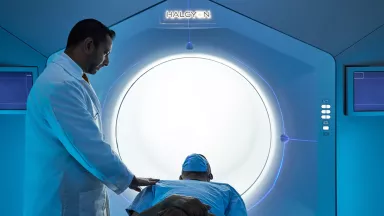
Acceda a una atención excepcional para el cáncer nasofaríngeo y otros tipos de cáncer de cabeza y cuello en el Centro Oncológico Integral Montefiore Einstein. Nuestro equipo multidisciplinario cuenta con amplia experiencia en el tratamiento de este tipo de cáncer. Como uno de los primeros centros oncológicos designados por el NCI, durante más de 50 años hemos sido líderes en la investigación, el diagnóstico y el tratamiento de más de 200 tipos de cáncer.
El equipo de Montefiore Einstein Comprehensive Cancer Center cuenta con un enfoque especializado para el diagnóstico y tratamiento del cáncer de nasofaringe y otros tipos de cáncer de cabeza y cuello. Mediante un enfoque multidisciplinario, expertos médicos de diversas disciplinas colaboran para ofrecer a los pacientes el plan de tratamiento más eficaz e individualizado posible.
Cuando se trata de ensayos clínicos, el equipo de investigación clínica del cáncer de cabeza y cuello ofrece ensayos para todos los tipos de cáncer de cabeza y cuello. Cualquiera que sea la etapa de su cáncer, pueden conectarlo con terapias innovadoras que prometen ser efectivas y preservar su calidad de vida. Por ejemplo, nuestra investigación sobre la función de deglución después de la radiación y la quimioterapia nos ha colocado a la vanguardia de nuestro campo.
Si necesita atención médica con relación al cáncer nasofaríngeo, recurra a nuestros proveedores que están apasionados por erradicar el cáncer y abordar todas sus necesidades de salud.

El Montefiore Einstein Comprehensive Cancer Center, designado como centro integral del cáncer por el National Cancer Institute (NCI), apoya la misión y las normas del NCI. La siguiente información sobre los tipos de cáncer, prevención y tratamientos ha sido facilitada por el NCI.
Tratamiento del cáncer nasofaríngeo (PDQ®) – Versión para el paciente
Información general sobre el cáncer de nasofaringe
Puntos clave
- El cáncer nasofaríngeo es un tipo de cáncer de cabeza y cuello que comienza en los tejidos de la nasofaringe.
- La exposición al virus de Epstein-Barr, la ascendencia y el lugar de residencia pueden influir en el riesgo de padecer cáncer nasofaríngeo.
- Los signos y síntomas del cáncer nasofaríngeo incluyen dificultad para respirar, hablar o oír.
- Para diagnosticar y estadificar el cáncer nasofaríngeo se utilizan pruebas que examinan la nariz, la garganta y los órganos cercanos.
- Algunas personas pueden decidir buscar una segunda opinión.
- Certain factors affect prognosis (chance of recovery) and treatment options.
El cáncer nasofaríngeo es un tipo de cáncer de cabeza y cuello que comienza en los tejidos de la nasofaringe.
La faringe es un tubo hueco en el cuello de aproximadamente 5 pulgadas de largo que está compuesto por tres partes:
- La nasofaringe es la parte superior de la faringe, ubicada detrás de la nariz. Las fosas nasales están conectadas a la nasofaringe. A cada lado de la nasofaringe hay aberturas que dan a los oídos.
- La orofaringe es la parte media, situada debajo de la nasofaringe.
- La hipofaringe es la parte más inferior de la faringe, y se abre tanto a la tráquea como al esófago .
Al respirar o tragar, la faringe actúa como conducto para que el aire llegue a los pulmones y los alimentos al estómago. El cáncer nasofaríngeo suele originarse en las células escamosas que recubren la nasofaringe.
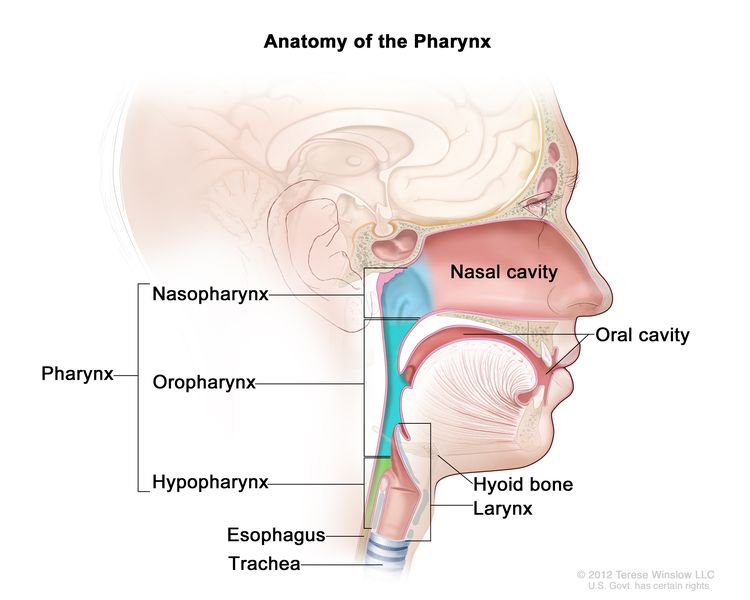
Anatomía de la faringe. La faringe es un tubo muscular hueco dentro del cuello que comienza detrás de la nariz y se abre hacia la laringe y el esófago. Está dividida en tres partes: la nasofaringe, la orofaringe y la hipofaringe.
La exposición al virus de Epstein-Barr, la ascendencia y el lugar de residencia pueden influir en el riesgo de padecer cáncer nasofaríngeo.
El cáncer nasofaríngeo se produce por ciertas alteraciones en el funcionamiento de las células nasofaríngeas, especialmente en su crecimiento y división celular. Existen muchos factores de riesgo para el cáncer nasofaríngeo, pero muchos no lo causan directamente. En cambio, aumentan la probabilidad de daño en el ADN celular, lo que puede derivar en cáncer nasofaríngeo. Para obtener más información sobre el desarrollo del cáncer, visite ¿Qué es el cáncer?
Un factor de riesgo es cualquier elemento que aumenta la probabilidad de contraer una enfermedad. Algunos factores de riesgo para el cáncer de nasofaringe, como el consumo de tabaco, se pueden modificar. Sin embargo, también existen factores de riesgo que no se pueden cambiar, como los antecedentes familiares . Conocer los factores de riesgo del cáncer de nasofaringe puede ayudarle a tomar decisiones que prevengan o reduzcan su riesgo de padecerlo.
Los factores de riesgo para el cáncer de nasofaringe incluyen:
- estar infectado con el virus de Epstein-Barr (VEB)
- vivir en ciertas partes de Asia, el norte de África y el Ártico, o tener ascendencia de esas regiones.
- tener un familiar con cáncer nasofaríngeo
- usar tabaco o respirar humo de segunda mano
- consumo frecuente y excesivo de alcohol
- tener una dieta rica en pescados y carnes curadas en sal porque estos alimentos pueden contener sustancias químicas cancerígenas, como la nitrosamina.
El cáncer nasofaríngeo puede aparecer a cualquier edad. En zonas donde la enfermedad no es común, es más frecuente diagnosticarlo en personas mayores de 50 años. En zonas de alto riesgo, las personas más jóvenes tienen mayor probabilidad de verse afectadas. Los hombres tienden a desarrollar cáncer nasofaríngeo con más frecuencia que las mujeres. En casos excepcionales, el virus del papiloma humano (VPH), especialmente el tipo 16, se ha relacionado con el cáncer nasofaríngeo. Más información sobre el VPH y el cáncer .
Más información sobre el tabaco, incluida ayuda para dejar de fumar.
Los signos y síntomas del cáncer nasofaríngeo incluyen dificultad para respirar, hablar o oír.
Los signos y síntomas del cáncer de nasofaringe pueden variar de una persona a otra. Los primeros signos y síntomas del cáncer de nasofaringe pueden incluir:
- un bulto en el cuello
- Dolor, pulsaciones o zumbido en el oído
- problemas de audición
- dolor de garganta
- congestión nasal
- hemorragias nasales
Los signos y síntomas del cáncer nasofaríngeo avanzado (cáncer nasofaríngeo que se ha diseminado a otras partes del cuerpo) pueden incluir síntomas del cáncer nasofaríngeo en etapa temprana y:
- Desalineación de los ojos (estrabismo)
- visión doble
- dolores de cabeza
- entumecimiento facial
- debilidad facial
Estos problemas pueden deberse a afecciones distintas al cáncer nasofaríngeo. Si presenta alguno de estos problemas, consulte con su médico para determinar la causa e iniciar el tratamiento, si fuera necesario.
Para diagnosticar y estadificar el cáncer nasofaríngeo se utilizan pruebas que examinan la nariz, la garganta y los órganos cercanos.
Si presenta síntomas que sugieren cáncer nasofaríngeo, su médico deberá determinar si se deben a cáncer o a otro problema. Le preguntará cuándo comenzaron los síntomas y con qué frecuencia los ha tenido. También le preguntará sobre sus antecedentes médicos personales y familiares y le realizará un examen físico . Según los resultados, el médico podría recomendarle otras pruebas. Si le diagnostican cáncer nasofaríngeo, los resultados de estas pruebas le ayudarán a usted y a su médico a planificar el tratamiento.
Las siguientes pruebas y procedimientos se utilizan para diagnosticar y estadificar el cáncer de nasofaringe:
- La nasofaringoscopia con biopsia es un procedimiento para examinar el interior de la nariz y la parte posterior de la garganta. El médico introduce un nasofaringoscopio (un tubo delgado, flexible e iluminado) por la nariz y lo avanza hasta la parte posterior de la garganta para buscar áreas anormales. El nasofaringoscopio puede tener un instrumento para extraer una muestra de células o tejido (biopsia) para que un patólogo la examine al microscopio y busque signos de cáncer. Para obtener más información sobre el tipo de información que puede encontrar en el informe de un patólogo acerca de las células o el tejido extraído durante una biopsia, visite Informes de Patología .
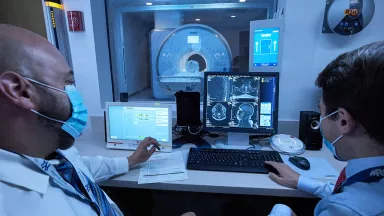
- La resonancia magnética ( RM ) utiliza un imán, ondas de radio y una computadora para crear una serie de imágenes detalladas de áreas internas del cuerpo. Este procedimiento también se conoce como resonancia magnética nuclear (RMN).
- Exploración PET-TC combina imágenes de un tomografía por emisión de positrones (PET) y una tomografía computarizada (TC)Las tomografías PET y CT se realizan simultáneamente en el mismo equipo. Las imágenes combinadas ofrecen una imagen más detallada que la que se obtendría con cualquiera de las pruebas por separado.
- Para la tomografía por emisión de positrones (PET), se inyecta una pequeña cantidad de glucosa radiactiva (azúcar) en una vena. El escáner gira alrededor del cuerpo y crea una imagen de dónde se está utilizando la glucosa. Dado que las células cancerosas suelen absorber más glucosa que las células normales, estas imágenes pueden utilizarse para detectar células cancerosas en el organismo.
- Para la tomografía computarizada (TC), se toman una serie de radiografías detalladas de las áreas internas del cuerpo desde diferentes ángulos. Se puede inyectar un contraste en una vena o ingerirlo para que los órganos o tejidos se visualicen con mayor claridad.
- La prueba del virus de Epstein-Barr (VEB) es un análisis de sangre que detecta anticuerpos y marcadores de ADN presentes en la sangre de personas que han sido infectadas con el VEB.
- La prueba del virus del papiloma humano (VPH) es una prueba de laboratorio que se utiliza para detectar ciertos tipos de infección por VPH en una muestra de tejido. Generalmente, se realiza una prueba de VPH si la prueba del virus de Epstein-Barr (VEB) resulta negativa. Esto se debe a que, en raras ocasiones, el VPH puede causar cáncer nasofaríngeo.
- Un examen neurológico utiliza una serie de preguntas y pruebas para evaluar el funcionamiento del cerebro, la médula espinal y los nervios . El examen evalúa el estado mental, la coordinación, la capacidad para caminar con normalidad y el funcionamiento de los músculos, los sentidos y los reflejos. También se le conoce como examen neurológico.
- Una prueba de audición evalúa la capacidad de oír sonidos suaves y fuertes, así como sonidos graves y agudos. Cada oído se examina por separado. Esta prueba se realiza porque el cáncer nasofaríngeo y su tratamiento pueden afectar la audición. Las pruebas de audición suelen realizarse antes, durante y después del tratamiento.
- El análisis bioquímico de sangre es una prueba de laboratorio que consiste en examinar una muestra de sangre para medir la cantidad de ciertas sustancias que liberan los órganos y tejidos del cuerpo. Una cantidad inusual (superior o inferior a lo normal) de alguna sustancia puede ser un signo de enfermedad.
- Biometría hemática Es una prueba de laboratorio en la que se extrae una muestra de sangre y se analiza para detectar:
- El número de glóbulos rojos, glóbulos blancos y plaquetas
- La cantidad de hemoglobina (la sustancia de la sangre que transporta oxígeno) en los glóbulos rojos
- the amount of hematocrit (whole blood that is made up of red blood cells)
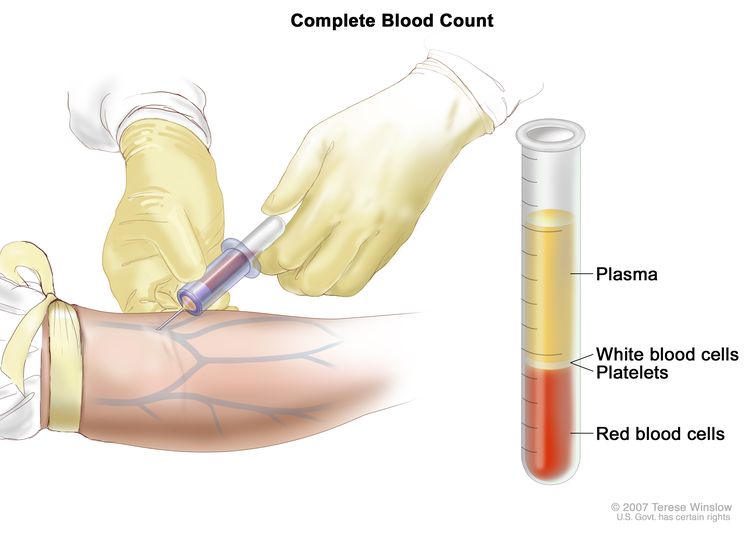
Hemograma completo (HC): la sangre se extrae insertando una aguja en una vena y dejando que fluya hacia un tubo. La muestra se envía al laboratorio y se cuentan los glóbulos rojos, los glóbulos blancos y las plaquetas. El HC se utiliza para detectar, diagnosticar y controlar diversas afecciones.
Algunas personas pueden decidir buscar una segunda opinión.
Quizás le convenga obtener una segunda opinión para confirmar su diagnóstico de cáncer nasofaríngeo y su plan de tratamiento. Si solicita una segunda opinión, deberá obtener los resultados de las pruebas e informes médicos del primer médico para compartirlos con el segundo. El segundo médico revisará el informe de patología, las muestras y las tomografías. Es posible que coincida con el primer médico, sugiera cambios o un enfoque de tratamiento diferente, o le brinde más información sobre su cáncer.
Para obtener más información sobre cómo elegir un médico y obtener una segunda opinión, visite la sección «Cómo encontrar atención oncológica» . Puede comunicarse con el Servicio de Información Oncológica del NCI por chat, correo electrónico o teléfono (en inglés y español) para obtener ayuda para encontrar un médico, un hospital o una segunda opinión. Para preguntas que pueda hacer durante sus citas, visite la sección «Preguntas para hacerle a su médico sobre el cáncer» .
Certain factors affect prognosis (chance of recovery) and treatment options.
The prognosis and treatment options depend on:
- El tamaño del tumor
- la etapa del cáncer, incluyendo si el cáncer se ha extendido a uno o más ganglios linfáticos en el cuello.
- si existen niveles elevados de anticuerpos contra el VEB y marcadores de ADN del VEB en la sangre antes y después del tratamiento.
Estadios del cáncer nasofaríngeo
Puntos clave
- Cancer stage describes the extent of cancer in the body.
- Los siguientes estadios se utilizan para el cáncer nasofaríngeo:
- Estadio 0 (también llamado carcinoma in situ de la nasofaringe)
- Cáncer nasofaríngeo en estadio I (también llamado estadio 1)
- Cáncer nasofaríngeo en estadio II (también llamado estadio 2).
- Cáncer nasofaríngeo en estadio III (también llamado estadio 3)
- Cáncer nasofaríngeo en estadio IV (también llamado estadio 4).
- El cáncer nasofaríngeo puede recidivar (reaparecer) después de haber sido tratado.
Cancer stage describes the extent of cancer in the body.
La etapa del cáncer describe la extensión del cáncer en el cuerpo, como el tamaño del tumor, si se ha diseminado y hasta dónde se ha extendido desde su lugar de origen. Conocer la etapa del cáncer ayuda a planificar el tratamiento.
Existen varios sistemas de estadificación para el cáncer que describen su extensión. La estadificación del cáncer nasofaríngeo generalmente utiliza el sistema TNM . Este sistema puede describirse en su informe de patología . Según los resultados del TNM, se asigna una etapa (I, II, III o IV, también escritas como 1, 2, 3 o 4) al cáncer. Al hablar con usted sobre su diagnóstico, su médico podría describir el cáncer como una de estas etapas.
Obtenga más información sobre la estadificación del cáncer .
Los siguientes estadios se utilizan para el cáncer nasofaríngeo:
Estadio 0 (también llamado carcinoma in situ de la nasofaringe)
En la etapa 0, se encuentran células anormales en el revestimiento de la nasofaringe . Estas células anormales pueden convertirse en cáncer y extenderse al tejido normal cercano.
Cáncer nasofaríngeo en estadio I (también llamado estadio 1)
En la etapa I, el cáncer se ha formado y el cáncer:
- El cáncer se encuentra únicamente en la nasofaringe.
- El cáncer se ha diseminado desde la nasofaringe a la orofaringe y/o a la cavidad nasal.
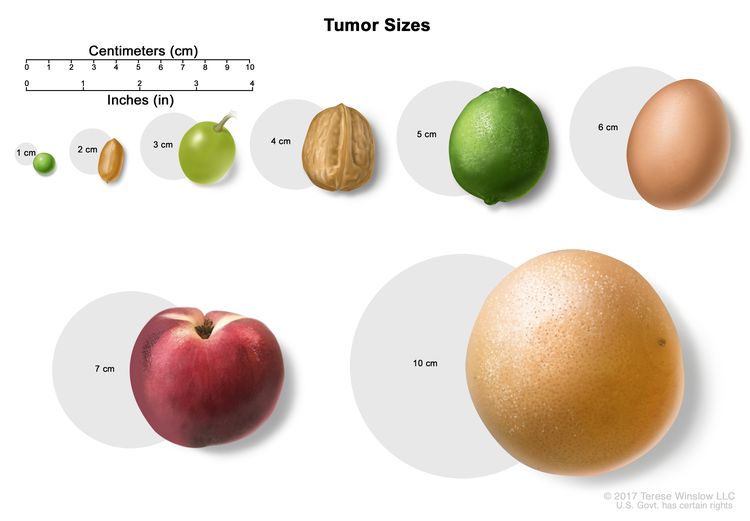
El tamaño de los tumores a menudo se mide en centímetros (cm) o pulgadas (in). A veces se usan alimentos comunes para mostrar el tamaño de un tumor en centímetros: una arveja o guisante (1 cm), un maní o cacahuate (2 cm), una uva (3 cm), una nuez (4 cm), una lima o limón verde (5 cm o 2 in), un huevo (6 cm), un durazno (7 cm) y un pomelo (10 cm o 4 in).
Cáncer nasofaríngeo en estadio II (también llamado estadio 2).
En la etapa II, se cumple una de las siguientes condiciones:
- El cáncer se ha extendido a uno o más ganglios linfáticos en un lado del cuello y/o en uno o más ganglios linfáticos en uno o ambos lados de la parte posterior de la garganta. Los ganglios linfáticos afectados miden 6 centímetros o menos. Se detecta cáncer:
- Únicamente en la nasofaringe o se ha diseminado desde la nasofaringe a la orofaringe y/o a la cavidad nasal.
- Solo en los ganglios linfáticos del cuello. Las células cancerosas de los ganglios linfáticos están infectadas con el virus de Epstein-Barr (un virus vinculado al cáncer de nasofaringe). No se detecta cáncer en la nasofaringe.
- El cáncer se ha extendido al espacio parafaríngeo y/o a los músculos cercanos. También puede haberse extendido a uno o más ganglios linfáticos de un lado del cuello y/o a uno o más ganglios linfáticos de uno o ambos lados de la parte posterior de la garganta. Los ganglios linfáticos afectados miden 6 centímetros o menos.
Cáncer nasofaríngeo en estadio III (también llamado estadio 3)
En la etapa III, se cumple una de las siguientes condiciones:
- El cáncer se ha extendido a uno o más ganglios linfáticos en ambos lados del cuello. Los ganglios linfáticos afectados miden 6 centímetros o menos. Se detecta cáncer:
- Únicamente en la nasofaringe o se ha diseminado desde la nasofaringe a la orofaringe y/o a la cavidad nasal.
- Solo en los ganglios linfáticos del cuello. Las células cancerosas de los ganglios linfáticos están infectadas con el virus de Epstein-Barr (un virus vinculado al cáncer de nasofaringe). No se detecta cáncer en la nasofaringe.
- El cáncer se ha propagado al espacio parafaríngeo o a los músculos cercanos. También se ha propagado a uno o más ganglios linfáticos a ambos lados del cuello. Los ganglios linfáticos afectados miden 6 centímetros o menos.
- El cáncer se ha diseminado a los huesos de la parte inferior del cráneo, los huesos del cuello, los músculos de la mandíbula y/o los senos nasales alrededor de la nariz y los ojos. Es posible que el cáncer también se haya diseminado a uno o más ganglios linfáticos en uno o ambos lados del cuello y/o en la parte posterior de la garganta. Los ganglios linfáticos afectados miden 6 centímetros o menos.
Cáncer nasofaríngeo en estadio IV (también llamado estadio 4).
La etapa IV se divide en las etapas IVA y IVB.
- En el estadio IVA, se presenta una de las siguientes situaciones:
- El cáncer se ha extendido al cerebro, los nervios craneales, la hipofaringe, la glándula salival en la parte frontal de la oreja, el hueso alrededor del ojo y/o los tejidos blandos de la mandíbula. El cáncer también puede haberse extendido a uno o más ganglios linfáticos en uno o ambos lados del cuello y/o la parte posterior de la garganta . Los ganglios linfáticos afectados miden 6 centímetros o menos; o
- El cáncer se ha propagado a uno o más ganglios linfáticos en uno o ambos lados del cuello. Los ganglios linfáticos afectados miden más de 6 centímetros o se encuentran en la parte más baja del cuello.
- En el estadio IVB: el cáncer se ha diseminado más allá de los ganglios linfáticos del cuello hasta los ganglios linfáticos distantes, como los que se encuentran entre los pulmones, debajo de la clavícula, o en la axila o la ingle, o a otras partes del cuerpo, como el pulmón, hueso o hígado.
El cáncer nasofaríngeo en estadio IV también se denomina cáncer nasofaríngeo metastásico. El cáncer metastásico se produce cuando las células cancerosas viajan a través del sistema linfático o la sangre y forman tumores en otras partes del cuerpo. El tumor metastásico es del mismo tipo de cáncer que el tumor primario. Por ejemplo, si el cáncer nasofaríngeo se disemina al pulmón, las células cancerosas en el pulmón son en realidad células de cáncer nasofaríngeo. La enfermedad se denomina cáncer nasofaríngeo metastásico, no cáncer de pulmón. Obtenga más información en Cáncer metastásico: Cuando el cáncer se disemina .
El cáncer nasofaríngeo puede recidivar (reaparecer) después de haber sido tratado.
El cáncer nasofaríngeo recurrente es aquel que reaparece después de haber sido tratado. Si el cáncer nasofaríngeo reaparece, puede hacerlo en la nasofaringe, los ganglios linfáticos u otras partes del cuerpo, como los pulmones, los huesos o el hígado. Las pruebas ayudarán a determinar en qué parte del cuerpo ha reaparecido el cáncer. El tipo de tratamiento para el cáncer nasofaríngeo recurrente dependerá de la localización de la reaparición.
Learn more in Recurrent Cancer: When Cancer Comes Back.
Treatment Option Overview
Puntos clave
- Existen diferentes tipos de tratamiento para las personas con cáncer nasofaríngeo.
- Las personas con cáncer nasofaríngeo deben tener su tratamiento planificado por un equipo de médicos con experiencia en el tratamiento del cáncer de cabeza y cuello.
- The following types of treatment are used:
- Radioterapia
- Quimioterapia
- Cirugía
- Inmunoterapia
- El tratamiento del cáncer nasofaríngeo puede ocasionar efectos secundarios.
- New types of treatment are being tested in clinical trials.
- Es posible que se necesiten cuidados de seguimiento.
Existen diferentes tipos de tratamiento para las personas con cáncer nasofaríngeo.
Existen diferentes tipos de tratamientos para el cáncer nasofaríngeo. Usted y su equipo de atención oncológica trabajarán juntos para definir su plan de tratamiento, que puede incluir más de un tipo de tratamiento. Se tendrán en cuenta muchos factores, como el estadio del cáncer, su estado de salud general y sus preferencias. Su plan incluirá información sobre su cáncer, los objetivos del tratamiento, las opciones de tratamiento disponibles, los posibles efectos secundarios y la duración prevista del tratamiento.
Hablar con tu equipo de atención oncológica antes de que comience el tratamiento sobre qué esperar te será de gran ayuda. Es importante que sepas qué debes hacer antes de que empiece el tratamiento, cómo te sentirás durante el mismo y qué tipo de ayuda necesitarás. Para obtener más información, consulta Preguntas para hacerle a tu médico sobre tu tratamiento .
Las personas con cáncer nasofaríngeo deben tener su tratamiento planificado por un equipo de médicos con experiencia en el tratamiento del cáncer de cabeza y cuello.
Un oncólogo, médico especializado en el tratamiento de personas con cáncer, supervisa el tratamiento del cáncer de nasofaringe. Dado que la nasofaringe ayuda a respirar, comer y hablar, es posible que necesite ayuda para adaptarse a los efectos secundarios del cáncer y su tratamiento. El oncólogo puede derivarlo a otros profesionales de la salud expertos en el tratamiento del cáncer de cabeza y cuello, que también se especializan en otras áreas de la medicina. Otros especialistas pueden incluir:
- cirujano de cabeza y cuello
- Oncólogo radioterapeuta
- cirujano plástico
- dentista
- Nutricionista
- Psicólogo
- Especialista en rehabilitación
- logopeda
The following types of treatment are used:
Radioterapia
La radioterapia utiliza rayos X de alta energía u otros tipos de radiación para destruir las células cancerosas o impedir su crecimiento dañando su ADN. La forma de administración de la radioterapia depende del tipo y la etapa del cáncer. La radioterapia externa e interna se utilizan para tratar el cáncer nasofaríngeo.
- Radioterapia externa se usa una máquina que envía radiación desde el exterior del cuerpo hacía el área en la que se encuentra el cáncer.
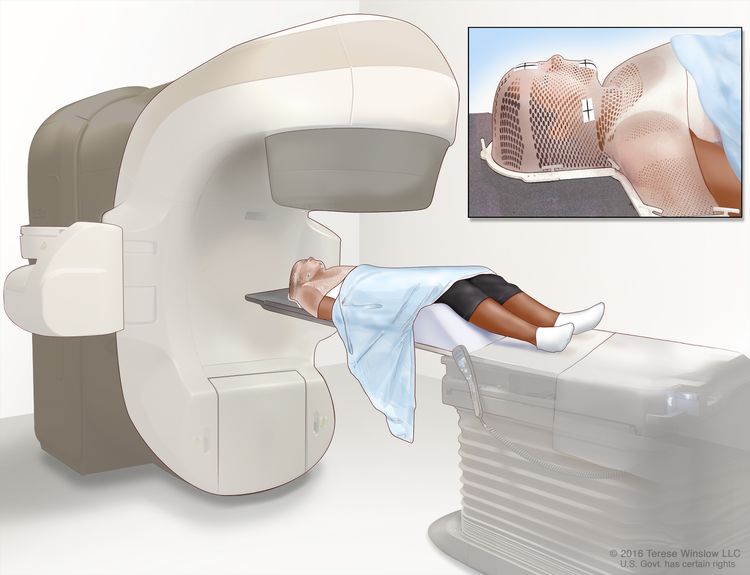
Radioterapia externa de cabeza y cuello. Se utiliza una máquina para dirigir radiación de alta energía hacia el cáncer. La máquina puede girar alrededor del paciente y administrar la radiación desde muchos ángulos diferentes para lograr un tratamiento altamente conformado. Una máscara de malla ayuda a mantener la cabeza y el cuello del paciente inmóviles durante el tratamiento. Se colocan pequeñas marcas de tinta en la máscara. Las marcas de tinta se utilizan para alinear la máquina de radiación en la misma posición antes de cada tratamiento.
Ciertas formas de administrar radioterapia pueden ayudar a evitar que la radiación dañe los tejidos sanos cercanos. Estas incluyen:
- Radioterapia de intensidad modulada (IMRT): La IMRT es un tipo de radioterapia tridimensional (3D) que utiliza una computadora para crear imágenes del tamaño y la forma del tumor. Se dirigen haces delgados de radiación de diferentes intensidades (potencias) al tumor desde múltiples ángulos. En comparación con la radioterapia estándar, la radioterapia de intensidad modulada puede tener menos probabilidades de causar sequedad bucal. Probablemente recibirá tratamiento una vez al día, de lunes a viernes, durante aproximadamente 6 a 7 semanas.
- Radioterapia estereotáctica: La radioterapia estereotáctica también utiliza una computadora para crear imágenes detalladas del tumor. Se dirigen haces de radiación delgados al tumor desde diferentes ángulos. La radiación de alta dosis se administra en una a cinco sesiones distribuidas a lo largo de varios días. Este procedimiento también se conoce como radioterapia estereotáctica externa o radioterapia estereotáctica.
La radioterapia externa aplicada a la tiroides o la hipófisis puede alterar el funcionamiento de la glándula tiroides. Antes y después del tratamiento, se realiza un análisis de sangre para medir los niveles de hormona tiroidea y asegurar que la glándula funcione correctamente. Asimismo, es importante que un dentista revise sus dientes, encías y boca, y corrija cualquier problema existente antes de comenzar la radioterapia.
- La radioterapia interna (también llamada braquiterapia) utiliza una sustancia radiactiva sellada en agujas, semillas, alambres o catéteres que se colocan directamente dentro o cerca del tumor. En algunos casos, puede combinarse con la radioterapia externa para administrar una dosis adicional de radiación directamente al tumor. Obtenga más información sobre la braquiterapia para el tratamiento del cáncer .
Quimioterapia
La quimioterapia utiliza fármacos para detener el crecimiento de las células cancerosas, ya sea destruyéndolas o impidiendo su división. La quimioterapia para el cáncer nasofaríngeo suele ser sistémica, es decir, se administra por vía oral o mediante inyección intravenosa o intramuscular. De esta forma, los fármacos entran en el torrente sanguíneo y pueden llegar a las células cancerosas de todo el cuerpo.
Los fármacos de quimioterapia utilizados para tratar el cáncer nasofaríngeo incluyen:
Combinations of these drugs may be used. Other chemotherapy drugs not listed here may also be used.
Chemotherapy may be combined with other types of treatment, such as radiation therapy.
Para obtener más información sobre cómo funciona la quimioterapia, cómo se administra, los efectos secundarios comunes y mucho más, visite Quimioterapia para tratar el cáncer y Quimioterapia y usted: Apoyo para personas con cáncer .
Cirugía
En ocasiones, se recurre a la cirugía para extirpar el tumor en casos de cáncer nasofaríngeo que no responden a la radioterapia. Si el cáncer se ha extendido a los ganglios linfáticos, el médico puede extirparlos, junto con otros tejidos del cuello.
Learn more about Surgery to Treat Cancer.
Inmunoterapia
La inmunoterapia es un tratamiento en el que se utiliza el sistema inmunológico del paciente para combatir el cáncer. Las sustancias producidas por el cuerpo o en un laboratorio se utilizan para estimular, dirigir o restaurar las defensas naturales del cuerpo contra el cáncer.
- Terapia con inhibidores de PD-1 y PD-L1: la PD-1 es una proteína presente en la superficie de los linfocitos T que ayuda a controlar la respuesta inmunitaria del organismo. La PD-L1 es una proteína presente en algunos tipos de células cancerosas. Cuando la PD-1 se une a la PD-L1, impide que el linfocito T destruya la célula cancerosa. Los inhibidores de PD-1 y PD-L1 impiden que las proteínas PD-1 y PD-L1 se unan entre sí. Esto permite que los linfocitos T destruyan las células cancerosas. Toripalimab es un tipo de inhibidor de PD-1 que se utiliza para tratar el cáncer nasofaríngeo metastásico o recidivante.
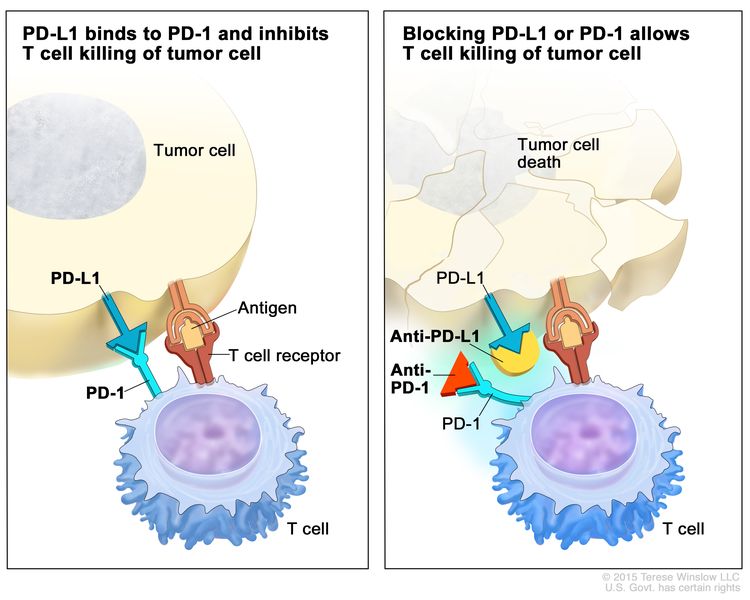
Inhibidor de puestos de control inmunitario. Las proteínas de puestos de control, como PD-L1 en las células tumorales y PD-1 en las células T, regulan las respuestas inmunitarias. La unión de PD-L1 y PD-1 evita que las células T destruyan las células tumorales en el cuerpo (panel izquierdo). El bloqueo de esta unión con un inhibidor del puesto de control inmunitario (anti-PD-L1 o anti-PD-1) permite que las células T eliminen las células tumorales (panel derecho).
Obtenga más información sobre la inmunoterapia para el tratamiento del cáncer .
El tratamiento del cáncer nasofaríngeo puede ocasionar efectos secundarios.
For information about side effects caused by treatment for cancer, visit our Side Effects page.
Los efectos secundarios del tratamiento del cáncer que comienzan después del tratamiento y continúan durante meses o años se denominan efectos tardíos . Los efectos tardíos del tratamiento del cáncer nasofaríngeo pueden incluir:
- Sequedad bucal crónica
- complicaciones dentales y orales
- Pérdida auditiva
- pérdida de visión
- dificultad para tragar
- trismo
- problemas con la tiroides y la glándula pituitaria
- daño a los nervios del cerebro
- Cambios en el estado de ánimo, los sentimientos, los pensamientos, el aprendizaje o la memoria
Algunos efectos secundarios tardíos pueden tratarse o controlarse. Es importante que hable con su médico sobre los posibles efectos secundarios tardíos causados por algunos tratamientos.
New types of treatment are being tested in clinical trials.
For some people, joining a clinical trial may be an option. There are different types of clinical trials for people with cancer. For example, a treatment trial tests new treatments or new ways of using current treatments. Supportive care and palliative care trials look at ways to improve quality of life, especially for those who have side effects from cancer and its treatment.
You can use the clinical trial search to find NCI-supported cancer clinical trials accepting participants. The search allows you to filter trials based on the type of cancer, your age, and where the trials are being done. Clinical trials supported by other organizations can be found on the ClinicalTrials.gov website.
Para más información sobre ensayos clínicos, cómo encontrarlos y participar en uno de ellos, visite la web Información sobre estudios clínicos para pacientes y cuidadores.
Es posible que se necesiten cuidados de seguimiento.
A medida que avanza el tratamiento, se le realizarán pruebas o controles de seguimiento. Es posible que se repitan algunas pruebas para diagnosticar o estadificar el cáncer con el fin de evaluar cómo está funcionando el tratamiento. Las decisiones sobre si continuar, modificar o suspender el tratamiento pueden basarse en los resultados de estas pruebas.
Algunas pruebas seguirán realizándose de manera periódica después de terminar el tratamiento. Los resultados pueden indicar si su afección ha cambiado o si el cáncer ha redicivado (regresado).
Una vez finalizado el tratamiento, es importante someterse a exámenes de cabeza y cuello para detectar signos de que el cáncer haya reaparecido.
Tratamiento del cáncer nasofaríngeo en estadio I
Learn more about these treatments in the Treatment Option Overview.
El tratamiento del cáncer de nasofaringe en estadio I generalmente consiste en radioterapia dirigida al tumor y a los ganglios linfáticos del cuello.
Puede utilizar la búsqueda de ensayos clínicos y encontrar ensayos clínicos sobre cáncer patrocinados por el NCI que acepten participantes. La búsqueda le permite filtrar los ensayos según el tipo de cáncer, la edad y el lugar donde se realizan los ensayos. También encontrará información general sobre los ensayos clínicos.
Tratamiento del cáncer de nasofaringe en estadios II, III y IVA
Learn more about these treatments in the Treatment Option Overview.
El tratamiento del cáncer nasofaríngeo en estadio II, III y IVA (no metastásico) puede incluir:
- radioterapia al tumor y a los ganglios linfáticos del cuello.
- quimioterapia administrada con radioterapia, seguida de más quimioterapia
- quimioterapia seguida de más quimioterapia administrada con radioterapia
- quimioterapia seguida de radioterapia (en estudio)
- Cirugía para extirpar los ganglios linfáticos si aún contienen células cancerosas después del tratamiento inicial.
- Quimioterapia
Puede utilizar la búsqueda de ensayos clínicos y encontrar ensayos clínicos sobre cáncer patrocinados por el NCI que acepten participantes. La búsqueda le permite filtrar los ensayos según el tipo de cáncer, la edad y el lugar donde se realizan los ensayos. También encontrará información general sobre los ensayos clínicos.
Tratamiento del cáncer nasofaríngeo en estadio IVB y recurrente
Learn more about these treatments in the Treatment Option Overview.
El tratamiento del cáncer nasofaríngeo en estadio IVB ( metastásico ) o recurrente puede incluir:
- radioterapia de intensidad modulada, radioterapia estereotáctica o radioterapia interna
- Cirugía
- Quimioterapia, inmunoterapia (toripalimab) administrada sola o inmunoterapia administrada con quimioterapia
Puede utilizar la búsqueda de ensayos clínicos y encontrar ensayos clínicos sobre cáncer patrocinados por el NCI que acepten participantes. La búsqueda le permite filtrar los ensayos según el tipo de cáncer, la edad y el lugar donde se realizan los ensayos. También encontrará información general sobre los ensayos clínicos.
Más información sobre el cáncer nasofaríngeo
Para obtener más información del Instituto Nacional del Cáncer sobre el cáncer nasofaríngeo, visite:
- Página de inicio sobre el cáncer de cabeza y cuello
- Detección de los cánceres de cavidad bucal y nasofaringe
- Oral Complications of Cancer Therapies
- Medicamentos aprobados para el cáncer de cabeza y cuello
- Cánceres de cabeza y cuello
- Tabaco (incluye ayuda para dejar de fumar)
For general cancer information and other resources from the National Cancer Institute, visit:
Sobre este resumen del PDQ
Acerca del PDQ
El Physician Data Query (PDQ) es la base de datos integral sobre el cáncer del National Cancer Institute (NCI). La base de datos del PDQ contiene resúmenes con la última información publicada sobre prevención, detección, genética, tratamiento, atención médica de apoyo y medicina complementaria y alternativa relacionada con el cáncer. La mayoría de los resúmenes se presentan en dos versiones. Las versiones para profesionales de la salud contienen información detallada escrita en lenguaje técnico. Las versiones para pacientes están escritas en un lenguaje fácil de entender y no tan técnico. Ambas versiones contienen información precisa y actualizada sobre el cáncer. La mayoría de las versiones también están disponibles en español.
El PDQ es un servicio del NCI. El NCI es parte de los Institutos Nacionales de Salud (NIH), que son el centro de investigación biomédica del Gobierno federal. Los resúmenes del PDQ se basan en una revisión independiente de la literatura médica. No son declaraciones de políticas del NCI ni de los NIH.
Propósito de este resumen
Este resumen de información sobre el cáncer del PDQ contiene información actualizada sobre el tratamiento de cáncer nasofaríngeo en adultos. Su objetivo es informar y ayudar a los pacientes, las familias y los cuidadores. No proporciona directrices ni recomendaciones formales para tomar decisiones sobre la atención médica.
Revisores y actualizaciones
Los comités editoriales escriben los resúmenes de información sobre el cáncer del PDQ y los mantienen actualizados. Estos comités están formados por equipos de especialistas en el tratamiento del cáncer y otras especialidades relacionadas con esta enfermedad. Los resúmenes se revisan periódicamente y se modifican cuando hay información nueva. La fecha de actualización al pie de cada resumen indica cuándo se realizó el cambio más reciente.
The information in this patient summary was taken from the health professional version, which is reviewed regularly and updated as needed, by the PDQ Adult Treatment Editorial Board.
Información sobre ensayos clínicos
Un ensayo clínico es un estudio para responder a una pregunta científica como, por ejemplo, si un tratamiento es mejor que otro. Los ensayos se basan en estudios anteriores y en lo aprendido en el laboratorio. Cada ensayo responde a determinadas preguntas científicas que permiten encontrar nuevas y mejores formas de ayudar a los pacientes con cáncer. Durante los ensayos clínicos de tratamiento, se recopila información sobre los efectos de un nuevo tratamiento y su eficacia. Si un ensayo clínico demuestra que un nuevo tratamiento es mejor que uno que se utiliza actualmente, el nuevo tratamiento puede convertirse en “estándar”. Los pacientes pueden valorar la posibilidad de participar en un ensayo clínico. Algunos ensayos clínicos solo están abiertos a pacientes que no hayan iniciado el tratamiento.
Los ensayos clínicos se pueden encontrar en línea en el sitio web del NCI. Para obtener más información, llame al Servicio de Información sobre el Cáncer (CIS, por sus siglas en inglés), el centro de contacto del NCI, al 1-800-4-CANCER (1-800-422-6237).
Permiso de uso de este resumen
Physician Data Query (PDQ) es una marca registrada. Se autoriza el libre uso del contenido de los documentos del PDQ como texto. Sin embargo, no se podrá identificar como un resumen de información sobre cáncer del PDQ del NCI, salvo que se reproduzca en su totalidad y se actualice con regularidad. Por otra parte, se permite que los autores incluyan una oración como “en el resumen del PDQ del NCI sobre la prevención del cáncer de mama se describen, de manera concisa, los siguientes riesgos: [incluir fragmento del resumen]”.
La forma recomendada para citar este resumen del PDQ es:
Comité Editorial del Tratamiento para Adultos de PDQ®. Tratamiento del cáncer nasofaríngeo de PDQ. Bethesda, MD: Instituto Nacional del Cáncer. Actualizado.
Las imágenes de este resumen se utilizan con el permiso del autor, artista y/o editorial para uso exclusivo en los resúmenes del PDQ. Si desea usar una imagen de un resumen del PDQ sin incluir el resumen completo, debe obtener autorización del propietario. El National Cancer Institute no puede otorgar dicho permiso. Para obtener más información sobre el uso de las imágenes de este resumen o de otras ilustraciones relacionadas con el cáncer, consulte Visuals Online, una colección de más de 3,000 imágenes científicas.
Descargo de responsabilidad
La información de estos resúmenes no debe utilizarse para tomar decisiones sobre reembolsos de seguros. Puede encontrar más información sobre la cobertura de seguros en Cancer.gov en el sitio Manejo de la atención del cáncer.
Contáctenos
Puede encontrar más información sobre cómo contactarnos o recibir ayuda en el sitio web Cancer.gov en la página Comuníquese con el NCI. También puede enviar sus preguntas a Cancer.gov en el apartado Escríbanos del sitio web.
Updated:
URL de origen: https://www.cancer.gov/node/4342/syndication
Agencia de origen: National Cancer Institute (NCI)
Fecha de captura: 2013-09-14 09:02:09.0