
Característica
Inside a CAP Peer Inspection: Two Residents Take on a New Role in Nashville
August 14, 2026
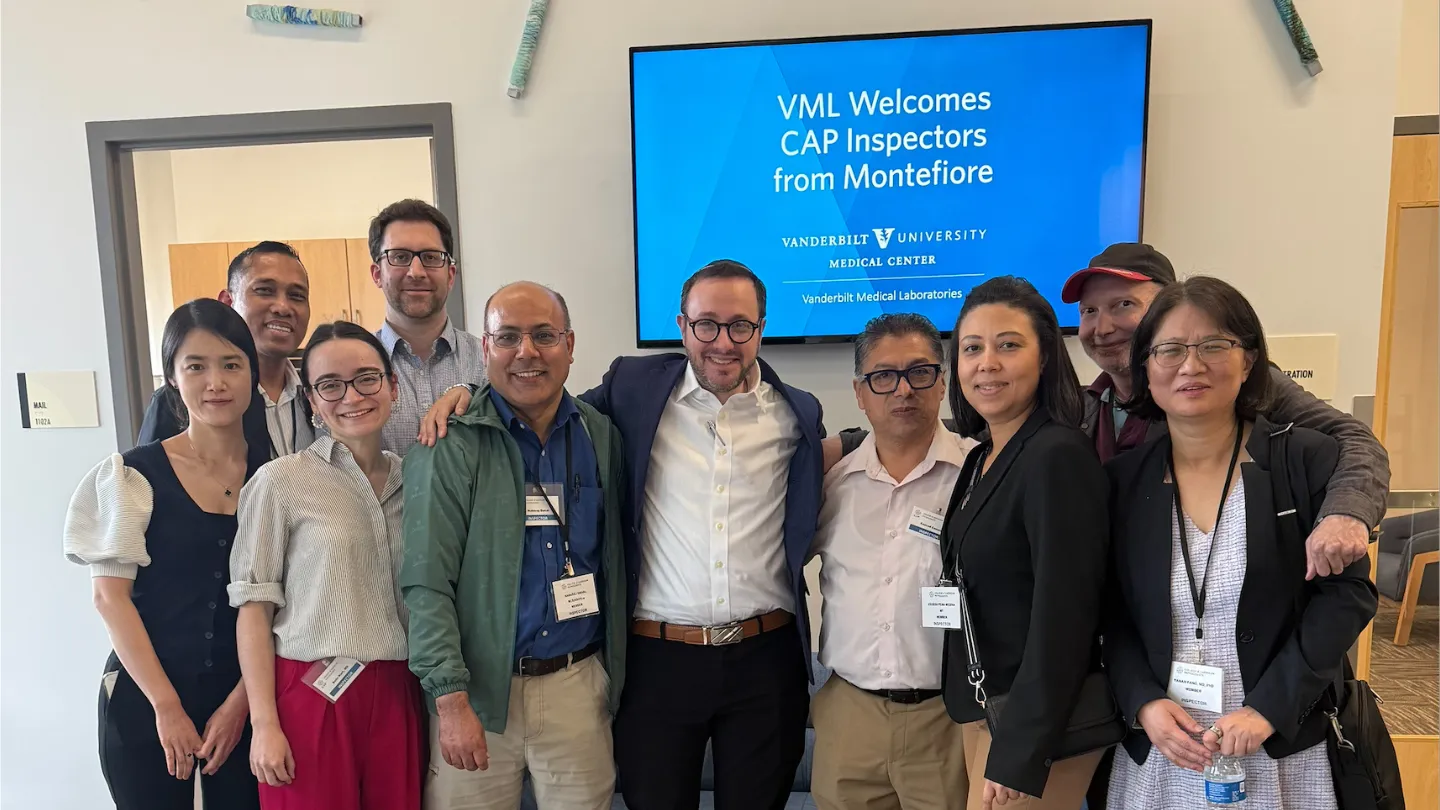
Part of the 19-member Montefiore CAP Peer-based Inspection Team at Vanderbilt University Medical Center. Top row from left: Gilbert Miranda, Garrison Pease. Bottom row from left: Xing Li, Selin Kurt, Nabaraj Dahal, Yitzchak Goldstein, Conrad Canales, Julissa Pena, Justin Joseph Mulvey, and Yanan Fang.
In late April, a team of 19 Montefiore Einstein Pathology members traveled to Nashville to conduct a CAP peer-based inspection of the Vanderbilt Medical Laboratories (VML) at Vanderbilt University Medical Center. CAP, the College of American Pathologists, is the primary accrediting body for pathology laboratories in the United States.
CAP inspections run on a peer-based model. Rather than employing its own inspector workforce, CAP authorizes peer institutions to inspect each other.
Among the cohort of attending pathologists, laboratory directors, clinical laboratory technicians (CLT), medical technologists (MT), and quality and regulatory leaders, were two third-year pathology residents, Selin Kurt, MD (now PGY4), and Xing Li, MD (now PGY4/Chief Resident), who volunteered to assist with the Nashville inspection. Once on site, the team fanned out across Vanderbilt's eight sites licensed under the Clinical Laboratory Improvement Amendments (CLIA) over two days, each assigned specific checklists covering chemistry, hematology, molecular pathology, cytogenetics, surgical pathology, and more.
"One of the guiding principles of CAP is education," said Adam Cole, MD, Director of Quality for Montefiore Einstein Pathology and Site Director for the Weiler and the Hutchinson clinical laboratories. "We always try to bring a few residents with us," he added. "They see how other institutions operate and that there is more than one way to be compliant. There's a large educational component to that."
Dr. Cole leads the team on every external CAP inspection. He led the Vanderbilt inspection team alongside Jeanette Williams, MPH, Assistant Director, Pathology Regulatory, and Dolis Ruiz, MS, MT, Manager, Quality Management Systems.
Highlights and Challenges of a First-Time Inspector
During their residency training, Drs. Li and Kurt had participated in CAP self-inspections at Montefiore, but neither had taken part at an external site. When the opportunity arose, both trainees were eager volunteer in Nashville. “I was curious to see how other institutions organized their labs and whether Vanderbilt had practices Montefiore could adopt,” Dr. Li said. And while Dr. Kurt didn’t know what to expect, she "jumped at the chance to volunteer.” “There's nothing like learning by doing,” she said.
During the two-day inspection, Dr. Li independently inspected the Mohs micrographic surgical lab, which handles tissue margins for skin cancer surgery. Dr. Kurt inspected the histology laboratory on her own, and partnered with Garrison Pease, MD, a genitourinary surgical pathologist, to inspect the renal pathology laboratory. The two residents worked together to inspect the surgical pathology labs.
Going in, Dr. Kurt expected a formal, checklist-driven process. Instead, she came away with a new lens for thinking about Montefiore's own workflows. "It was a genuine learning experience," she said.
One standout moment happened during the renal pathology inspection, when the team let her run a sample on the electron microscope herself. "That was a highlight I did not expect at all," she said.
Not every moment was as smooth. "The most challenging part was building confidence in my own judgment when assessing whether something met a standard," Dr. Kurt said. "As a first-time inspector, there's a learning curve in trusting yourself to make that call."
When the residents were unsure whether an item met the inspection criteria, Dr. Cole was always available to help them navigate the gray areas. Dr. Kurt said the experience reminded them that asking questions is always appropriate.
By the end of the inspection, Dr. Pease was impressed. "Both Drs. Li and Kurt took it very seriously and did an excellent job," he said. "They came in and operated as if they were veteran inspectors."
The Stakes Behind the Checklist
CAP accreditation is required for virtually every hospital laboratory that accepts reimbursement from Medicare and Medicaid. The authority comes from federal law. CLIA governs every laboratory in the country that tests human specimens for clinical or diagnostic purposes. Rather than conducting inspections itself, the federal government authorizes deemed agencies whose standards meet or exceed federal requirements to accredit and inspect labs on its behalf. CAP is one of them, and the most widely recognized in pathology. Losing accreditation would mean losing the ability to operate as a clinical laboratory.
"We have been inspected by UCLA, the University of Rochester, and the University of Pittsburgh, among others," Dr. Cole said. "And we have had the privilege to inspect the Mayo Clinic, ARUP, and many others, as well."
A combined checklist across all laboratory areas totals more than 3,000 items. When inspectors identify a deficiency, the inspected lab must respond within 30 days with a root cause analysis and a corrective action plan. Serious deficiencies can trigger follow-up regulatory actions.
Lessons Learned
Having inspected labs at numerous hospitals, Dr. Cole and his colleagues have developed a broad view of how different institutions operate, with varying staffing models, standard operating procedures, and information systems. Vanderbilt is currently migrating to Epic's Beaker laboratory system, a transition that Montefiore Einstein completed in 2018, and the team shared what they learned about the pitfalls. Its newly opened 110,000-square-foot consolidated reference laboratory, which centralizes microbiology, chemistry, and surgical pathology for its entire system, gave the team a concrete example of what that kind of consolidation looks like at scale.
"You see how different places operate," Dr. Cole said. "And you can take best practices and good ideas back to Montefiore."
Off the Clock
The inspection days are long and intense, but at night there's time to unwind with team dinners, music, and sometimes a museum. For Dr. Pease, that's part of the value. The trips give team members a chance to network with colleagues at other hospitals, meet new people, and connect with co-workers who rarely cross paths on a normal workday at Montefiore. "It's a fun time," he said.
For Dr. Li, the social downtime added to her overall positive experience as a first-time inspector. "The team dinner after the first day was a great opportunity to relax and get to know colleagues I don't see often on a normal shift," she said.
As a chief resident, she strongly encourages pathology residents to volunteer for future CAP peer-based inspections. "It helps build teamwork, communication skills, and confidence in identifying and addressing potential issues," she said. "It is also an opportunity to learn about practices and workflows from other institutions, which can broaden your perspective and improve your own approach to patient care."
Dr. Kurt's advice for any first-year resident on the fence about volunteering is clear and concise. "Do it," she said. "Don't think twice. You're going to learn things you can't learn from a textbook or from staying in your own lab."
For Dr. Cole, that response is exactly the point. He said, "The residents who volunteer always come back with new perspectives.”
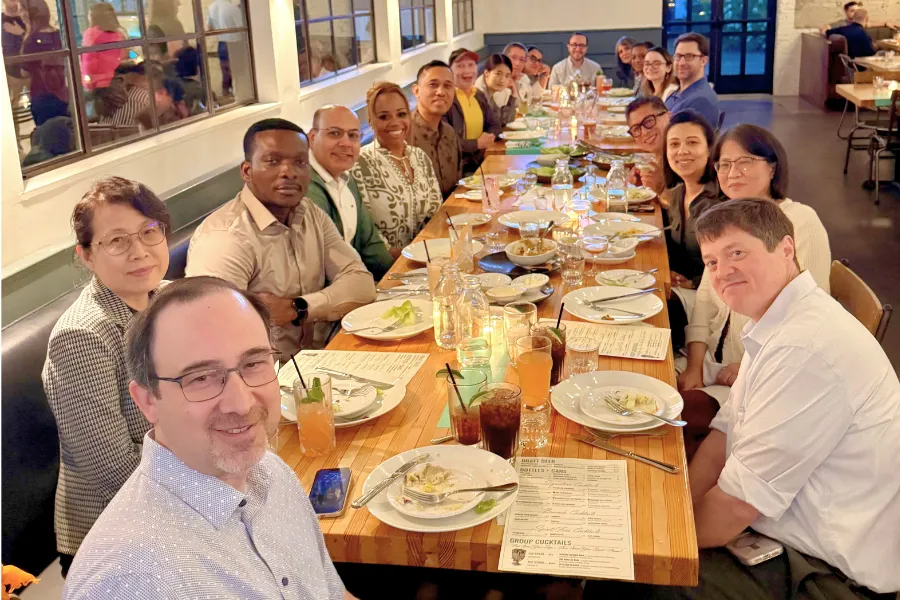
The 19-member Montefiore pathology peer inspection team at dinner in Nashville. Clockwise from bottom: Adam Cole, MD (team leader), Xuemei Shi, PhD, Kayode Balogun, PhD, Nabaraj Dahal, CLT, Dolis Ruiz, MS, MT, Gilbert Miranda, MT, Justin Joseph Mulvey, MD, PhD, Xing Li, MD, Shanlong Jiang, CLT, Sarah Pantoja, CLT, Yitzchak Goldstein, MD, Mahnaz Zohouri, MT, Jeanette Williams, MPH, Selin Kurt, MD, Garrison Pease, MD, Conrad Canales, CLT, Julissa Pena, CLT, Yanan Fang, MD, PhD, Jared Larson, CLT