





Tratamiento del cáncer de la vesícula biliar
Access exceptional care for gallbladder cancer and other types of gastrointestinal cancers at Montefiore Einstein Comprehensive Cancer Center. Our multidisciplinary team has extensive experience caring for this cancer. As one of the first NCI-designated cancer centers, for more than 50 years, we’ve been a leader in the research, diagnosis and treatment of over 200 types of cancer.
We’re at the forefront of treatment and research for gallbladder cancer and other gastrointestinal cancers. Our patient-centered and evidence-based cancer care addresses the unique needs of each individual patient. Montefiore Einstein Comprehensive Cancer Center’s experts are equipped to undertake advanced surgical procedures not available at many other facilities and have greatly improved survival rates while reducing hospital stay and minimizing complications for our patients.
When you need gallbladder cancer care, turn to our providers who are passionate about ending cancer and addressing your whole health needs.

El Montefiore Einstein Comprehensive Cancer Center, designado como centro integral del cáncer por el National Cancer Institute (NCI), apoya la misión y las normas del NCI. La siguiente información sobre los tipos de cáncer, prevención y tratamientos ha sido facilitada por el NCI.
Gallbladder Cancer Treatment (PDQ®)–Patient Version
General Information About Gallbladder Cancer
Puntos clave
- Gallbladder cancer is a rare type of cancer that starts in the tissues of the gallbladder.
- Signs and symptoms of gallbladder cancer include jaundice, fever, and pain.
- Gallbladder cancer is difficult to detect (find) and diagnose early.
- Tests that examine the gallbladder and nearby organs are used to detect (find), diagnose, and stage gallbladder cancer.
- Certain factors affect the prognosis (chance of recovery) and treatment options.
Gallbladder cancer is a rare type of cancer that starts in the tissues of the gallbladder.
Gallbladder cancer occurs when cells in the gallbladder start to grow out of control. The gallbladder is a pear-shaped organ that lies just under the liver in the upper abdomen. The gallbladder stores bile, a fluid made by the liver to digest fat. When food is being broken down in the stomach and intestines, bile is released from the gallbladder through a tube called the common bile duct, which connects the gallbladder and liver to the first part of the small intestine.
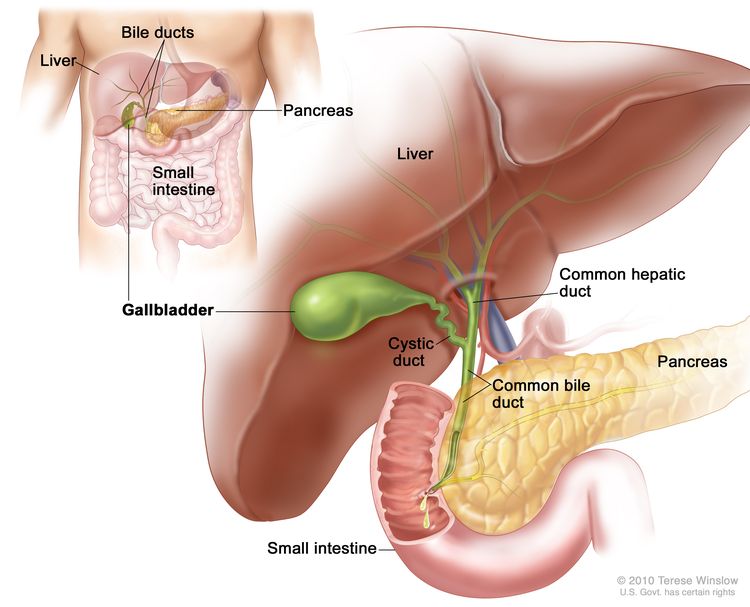
Anatomy of the gallbladder. The gallbladder is just below the liver. Bile is stored in the gallbladder and flows through the cystic duct and the common bile duct into the small intestine when food is being digested.
The wall of the gallbladder has 4 main layers of tissue:
- mucosal (inner) layer
- muscle layer
- connective tissue layer
- serosal (outer) layer
Primary gallbladder cancer starts in the inner layer and spreads through the outer layers as it grows.
Signs and symptoms of gallbladder cancer include jaundice, fever, and pain.
These and other signs and symptoms may be caused by gallbladder cancer or by other conditions. Check with your doctor if you have:
Gallbladder cancer is difficult to detect (find) and diagnose early.
Gallbladder cancer is difficult to detect and diagnose because:
- People rarely have signs or symptoms in the early stages of gallbladder cancer.
- The symptoms of gallbladder cancer, when present, are like the symptoms of many other illnesses.
- The gallbladder is hidden behind the liver.
Gallbladder cancer is sometimes found when the gallbladder is removed for other reasons. Although gallstones are the most common risk factor for developing gallbladder cancer, the overall risk is low. Most people with gallstones do not develop gallbladder cancer.
Tests that examine the gallbladder and nearby organs are used to detect (find), diagnose, and stage gallbladder cancer.
Procedures that make pictures of the gallbladder and the area around it help diagnose gallbladder cancer and show how far the cancer has spread. The process used to find out if cancer cells have spread within and around the gallbladder is called staging.
To plan treatment, it is important to know if the gallbladder cancer can be removed by surgery. Tests and procedures to detect, diagnose, and stage gallbladder cancer are usually done at the same time. In addition to asking about your personal and family health history and doing a physical exam, your doctor may perform the following tests and procedures:
- Liver function tests: A procedure in which a blood sample is checked to measure the amounts of certain substances released into the blood by the liver. A higher-than-normal amount of a substance can be a sign of liver disease that may be caused by gallbladder cancer.
- Blood chemistry studies: A procedure in which a blood sample is checked to measure the amounts of certain substances released into the blood by organs and tissues in the body. An unusual (higher or lower than normal) amount of a substance can be a sign of disease.
- Tomografía computarizada (CAT scan): A procedure that makes a series of detailed pictures of areas inside the body, such as the chest, abdomen, and pelvis, taken from different angles. The pictures are made by a computer linked to an x-ray machine. A dye may be injected into a vein or swallowed to help the organs or tissues show up more clearly. This procedure is also called computed tomography, computerized tomography, or computerized axial tomography.
- Ultrasound exam: A procedure in which high-energy sound waves (ultrasound) are bounced off internal tissues or organs and make echoes. The echoes form a picture of body tissues called a sonogram. An abdominal ultrasound is done to diagnose gallbladder cancer.
- PTC (percutaneous transhepatic cholangiography): A procedure used to x-ray the liver and bile ducts. A thin needle is inserted through the skin below the ribs and into the liver. Dye is injected into the liver or bile ducts and an x-ray is taken. If a blockage is found, a thin, flexible tube called a stent is sometimes left in the liver to drain bile into the small intestine or a collection bag outside the body.
- ERCP (endoscopic retrograde cholangiopancreatography): A procedure used to x-ray the ducts (tubes) that carry bile from the liver to the gallbladder and from the gallbladder to the small intestine. Sometimes gallbladder cancer causes these ducts to narrow and block or slow the flow of bile, causing jaundice. An endoscope (a thin, lighted tube) is passed through the mouth, esophagus, and stomach into the first part of the small intestine. A catheter (a smaller tube) is then inserted through the endoscope into the bile ducts. A dye is injected through the catheter into the ducts and an x-ray is taken. If the ducts are blocked by a tumor, a fine tube may be inserted into the duct to unblock it. This tube (or stent) may be left in place to keep the duct open. Tissue samples may also be taken.
- Resonancia magnética (magnetic resonance imaging) with gadolinio: A procedure that uses a magnet, radio waves, and a computer to make a series of detailed pictures of areas inside the body. A substance called gadolinium is injected into a vein. The gadolinium collects around the cancer cells so they show up brighter in the picture. This procedure is also called nuclear magnetic resonance imaging (NMRI).
- Endoscopic ultrasound (EUS): A procedure in which an endoscope is inserted into the body, usually through the mouth or rectum. An endoscope is a thin, tube-like instrument with a light and a lens for viewing. A probe at the end of the endoscope is used to bounce high-energy sound waves (ultrasound) off internal tissues or organs and make echoes. The echoes form a picture of body tissues called a sonogram. This procedure is also called endosonography.
- Laparoscopy: A surgical procedure to look at the organs inside the abdomen to check for signs of disease. Small incisions (cuts) are made in the wall of the abdomen and a laparoscope (a thin, lighted tube) is inserted into one of the incisions. Other instruments may be inserted through the same or other incisions to perform procedures such as removing organs or taking tissue samples for biopsy. Laparoscopy helps to find out if the cancer is within the gallbladder only or has spread to nearby tissues and if it can be removed by surgery.
- Biopsy: The removal of cells or tissues so they can be viewed under a microscope by a pathologist to check for signs of cancer. The biopsy may be done after surgery to remove the tumor. If the tumor clearly cannot be removed by surgery, the biopsy may be done using a fine needle to remove cells from the tumor.
Certain factors affect the prognosis (chance of recovery) and treatment options.
The prognosis and treatment options depend on:
- the stage of the cancer (whether the cancer has spread from the gallbladder to other places in the body)
- whether the cancer can be completely removed by surgery
- the type of gallbladder cancer (how the cancer cell looks under a microscope)
- Si el cáncer se ha diagnosticado recientemente o si ha reaparecido (regresado)
Treatment may also depend on the age and general health of the patient and whether the cancer is causing signs or symptoms.
Gallbladder cancer can be cured only if it is found before it has spread, when it can be removed by surgery. If the cancer has spread, palliative treatment can improve the patient's quality of life by controlling the symptoms and complications of this disease.
Stages of Gallbladder Cancer
Puntos clave
- Tests and procedures to stage gallbladder cancer are usually done at the same time as diagnosis.
- There are three ways that cancer spreads in the body.
- El cáncer puede extenderse desde donde comenzó a otras partes del cuerpo.
- The following stages are used for gallbladder cancer:
- Estadio 0 (carcinoma in situ)
- Estadio I
- Estadio II
- Estadio III
- Estadio IV
- For gallbladder cancer, stages are also grouped according to how the cancer may be treated. There are two treatment groups:
- Localized (Stage I)
- Unresectable, recurrent, or metastatic (Stage II, Stage III, and Stage IV)
Tests and procedures to stage gallbladder cancer are usually done at the same time as diagnosis.
Learn more about tests and procedures used to detect, diagnose, and stage gallbladder cancer in the General Information section.
There are three ways that cancer spreads in the body.
Cancer can spread through tissue, the lymph system, and the blood:
- Tissue. The cancer spreads from where it began by growing into nearby areas.
- Lymph system. The cancer spreads from where it began by getting into the lymph system. The cancer travels through the lymph vessels to other parts of the body.
- Blood. The cancer spreads from where it began by getting into the blood. The cancer travels through the blood vessels to other parts of the body.
El cáncer puede extenderse desde donde comenzó a otras partes del cuerpo.
Cuando el cáncer se extiende a otra parte del cuerpo se denomina metástasis. Las células cancerosas se desprenden de donde comenzaron (tumor primario) y viajan a través del sistema linfático o la sangre.
- Sistema linfático: el cáncer entra en el sistema linfático, viaja a través de los vasos linfáticos y forma un tumor (tumor metastásico) en otra parte del cuerpo.
- Sangre: el cáncer llega a la sangre, viaja a través de los vasos sanguíneos y forma un tumor (tumor metastásico) en otra parte del cuerpo.
The metastatic tumor is the same type of cancer as the primary tumor. For example, if gallbladder cancer spreads to the liver, the cancer cells in the liver are actually gallbladder cancer cells. The disease is metastatic gallbladder cancer, not liver cancer.
The following stages are used for gallbladder cancer:
Estadio 0 (carcinoma in situ)
In stage 0, abnormal cells are found in the mucosa (innermost layer) of the gallbladder wall. These abnormal cells may become cancer and spread into nearby normal tissue. Stage 0 is also called carcinoma in situ.
Estadio I
In stage I, cancer has formed in the mucosa (innermost layer) of the gallbladder wall and may have spread to the muscle layer of the gallbladder wall.
Estadio II
Stage II is divided into stages IIA and IIB, depending on where the cancer has spread in the gallbladder.
- In stage IIA, cancer has spread through the muscle layer to the connective tissue layer of the gallbladder wall on the side of the gallbladder that is not near the liver.
- In stage IIB, cancer has spread through the muscle layer to the connective tissue layer of the gallbladder wall on the same side as the liver. Cancer has not spread to the liver.
Estadio III
El estadio III se divide en los estadios IIIA y IIIB, según el lugar donde se haya diseminado el cáncer.
- In stage IIIA, cancer has spread through the connective tissue layer of the gallbladder wall and one or more of the following is true:
- Cancer has spread to the serosa (layer of tissue that covers the gallbladder).
- Cancer has spread to the liver.
- Cancer has spread to one nearby organ or structure (such as the stomach, small intestine, colon, pancreas, or the bile ducts outside the liver).
- In stage IIIB, cancer has formed in the mucosa (innermost layer) of the gallbladder wall and may have spread to the muscle, connective tissue, or serosa (layer of tissue that covers the gallbladder) and may have also spread to the liver or to one nearby organ or structure (such as the stomach, small intestine, colon, pancreas, or the bile ducts outside the liver). Cancer has spread to one to three nearby lymph nodes.
Estadio IV
Stage IV is divided into stages IVA and IVB.
- In stage IVA, cancer has spread to the portal vein or hepatic artery or to two or more organs or structures other than the liver. Cancer may have spread to one to three nearby lymph nodes.
- In stage IVB, cancer may have spread to nearby organs or structures. Cancer has spread:
- to four or more nearby lymph nodes; or
- to other parts of the body, such as the peritoneum and liver.
For gallbladder cancer, stages are also grouped according to how the cancer may be treated. There are two treatment groups:
Localized (Stage I)
Cancer is found in the wall of the gallbladder and can be completely removed by surgery.
Unresectable, recurrent, or metastatic (Stage II, Stage III, and Stage IV)
Unresectable cancer cannot be removed completely by surgery. Most patients with gallbladder cancer have unresectable cancer.
Recurrent cancer is cancer that has recurred (come back) after it has been treated. Gallbladder cancer may come back in the gallbladder or in other parts of the body.
Metastasis is the spread of cancer from the primary site (place where it started) to other places in the body. Metastatic gallbladder cancer may spread to surrounding tissues, organs, throughout the abdominal cavity, or to distant parts of the body.
Treatment Option Overview
Puntos clave
- There are different types of treatment for patients with gallbladder cancer.
- The following types of treatment are used:
- Cirugía
- Radioterapia
- Quimioterapia
- New types of treatment are being tested in clinical trials.
- Radiation sensitizers
- Terapia dirigida
- Inmunoterapia
- Treatment for gallbladder cancer may cause side effects.
- Patients may want to think about taking part in a clinical trial.
- Patients can enter clinical trials before, during, or after starting their cancer treatment.
- Es posible que se necesiten cuidados de seguimiento.
There are different types of treatment for patients with gallbladder cancer.
Different types of treatments are available for patients with gallbladder cancer. Some treatments are standard (the currently used treatment), and some are being tested in clinical trials. A treatment clinical trial is a research study meant to help improve current treatments or obtain information on new treatments for patients with cancer. When clinical trials show that a new treatment is better than the standard treatment, the new treatment may become the standard treatment. Patients may want to think about taking part in a clinical trial. Some clinical trials are open only to patients who have not started treatment.
The following types of treatment are used:
Cirugía
Gallbladder cancer may be treated with a cholecystectomy, surgery to remove the gallbladder and some of the tissues around it. Nearby lymph nodes may be removed. A laparoscope is sometimes used to guide gallbladder surgery. The laparoscope is attached to a video camera and inserted through an incision (port) in the abdomen. Surgical instruments are inserted through other ports to perform the surgery. Because there is a risk that gallbladder cancer cells may spread to these ports, tissue surrounding the port sites may also be removed.
If the cancer has spread and cannot be removed, the following types of palliative surgery may relieve symptoms:
- Biliary bypass: If the tumor is blocking the bile duct and bile is building up in the gallbladder, a biliary bypass may be done. During this operation, the doctor will cut the gallbladder or bile duct in the area before the blockage and sew it to the small intestine to create a new pathway around the blocked area.
- Endoscopic stent placement: If the tumor is blocking the bile duct, surgery may be done to put in a stent (a thin tube) to drain bile that has built up in the area. The doctor may place the stent through a catheter that drains the bile into a bag on the outside of the body or the stent may go around the blocked area and drain the bile into the small intestine.
- Percutaneous transhepatic biliary drainage: A procedure done to drain bile when there is a blockage and endoscopic stent placement is not possible. An x-ray of the liver and bile ducts is done to locate the blockage. Images made by ultrasound are used to guide placement of a stent, which is left in the liver to drain bile into the small intestine or a collection bag outside the body. This procedure may be done to relieve jaundice before surgery.
Radioterapia
Radiation therapy is a cancer treatment that uses high-energy x-rays or other types of radiation to kill cancer cells or keep them from growing. External radiation therapy uses a machine outside the body to send radiation toward area of the body with cancer.
Quimioterapia
Chemotherapy is a cancer treatment that uses drugs to stop the growth of cancer cells, either by killing the cells or by stopping the cells from dividing. When chemotherapy is taken by mouth or injected into a vein or muscle, the drugs enter the bloodstream and can reach cancer cells throughout the body (systemic therapy).
New types of treatment are being tested in clinical trials.
En esta sección se resumen los tratamientos que se están estudiando en ensayos clínicos. Es posible que no se mencionen todos los tratamientos nuevos que se están estudiando. La información sobre los ensayos clínicos está disponible en el sitio web del NCI.
Radiation sensitizers
Clinical trials are studying ways to improve the effect of radiation therapy on tumor cells, including:
- Hyperthermia therapy: A treatment in which body tissue is exposed to high temperatures to damage and kill cancer cells or to make cancer cells more sensitive to the effects of radiation therapy and certain anticancer drugs.
- Radiosensitizers: Drugs that make tumor cells more sensitive to radiation therapy. Giving radiation therapy together with radiosensitizers may kill more tumor cells.
Terapia dirigida
Targeted therapy is a type of treatment that uses drugs or other substances to identify and attack specific cancer cells. The following targeted therapies are being studied in patients with gallbladder cancer that is locally advanced and cannot be removed by surgery or has spread to other parts of the body:
- Ivosidenib is a type of targeted therapy that blocks a specific mutation in a gene called IDH1. It works by slowing or stopping the growth of cancer cells.
- Pemigatinib is a type of targeted therapy that blocks specific changes in a gene called FGFR2. This may help keep cancer cells from growing and may kill them.
Inmunoterapia
La inmunoterapia es un tratamiento en el que se utiliza el sistema inmunológico del paciente para combatir el cáncer. Las sustancias producidas por el cuerpo o en un laboratorio se utilizan para estimular, dirigir o restaurar las defensas naturales del cuerpo contra el cáncer.
Immune checkpoint inhibitor therapy is a type of immunotherapy that may be used to treat gallbladder cancer.
- Terapia con inhibidores de PD-1 and PD-L1 inhibitor therapy: PD-1 is a protein en la superficie de células T that helps keep the body's immune responses in check. PD-L1 is a protein found on some types of cancer cells. When PD-1 attaches to PD-L1, it stops the T cell from killing the cancer cell. PD-1 and PD-L1 inhibitors keep PD-1 and PD-L1 proteins from attaching to each other. This allows the T cells to kill cancer cells.
- Pembrolizumab is a type of PD-1 inhibitor that may be used in patients whose cancer is locally advanced and cannot be removed by surgery or has spread to other parts of the body.
- Durvalumab is a type of PD-L1 inhibitor that is being studied in combination with chemotherapy in previously untreated patients whose cancer is locally advanced, recurrent, or has spread to other parts of the body.
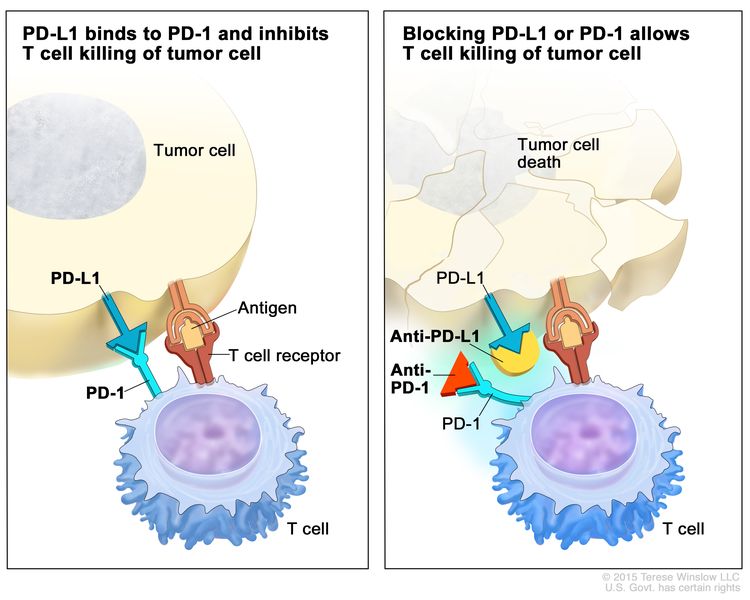
Inhibidor de puestos de control inmunitario. Las proteínas de puestos de control, como PD-L1 en las células tumorales y PD-1 en las células T, regulan las respuestas inmunitarias. La unión de PD-L1 y PD-1 evita que las células T destruyan las células tumorales en el cuerpo (panel izquierdo). El bloqueo de esta unión con un inhibidor del puesto de control inmunitario (anti-PD-L1 o anti-PD-1) permite que las células T eliminen las células tumorales (panel derecho).
Treatment for gallbladder cancer may cause side effects.
For information about side effects caused by treatment for cancer, visit our Side Effects page.
Patients may want to think about taking part in a clinical trial.
For some patients, taking part in a clinical trial may be the best treatment choice. Clinical trials are part of the cancer research process. Clinical trials are done to find out if new cancer treatments are safe and effective or better than the standard treatment.
Many of today's standard treatments for cancer are based on earlier clinical trials. Patients who take part in a clinical trial may receive the standard treatment or be among the first to receive a new treatment.
Patients who take part in clinical trials also help improve the way cancer will be treated in the future. Even when clinical trials do not lead to effective new treatments, they often answer important questions and help move research forward.
Patients can enter clinical trials before, during, or after starting their cancer treatment.
Some clinical trials only include patients who have not yet received treatment. Other trials test treatments for patients whose cancer has not gotten better. There are also clinical trials that test new ways to stop cancer from recurring (coming back) or reduce the side effects of cancer treatment.
Clinical trials are taking place in many parts of the country. Information about clinical trials supported by NCI can be found on NCI’s clinical trials search webpage. Clinical trials supported by other organizations can be found on the ClinicalTrials.gov website.
Es posible que se necesiten cuidados de seguimiento.
A medida que avanza el tratamiento, se le realizarán pruebas o controles de seguimiento. Es posible que se repitan algunas pruebas para diagnosticar o estadificar el cáncer con el fin de evaluar cómo está funcionando el tratamiento. Las decisiones sobre si continuar, modificar o suspender el tratamiento pueden basarse en los resultados de estas pruebas.
Algunas pruebas seguirán realizándose de manera periódica después de terminar el tratamiento. Los resultados pueden indicar si su afección ha cambiado o si el cáncer ha redicivado (regresado).
Treatment of Localized and Locally Advanced Gallbladder Cancer
For information about the treatments listed below, visit the Treatment Option Overview section.
Treatment of localized and locally advanced gallbladder cancer may include:
- Surgery to remove the gallbladder and some of the tissue around it. Part of the liver and nearby lymph nodes may also be removed. Radiation therapy with or without chemotherapy may follow surgery.
- Radiation therapy with or without chemotherapy.
- A clinical trial of radiation therapy with radiosensitizers.
Puede utilizar la búsqueda de ensayos clínicos y encontrar ensayos clínicos sobre cáncer patrocinados por el NCI que acepten participantes. La búsqueda le permite filtrar los ensayos según el tipo de cáncer, la edad y el lugar donde se realizan los ensayos. También encontrará información general sobre los ensayos clínicos.
Treatment of Unresectable, Metastatic, or Recurrent Gallbladder Cancer
For information about the treatments listed below, visit the Treatment Option Overview section.
Treatment of unresectable, metastatic, or recurrent gallbladder cancer is usually within a clinical trial. Treatment may include:
- Percutaneous transhepatic biliary drainage or the placement of stents to relieve symptoms caused by blocked bile ducts. This may be followed by radiation therapy as palliative treatment.
- Surgery as palliative treatment to relieve symptoms caused by blocked bile ducts.
- Quimioterapia.
- A clinical trial of new ways to give palliative radiation therapy, such as giving it together with hyperthermia therapy, radiosensitizers, or chemotherapy.
- A clinical trial of targeted therapy or immunotherapy for patients with mutations (changes) in certain genes.
Puede utilizar la búsqueda de ensayos clínicos y encontrar ensayos clínicos sobre cáncer patrocinados por el NCI que acepten participantes. La búsqueda le permite filtrar los ensayos según el tipo de cáncer, la edad y el lugar donde se realizan los ensayos. También encontrará información general sobre los ensayos clínicos.
To Learn More About Gallbladder Cancer
For more information from the National Cancer Institute about gallbladder cancer, visit the Gallbladder Cancer Home Page.
For general cancer information and other resources from the National Cancer Institute, visit:
Sobre este resumen del PDQ
Acerca del PDQ
El Physician Data Query (PDQ) es la base de datos integral sobre el cáncer del National Cancer Institute (NCI). La base de datos del PDQ contiene resúmenes con la última información publicada sobre prevención, detección, genética, tratamiento, atención médica de apoyo y medicina complementaria y alternativa relacionada con el cáncer. La mayoría de los resúmenes se presentan en dos versiones. Las versiones para profesionales de la salud contienen información detallada escrita en lenguaje técnico. Las versiones para pacientes están escritas en un lenguaje fácil de entender y no tan técnico. Ambas versiones contienen información precisa y actualizada sobre el cáncer. La mayoría de las versiones también están disponibles en español.
El PDQ es un servicio del NCI. El NCI es parte de los Institutos Nacionales de Salud (NIH), que son el centro de investigación biomédica del Gobierno federal. Los resúmenes del PDQ se basan en una revisión independiente de la literatura médica. No son declaraciones de políticas del NCI ni de los NIH.
Propósito de este resumen
This PDQ cancer information summary has current information about the treatment of gallbladder cancer. It is meant to inform and help patients, families, and caregivers. It does not give formal guidelines or recommendations for making decisions about health care.
Revisores y actualizaciones
Los comités editoriales escriben los resúmenes de información sobre el cáncer del PDQ y los mantienen actualizados. Estos comités están formados por equipos de especialistas en el tratamiento del cáncer y otras especialidades relacionadas con esta enfermedad. Los resúmenes se revisan periódicamente y se modifican cuando hay información nueva. La fecha de actualización al pie de cada resumen indica cuándo se realizó el cambio más reciente.
The information in this patient summary was taken from the health professional version, which is reviewed regularly and updated as needed, by the PDQ Adult Treatment Editorial Board.
Información sobre ensayos clínicos
Un ensayo clínico es un estudio para responder a una pregunta científica como, por ejemplo, si un tratamiento es mejor que otro. Los ensayos se basan en estudios anteriores y en lo aprendido en el laboratorio. Cada ensayo responde a determinadas preguntas científicas que permiten encontrar nuevas y mejores formas de ayudar a los pacientes con cáncer. Durante los ensayos clínicos de tratamiento, se recopila información sobre los efectos de un nuevo tratamiento y su eficacia. Si un ensayo clínico demuestra que un nuevo tratamiento es mejor que uno que se utiliza actualmente, el nuevo tratamiento puede convertirse en “estándar”. Los pacientes pueden valorar la posibilidad de participar en un ensayo clínico. Algunos ensayos clínicos solo están abiertos a pacientes que no hayan iniciado el tratamiento.
Los ensayos clínicos se pueden encontrar en línea en el sitio web del NCI. Para obtener más información, llame al Servicio de Información sobre el Cáncer (CIS, por sus siglas en inglés), el centro de contacto del NCI, al 1-800-4-CANCER (1-800-422-6237).
Permiso de uso de este resumen
Physician Data Query (PDQ) es una marca registrada. Se autoriza el libre uso del contenido de los documentos del PDQ como texto. Sin embargo, no se podrá identificar como un resumen de información sobre cáncer del PDQ del NCI, salvo que se reproduzca en su totalidad y se actualice con regularidad. Por otra parte, se permite que los autores incluyan una oración como “en el resumen del PDQ del NCI sobre la prevención del cáncer de mama se describen, de manera concisa, los siguientes riesgos: [incluir fragmento del resumen]”.
La forma recomendada para citar este resumen del PDQ es:
Comité editorial del PDQ® sobre el tratamiento de adultos. Tratamiento del cáncer de vesícula biliar (PDQ). Bethesda, MD: National Cancer Institute. Actualizado el [DD/MM/AAAA]
Las imágenes de este resumen se utilizan con el permiso del autor, artista y/o editorial para uso exclusivo en los resúmenes del PDQ. Si desea usar una imagen de un resumen del PDQ sin incluir el resumen completo, debe obtener autorización del propietario. El National Cancer Institute no puede otorgar dicho permiso. Para obtener más información sobre el uso de las imágenes de este resumen o de otras ilustraciones relacionadas con el cáncer, consulte Visuals Online, una colección de más de 3,000 imágenes científicas.
Descargo de responsabilidad
La información de estos resúmenes no debe utilizarse para tomar decisiones sobre reembolsos de seguros. Puede encontrar más información sobre la cobertura de seguros en Cancer.gov en el sitio Manejo de la atención del cáncer.
Contáctenos
Puede encontrar más información sobre cómo contactarnos o recibir ayuda en el sitio web Cancer.gov en la página Comuníquese con el NCI. También puede enviar sus preguntas a Cancer.gov en el apartado Escríbanos del sitio web.
Actualizado:
Source URL: https://www.cancer.gov/node/5383/syndication
Agencia de origen: National Cancer Institute (NCI)
Captured Date: 2013-09-14 09:02:49.0