





Tratamiento del cáncer de próstata
Acceda a una atención excepcional para el cáncer de próstata en Montefiore Einstein Comprehensive Cancer Center. Somos uno de los primeros centros de cáncer designados por el NCI y, durante más de 50 años, hemos sido líderes en la investigación, el diagnóstico y el tratamiento de más de 200 tipos de cáncer.
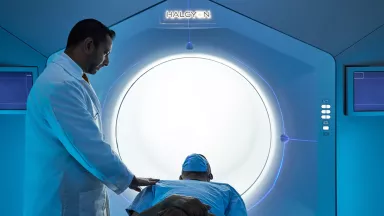
Como uno de los principales centros oncológicos del país, clasificado en el 1 % de los mejores hospitales del país en cuanto a atención médica del cáncer según U.S. News & World Report y reconocido por nuestra calidad en la atención médica del cáncer de próstata, brindamos atención compasiva y personalizada que cumple con los más altos estándares de calidad y seguridad. Ofrecemos tratamientos para toda la gama de cánceres urológicos, incluidos los de próstata, vejiga, riñón, testículos, uretra y pene. Además, nuestros médicos científicos colaboran estrechamente con los investigadores para desarrollar los últimos tratamientos para el cáncer de próstata, que incluyen el uso de radioterapia de fotones y protones, así como radiación de iones de carbono.
Nuestro centro del cáncer también ofrece prostatectomía radical y cirugía robótica de próstata de última generación. Nuestro objetivo es eliminar el cáncer, normalizar la función urinaria y restaurar la función sexual. Nuestro programa de recuperación del paciente apoya estos objetivos y, al mismo tiempo, da acceso a grupos de apoyo dirigidos por personal de enfermería.
Cuando necesite atención médica para el cáncer de próstata, confíe en nuestros proveedores, muy comprometidos con erradicar el cáncer y atender todas sus necesidades de salud.

El Montefiore Einstein Comprehensive Cancer Center, designado como centro integral del cáncer por el National Cancer Institute (NCI), apoya la misión y las normas del NCI. La siguiente información sobre los tipos de cáncer, prevención y tratamientos ha sido facilitada por el NCI.
Tratamiento del cáncer de próstata (PDQ®): versión para pacientes
Información general sobre el cáncer de próstata
Puntos clave
- El cáncer de próstata es un tipo de cáncer que se forma en los tejidos de la próstata.
- Los signos del cáncer de próstata pueden incluir un flujo urinario débil o micción frecuente.
- Para diagnosticar el cáncer de próstata se realizan pruebas que examinan la próstata y analizan muestras de sangre.
- Se realiza una biopsia para diagnosticar el cáncer de próstata y determinar el grado del cáncer a través de la puntuación de Gleason.
- Certain factors affect prognosis (chance of recovery) and treatment options.
El cáncer de próstata es un tipo de cáncer que se forma en los tejidos de la próstata.
La próstata es una glándula del sistema reproductor masculino. Se encuentra justo debajo de la vejiga (el órgano que recoge y vacía la orina) y delante del recto (la parte inferior del intestino). Tiene aproximadamente el tamaño de una nuez y rodea parte de la uretra (el conducto que vacía la orina de la vejiga). La glándula prostática produce un líquido que forma parte del semen.
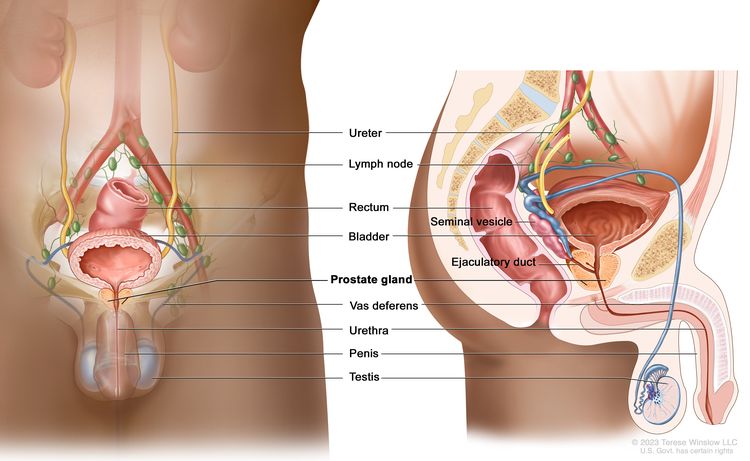
Anatomía de los sistemas reproductivo y urinario masculino que muestra los uréteres, la vejiga, la próstata, la uretra, el pene, los testículos y otros órganos.
El cáncer de próstata es más común en hombres mayores. En Estados Unidos, aproximadamente uno de cada ocho hombres recibirá un diagnóstico de esta enfermedad.
Los signos del cáncer de próstata pueden incluir un flujo urinario débil o micción frecuente.
Los siguientes signos y síntomas pueden estar relacionados con el cáncer de próstata u otras afecciones. Consulte con su médico si presenta:
- Dificultad para iniciar el flujo de orina
- Micción frecuente, especialmente durante la noche
- Dificultad para vaciar la vejiga por completo
- Flujo de orina débil o interrumpido (intermitente)
Cuando el cáncer de próstata se detecta en un estadio avanzado, los síntomas pueden ser:
- Dolor persistente en la espalda, caderas o pelvis
- Falta de aire, fatiga extrema, taquicardia, mareos o piel pálida, síntomas asociados con anemia
Otras afecciones pueden causar los mismos síntomas. A medida que los hombres envejecen, la próstata puede aumentar de tamaño y bloquear la uretra o la vejiga, lo que puede generar dificultades para orinar o problemas sexuales. Esta afección, conocida como hiperplasia prostática benigna (HPB) no es cáncer, pero en ciertos casos puede requerir una cirugía. Los síntomas de la HPB u otros problemas en la próstata pueden ser similares a los del cáncer de próstata.
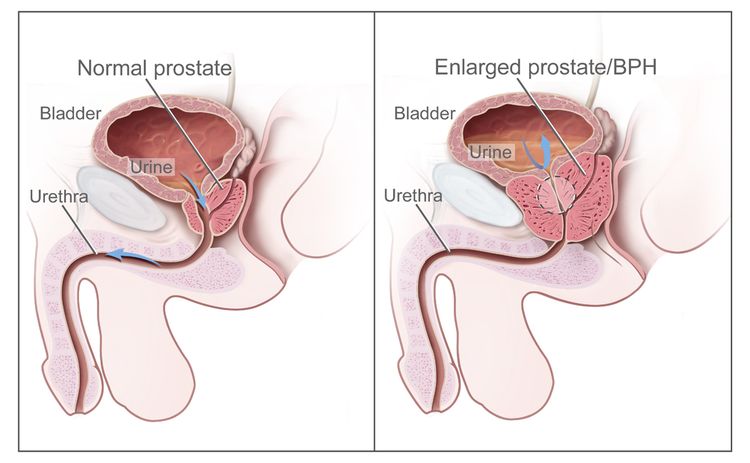
Próstata normal e hiperplasia prostática benigna (HPB). Una próstata normal no bloquea el flujo de orina desde la vejiga. Una próstata agrandada presiona la vejiga y la uretra y bloquea el flujo de orina.
Para diagnosticar el cáncer de próstata se realizan pruebas que examinan la próstata y analizan muestras de sangre.
In addition to asking about your personal and family health history and doing a physical exam, your doctor may perform the following tests and procedures:
- Examen rectal digital (ERD): examen del recto. El médico o enfermero inserta un dedo, con guante y lubricado, en el recto y palpa la próstata para detectar bultos o anómalas zonas.
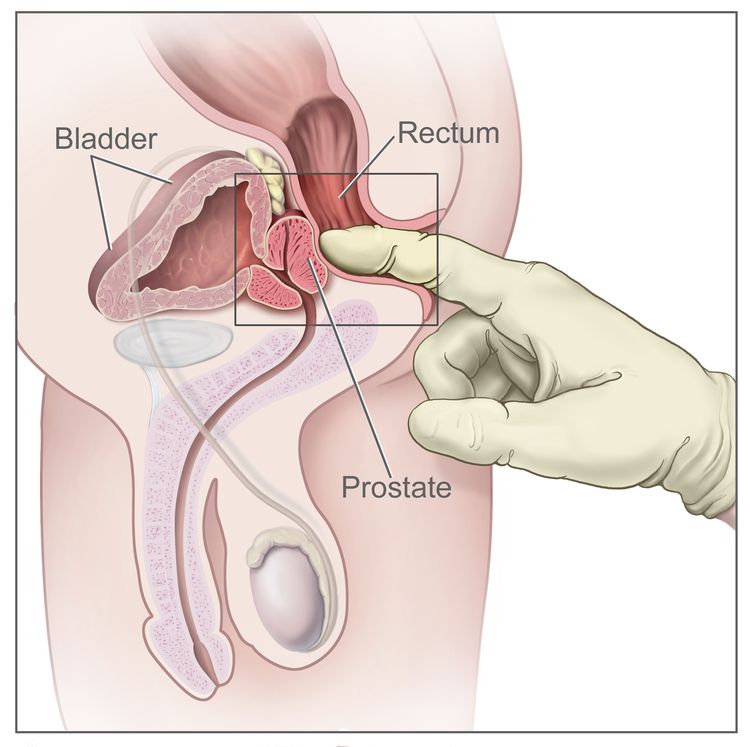
Examen rectal digital (ERD). El médico inserta un dedo, con guante y lubricado, en el recto y palpa el recto, el ano y la próstata (en los hombres) para detectar cualquier anomalía.
- Prueba del antígeno prostático específico (PSA): Esta prueba mide el nivel de PSA en la sangre. El PSA es una sustancia producida por la próstata que puede encontrarse en cantidades superiores a lo normal en la sangre de hombres con cáncer de próstata. Los niveles de PSA también pueden ser elevados en hombres con infección o inflamación de la próstata o hiperplasia prostática benigna (HPB, por sus siglas en inglés), que consiste en un agrandamiento de la próstata sin cáncer.
- PET con PSMA: procedimiento de imágenes utilizado para detectar células cancerosas de próstata que se han propagado más allá de la próstata, afectando los huesos, ganglios linfáticos u otros órganos. En este procedimiento, se inyecta en el cuerpo una molécula dirigida a las células, vinculada a una sustancia radiactiva, que viaja a través del torrente sanguíneo. Esta molécula se adhiere a la proteína denominada antígeno de membrana específico de la próstata (PSMA, por sus siglas en inglés), presente en la superficie de las células cancerosas de la próstata. Un escáner PET detecta altas concentraciones de esta molécula radiactiva, revelando la ubicación de las células malignas en el cuerpo. Se puede utilizar un PET con PSMA para ayudar a diagnosticar el cáncer de próstata que puede haber reaparecido o haberse extendido a otras partes del cuerpo. También se puede utilizar para ayudar a planificar el tratamiento.
- Ecografía transrectal: procedimiento en el que una sonda del tamaño de un dedo se introduce en el recto para examinar la próstata. La sonda se utiliza para hacer rebotar ondas sonoras de alta energía (ecografía) en los tejidos u órganos internos y producir ecos. Los ecos forman una imagen de los tejidos del cuerpo llamada ecograma. La ecografía transrectal se puede utilizar durante un procedimiento de biopsia . Esto se llama biopsia guiada por ecografía transrectal.
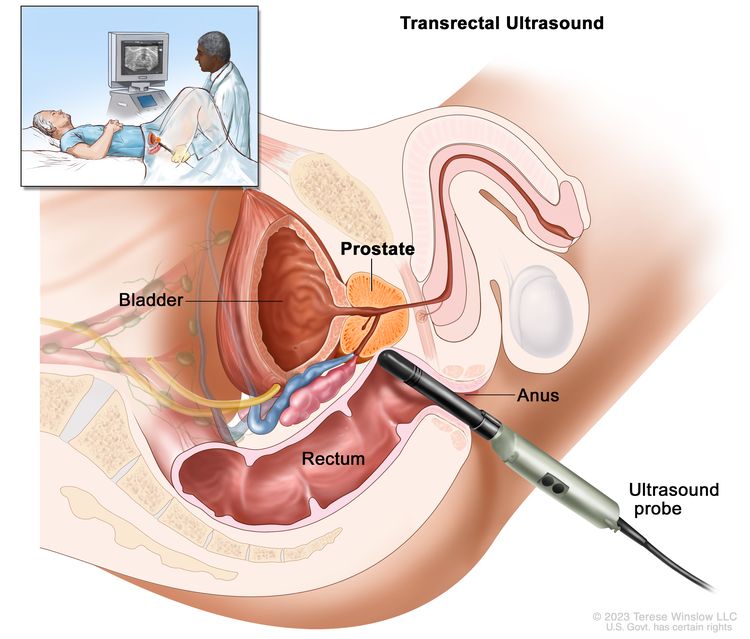
Ecografía transrectal. Se inserta una sonda de ultrasonido en el recto para examinar la próstata. La sonda emite ondas sonoras que rebotan en los tejidos corporales y producen ecos que forman un ecograma (imagen por computadora) de la próstata.
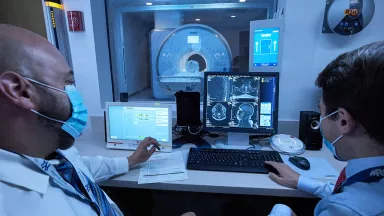
- Imágenes por resonancia magnética (RM) transrectal: procedimiento en el que se utiliza un imán potente, ondas de radio y una computadora para generar una serie de imágenes detalladas de áreas internas del cuerpo. Se inserta una sonda que emite ondas de radio en el recto cerca de la próstata. Esto ayuda a que la máquina de resonancia magnética obtenga imágenes más claras de la próstata y el tejido cercano. Se realiza una resonancia magnética transrectal para determinar si el cáncer se ha diseminado fuera de la próstata hacia los tejidos cercanos. Este procedimiento también se llama resonancia magnética nuclear (RMN). La resonancia magnética transrectal se puede utilizar durante un procedimiento de biopsia. Esto se llama biopsia transrectal guiada por resonancia magnética.
Se realiza una biopsia para diagnosticar el cáncer de próstata y determinar el grado del cáncer a través de la puntuación de Gleason.
La biopsia transrectal es un procedimiento utilizado para diagnosticar el cáncer de próstata. Consiste en la extracción de tejido prostático mediante la inserción de una aguja delgada que se introduce a través del recto hasta la próstata. Este procedimiento puede realizarse con ecografía transrectal o resonancia magnética transrectal, lo que ayuda a determinar con precisión el área de la que se tomarán las muestras. Un patólogo observa el tejido bajo un microscopio para detectar células cancerosas.
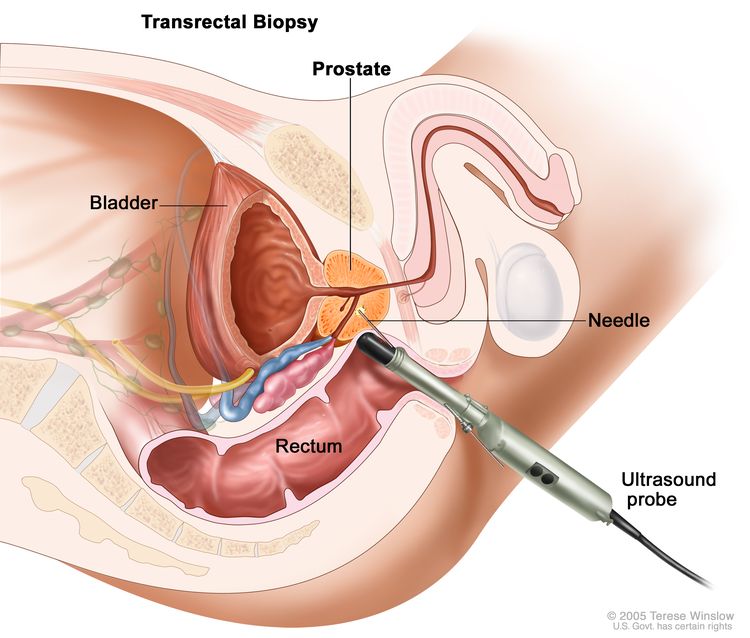
Biopsia transrectal. Se inserta una sonda de ultrasonido en el recto para mostrar la ubicación del tumor. Luego, se introduce una aguja a través del recto hasta la próstata para extraer muestras de tejido.
A veces, se realiza una biopsia utilizando una muestra de tejido extraída durante una resección transuretral de la próstata (RTUP), procedimiento empleado para tratar la hiperplasia prostática benigna.
Si se detecta cáncer, el patólogo le asignará un grado. El grado del cáncer describe el aspecto anómalo de las células cancerosas bajo el microscopio y la rapidez con la que es probable que crezca y se extienda el cáncer. El grado del cáncer se denomina puntuación de Gleason.
Para clasificar el cáncer, el patólogo analiza las muestras de tejido prostático para evaluar la similitud del tejido tumoral con el tejido prostático normal y para identificar los dos patrones celulares principales. El patrón primario representa el tipo tisular predominante, mientras que el patrón secundario es el siguiente patrón más común. Cada patrón recibe una calificación del 3 al 5, siendo el grado 3 el que más se asemeja al tejido prostático normal y el grado 5 es el más anómalo. Posteriormente, se suman ambos grados para obtener la puntuación de Gleason.
La puntuación de Gleason puede oscilar entre 6 y 10. Cuanto más alta sea la puntuación de Gleason, más probabilidades habrá de que el cáncer crezca y se propague rápidamente. Una puntuación de 6 indica un cáncer de bajo grado; una puntuación de 7 señala un cáncer de grado medio; y una puntuación de 8, 9 o 10 corresponde a un cáncer de alto grado. Por ejemplo, si el patrón de tejido predominante es de grado 3 y el patrón secundario es de grado 4, significa que la mayor parte del cáncer es de grado 3, con una menor presencia de grado 4. La suma de ambos resulta en una puntuación de Gleason de 7, lo cual indica un cáncer de grado medio. Esta puntuación puede expresarse como 3+4=7, Gleason 7/10 o puntuación de Gleason combinada de 7.
Certain factors affect prognosis (chance of recovery) and treatment options.
The prognosis and treatment options depend on:
- El estadio del cáncer, determinado por el nivel de PSA, la puntuación de Gleason, el grupo de grados, la extensión del cáncer dentro de la próstata y si se ha diseminado a otras partes del cuerpo
- La edad del paciente
- Si el cáncer acaba de ser diagnosticado o ha recidivado (regresado)
Las opciones de tratamiento también pueden depender de:
- La presencia de otros problemas de salud en el paciente
- Los efectos secundarios esperados del tratamiento
- Tratamientos previos del cáncer de próstata
- Los deseos de cada paciente
La mayoría de los hombres diagnosticados con cáncer de próstata no fallecen a causa de la enfermedad.
Estadios del cáncer de próstata
Puntos clave
- Una vez diagnosticado el cáncer de próstata, se realizan pruebas para determinar si las células cancerosas se han diseminado dentro de la próstata o hacia otras partes del cuerpo.
- There are three ways that cancer spreads in the body.
- El cáncer puede extenderse desde donde comenzó a otras partes del cuerpo.
- Para estadificar el cáncer de próstata se utiliza el grupo de grado y el nivel de PSA.
- Para clasificar el cáncer de próstata se utilizan los siguientes estadios:
- Estadio I
- Estadio II
- Estadio III
- Estadio IV
- El cáncer de próstata puede recidivar (regresar) después de haber sido tratado.
Una vez diagnosticado el cáncer de próstata, se realizan pruebas para determinar si las células cancerosas se han diseminado dentro de la próstata o hacia otras partes del cuerpo.
El proceso que se utiliza para determinar si el cáncer se ha propagado dentro de la próstata o a otras partes del cuerpo se denomina estadificación. La información obtenida a partir del proceso de estadificación determina el estadio de la enfermedad. Es importante conocer el estadio para planificar el tratamiento. Los resultados de las pruebas que se utilizan para diagnosticar el cáncer de próstata también se utilizan para estadificar la enfermedad (consulte la sección Información general). En el caso del cáncer de próstata, es posible que no se realicen pruebas de estadificación a menos que el paciente presente síntomas o signos de que el cáncer se ha propagado, como dolor en los huesos, niveles elevados de PSA o una puntuación de Gleason alta.
También se pueden utilizar las siguientes pruebas y procedimientos en el proceso de estadificación:
- Gammagrafía ósea: procedimiento para comprobar si hay divisiones rápidas de células, como las células cancerosas, en el hueso. Una cantidad muy pequeña de material de origen radioactivo se inyecta into a vena y viaja por el torrente sanguíneo. El material radiactivo se acumula en los huesos con cáncer y es detectado por un escáner.
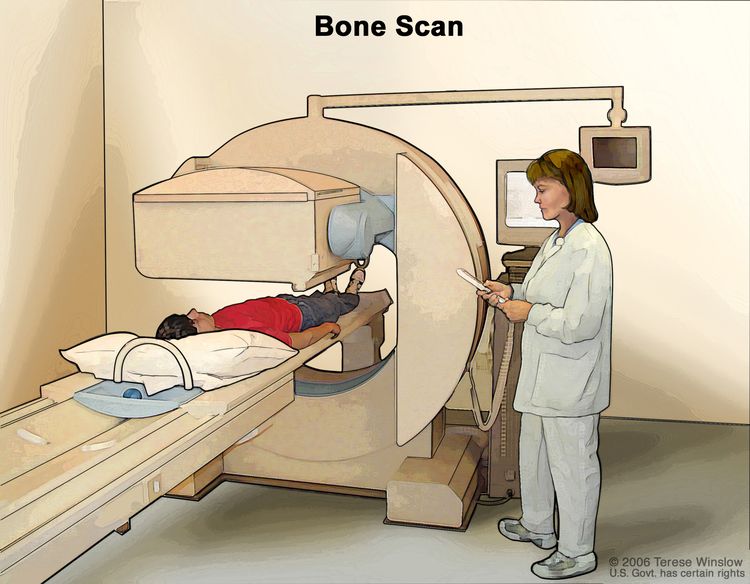
Gammagrafía ósea. Se inyecta una pequeña cantidad de material radiactivo en la vena del paciente y este circula por la sangre. El material radiactivo se acumula en los huesos. Mientras el paciente se recuesta sobre una camilla que se desliza bajo el escáner, se detecta el material radiactivo y se generan imágenes en la pantalla de una computadora.
- Resonancia magnética (magnetic resonance imaging): A procedure that uses a magnet, radio waves, and a computer to make a series of detailed pictures of areas inside the body. This procedure is also called nuclear magnetic resonance imaging (NMRI).
- Tomografía computarizada (TC): procedimiento en el que se utiliza una computadora conectada a una máquina de rayos X para generar una serie de imágenes detalladas de las estructuras internas del cuerpo desde diferentes ángulos y crear vistas tridimensionales de tejidos y órganos. Para mejorar la visibilidad de los órganos o tejidos, se puede inyectar en una vena un tinte de contraste, o ingerirlo. Este procedimiento también se denomina tomografía computarizada (TC), tomografía axial computarizada (TAC) o escáner axial computarizado.
- Linfadenectomía pélvica: procedimiento quirúrgico para extirpar los ganglios linfáticos de la pelvis. Un patólogo examina el tejido bajo el microscopio para detectar células cancerosas.
- Biopsia de vesículas seminales: extracción de líquido de las (glándulas de las vesículas seminales que producen semen) mediante una aguja. Un patólogo examina el líquido bajo un microscopio para buscar células cancerosas.
- Exploración ProstaScint: procedimiento para detectar si el cáncer se ha extendido desde la próstata a otras partes del cuerpo, como los ganglios linfáticos. Se inyecta una cantidad muy pequeña de material radiactivo en una vena y este viaja a través del torrente sanguíneo. El material radiactivo se adhiere a las células cancerosas de la próstata y se detecta mediante un escáner. El material radiactivo aparece como un punto brillante en la imagen en las zonas donde hay muchas células cancerosas de próstata.
There are three ways that cancer spreads in the body.
Cancer can spread through tissue, the lymph system, and the blood:
- Tissue. The cancer spreads from where it began by growing into nearby areas.
- Lymph system. The cancer spreads from where it began by getting into the lymph system. The cancer travels through the lymph vessels to other parts of the body.
- Blood. The cancer spreads from where it began by getting into the blood. The cancer travels through the blood vessels to other parts of the body.
El cáncer puede extenderse desde donde comenzó a otras partes del cuerpo.
Cuando el cáncer se extiende a otra parte del cuerpo se denomina metástasis. Las células cancerosas se desprenden de donde comenzaron (tumor primario) y viajan a través del sistema linfático o la sangre.
- Sistema linfático: el cáncer entra en el sistema linfático, viaja a través de los vasos linfáticos y forma un tumor (tumor metastásico) en otra parte del cuerpo.
- Sangre: el cáncer llega a la sangre, viaja a través de los vasos sanguíneos y forma un tumor (tumor metastásico) en otra parte del cuerpo.
El tumor metastásico es el mismo tipo de cáncer que el tumor primario. Por ejemplo, si el cáncer de próstata se propaga al hueso, las células cancerosas en el hueso son, en realidad, células de cáncer de próstata. La enfermedad es cáncer de próstata metastásico, y no cáncer de huesos.
Para prevenir metástasis óseas puede utilizarse denosumab, un anticuerpo monoclonal.
Para estadificar el cáncer de próstata se utiliza el grupo de grado y el nivel de PSA.
El estadio del cáncer se determina a partir de los resultados de las pruebas de estadificación y diagnóstico, incluida la prueba del antígeno prostático específico (PSA) y el grupo de grado. Las muestras de tejido extraídas durante la biopsia se utilizan para calcular la puntuación de Gleason, que oscila entre 2 y 10. Esta puntuación describe el grado de diferencia entre las células cancerosas y las células normales al observarlas con un microscopio y la probabilidad de que el tumor se extienda. Cuanto menor sea el número, más se parecerán las células cancerosas a las células normales y más probable será que crezcan y se extiendan lentamente.
El grupo de grado está determinado por la puntuación de Gleason. Consulte la sección Información general para saber más sobre la puntuación de Gleason.
- El grupo de grado 1 tiene una puntuación de Gleason de 6 o menos.
- El grupo de grado 2 o 3 tiene una puntuación de Gleason de 7.
- El grupo de grado 4 tiene una puntuación de Gleason de 8.
- El grupo de grado 5 tiene una puntuación de Gleason de 9 o 10.
La prueba de PSA mide el nivel de PSA en la sangre. El PSA es una sustancia producida por la próstata, que puede encontrarse en mayor cantidad en la sangre de los hombres con cáncer de próstata.
Para clasificar el cáncer de próstata se utilizan los siguientes estadios:
Estadio I
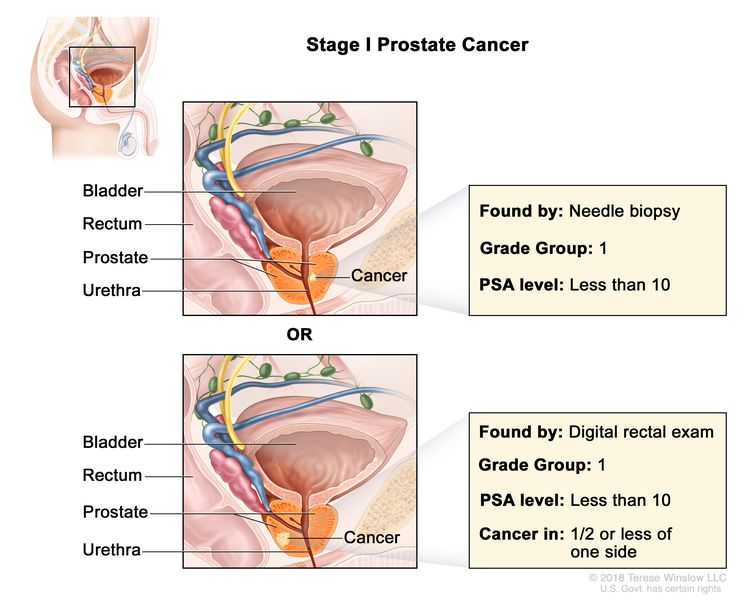
Cáncer de próstata en estadio I. El cáncer se encuentra solo en la próstata. No se detecta durante un examen rectal digital, sino mediante una biopsia con aguja realizada para determinar un nivel elevado de antígeno prostático específico (PSA) o en una muestra de tejido obtenida durante una cirugía por otros motivos. El nivel de PSA es inferior a 10 y el grupo de grado es 1. En algunos casos, el cáncer puede detectarse durante un examen rectal digital, encontrándose en la mitad o menos de un lado de la próstata. Aun así, el nivel de PSA sigue siendo inferior a 10 y el grupo de grado es 1.
En el estadio I, el cáncer se encuentra únicamente en la próstata y además:
- El cáncer no se detecta durante un examen rectal digital y se encuentra mediante una biopsia con aguja (realizada debido a un nivel alto de PSA) o en una muestra de tejido extirpado durante una cirugía por otros motivos (como hiperplasia prostática benigna). El nivel de PSA es inferior a 10 y el grupo de grado es 1.
- El cáncer se palpa durante un tacto rectal y se encuentra en la mitad o menos de un lado de la próstata. El nivel de PSA es inferior a 10 y el grupo de grado es 1.
Estadio II
En el estadio II, el cáncer está más avanzado que en el estadio I, pero no se ha extendido fuera de la próstata. El estadio II se divide en los estadios IIA, IIB y IIC.
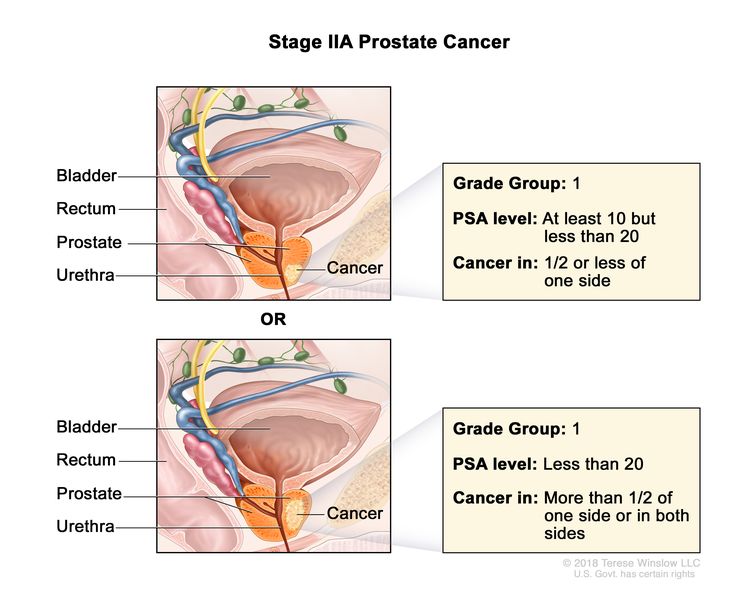
Cáncer de próstata en estadio IIA. El cáncer se encuentra únicamente en la próstata. Puede estar presente en la mitad o menos de un lado de la próstata, con un nivel de antígeno prostático específico (PSA) de al menos 10 pero menos de 20, y el grupo de grado es 1. O bien el cáncer se encuentra en más de la mitad de un lado de la próstata o en ambos lados de la próstata. En este caso, el nivel de PSA es inferior a 20 y el grupo de grado es 1.
En el estadio IIA:
- El cáncer se encuentra en la mitad o menos de un lado de la próstata. El nivel de PSA es de al menos 10 pero inferior a 20 y el grupo de grado es 1.
- El cáncer se encuentra en más de la mitad de un lado de la próstata o en ambos lados de la próstata. En este caso, el nivel de PSA es inferior a 20 y el grupo de grado es 1.

Cáncer de próstata en estadio IIB. El cáncer se encuentra solo en la próstata y puede estar presente en uno o ambos lados de la próstata. El nivel de antígeno prostático específico (PSA) es inferior a 20 y el grupo de grado es 2.
En el estadio IIB:
- El cáncer se encuentra en uno o ambos lados de la próstata. El nivel de PSA es inferior a 20 y el grupo de grado es 2.
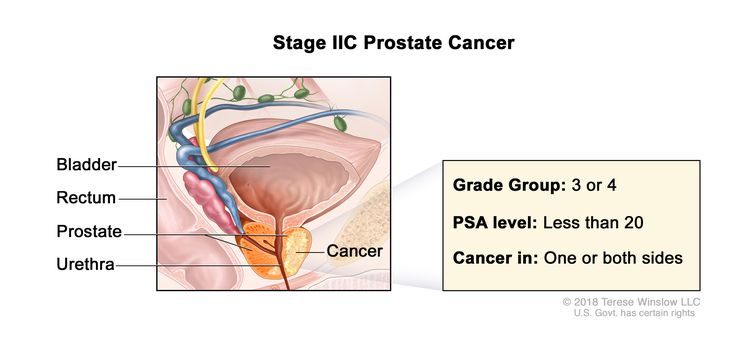
Cáncer de próstata en estadio IIC. El cáncer se encuentra solo en la próstata y está presente en uno o ambos lados de la próstata. El nivel de antígeno prostático específico (PSA) es inferior a 20 y el grupo de grado es 3 o 4.
En el estadio IIC:
- El cáncer se encuentra en uno o ambos lados de la próstata. El nivel de PSA es inferior a 20 y el grupo de grado es 3 o 4.
Estadio III
El estadio III se divide en los estadios IIIA, IIIB y IIIC.
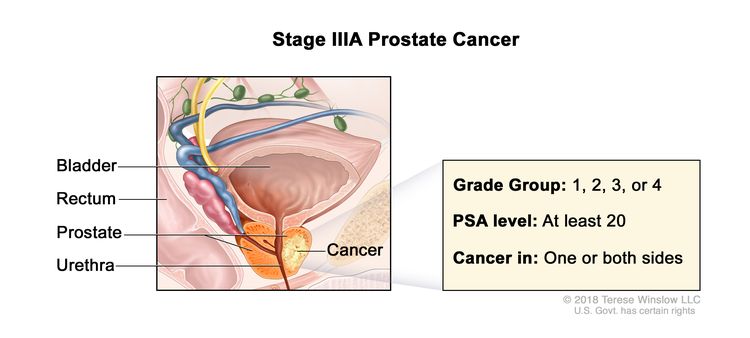
Cáncer de próstata en estadio IIIA. El cáncer se encuentra solo en la próstata. El cáncer se encuentra en uno o ambos lados de la próstata. El nivel de antígeno prostático específico (PSA) es al menos 20 y el grupo de grado es 1, 2, 3 o 4.
En el estadio IIIA:
- El cáncer se encuentra en uno o ambos lados de la próstata. El nivel de PSA es al menos 20 y el grupo de grado es 1, 2, 3 o 4.
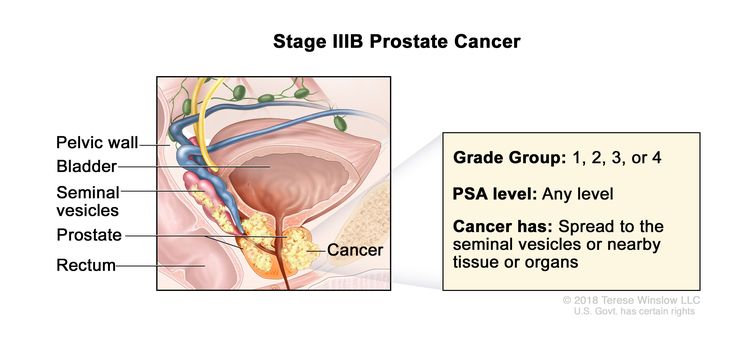
Cáncer de próstata en estadio IIIB. El cáncer se ha extendido desde la próstata hasta las vesículas seminales o hacia los tejidos u órganos cercanos, como el recto, la vejiga o la pared pélvica. El antígeno prostático específico puede ser de cualquier nivel y el grupo de grado es 1, 2, 3 o 4.
En el estadio IIIB:
- El cáncer se ha extendido desde la próstata a las vesículas seminales o al tejido u órganos cercanos, como el recto, la vejiga o la pared pélvica. El PSA puede ser de cualquier nivel, y el grupo de grado es 1, 2, 3 o 4.
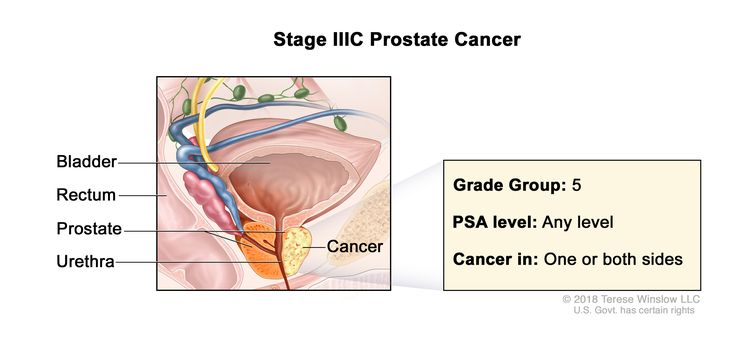
Cáncer de próstata en estadio IIIC. El cáncer se encuentra en uno o ambos lados de la próstata y es posible que se haya extendido a las vesículas seminales o al tejido u órganos cercanos, como el recto, la vejiga o la pared pélvica. El antígeno prostático específico (PSA) puede ser de cualquier nivel, y el grupo de grado es 5.
En el estadio IIIC:
- El cáncer se encuentra en uno o ambos lados de la próstata y puede haberse extendido a las vesículas seminales o a tejidos u órganos cercanos, como el recto, la vejiga o la pared pélvica. El PSA puede ser de cualquier nivel, y el grupo de grado es 5.
Estadio IV
Stage IV is divided into stages IVA and IVB.
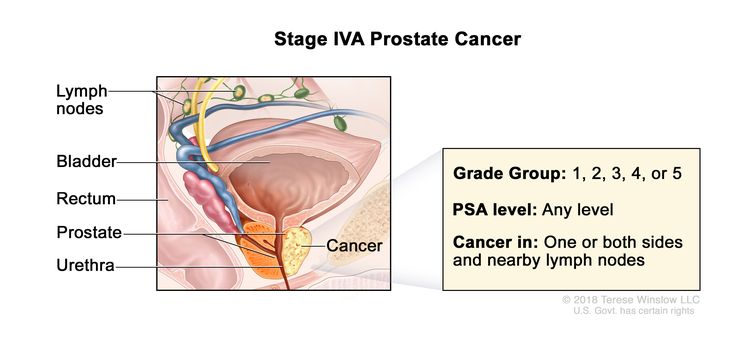
Cáncer de próstata en estadio IVA. El cáncer se encuentra en uno o ambos lados de la próstata y puede haberse propagado a las vesículas seminales o al tejido u órganos cercanos, como el recto, la vejiga o la pared pélvica. El cáncer se ha propagado a los ganglios linfáticos cercanos. El antígeno prostático específico (PSA) puede ser de cualquier nivel, y el grupo de grado es 1, 2, 3, 4 o 5.
En el estadio IVA:
- El cáncer se encuentra en uno o ambos lados de la próstata y puede haberse extendido a las vesículas seminales o al tejido u órganos cercanos, como el recto, la vejiga o la pared pélvica. El cáncer se ha extendido a los ganglios linfáticos cercanos. El PSA puede ser de cualquier nivel, y el grupo de grado es 1, 2, 3, 4 o 5.
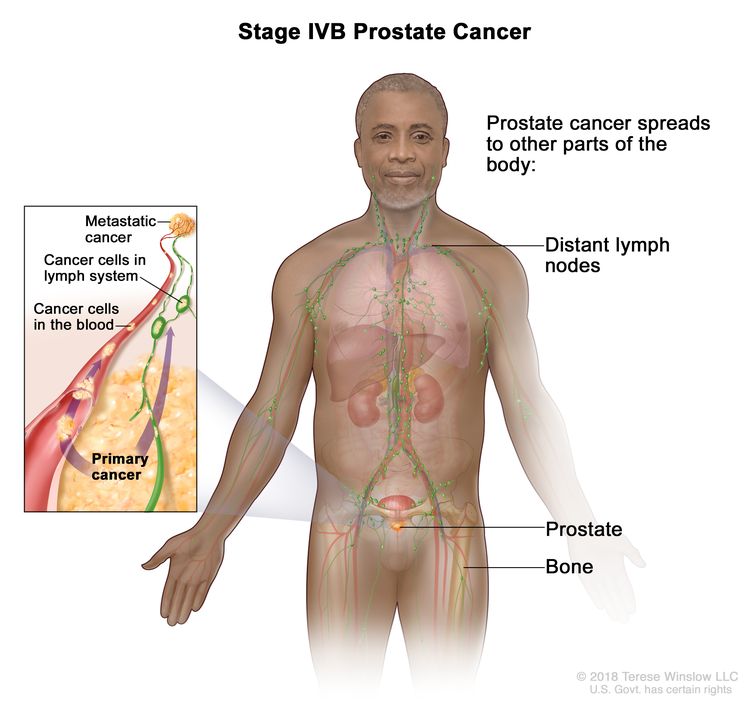
Cáncer de próstata en estadio IVB. El cáncer se ha extendido a otras partes del cuerpo, como a los huesos o a los ganglios linfáticos distantes.
En el estadio IVB:
- El cáncer se ha extendido a otras partes del cuerpo, como los huesos o ganglios linfáticos distantes. El cáncer de próstata a menudo se extiende a los huesos.
El cáncer de próstata puede recidivar (regresar) después de haber sido tratado.
El cáncer puede reaparecer en la próstata o en otras partes del cuerpo.
Treatment Option Overview
Puntos clave
- Existen diferentes tipos de tratamiento para personas con cáncer de próstata.
- The following types of treatment are used:
- Observación cuidadosa o vigilancia activa
- Cirugía
- Radioterapia y terapia radiofarmacéutica
- Terapia hormonal
- Quimioterapia
- Terapia dirigida
- Inmunoterapia
- Terapia con bisfosfonatos
- Existen tratamientos para el dolor de huesos causado por metástasis óseas o terapia hormonal.
- New types of treatment are being tested in clinical trials.
- Cryosurgery
- Terapia de ultrasonido focalizado de alta intensidad
- Radioterapia con haz de protones
- Terapia fotodinámica
- El tratamiento para el cáncer de próstata puede causar efectos secundarios.
- Patients may want to think about taking part in a clinical trial.
- Patients can enter clinical trials before, during, or after starting their cancer treatment.
- Es posible que se necesiten cuidados de seguimiento.
Existen diferentes tipos de tratamiento para personas con cáncer de próstata.
Existen diferentes tipos de tratamientos disponibles para los pacientes con cáncer de próstata. Algunos son estándar (es decir, los tratamientos que se utilizan actualmente) y otros se están evaluando en ensayos clínicos. Un ensayo clínico de tratamiento es un estudio de investigación cuyo objetivo es mejorar los tratamientos existentes y obtener información sobre nuevos tratamientos para pacientes con cáncer. Cuando los ensayos clínicos demuestran que un nuevo tratamiento es mejor que el tratamiento estándar, este puede convertirse en el tratamiento estándar. Los pacientes podrían valorar la posibilidad de participar en un ensayo clínico. Algunos ensayos clínicos están abiertos solo a pacientes que no han comenzado el tratamiento.
The following types of treatment are used:
Observación cuidadosa o vigilancia activa
La observación cuidadosa y la vigilancia activa son opciones de tratamientos que se utilizan en hombres mayores que no presentan signos ni síntomas, que tienen otras afecciones médicas o en aquellos hombres cuyo cáncer de próstata se detecta durante una prueba de detección.
La observación cuidadosa consiste en controlar de cerca el estado del paciente sin administrar ningún tratamiento hasta que aparezcan o cambien los signos o síntomas. El tratamiento se administra para aliviar los síntomas y mejorar la calidad de vida.
La vigilancia activa consiste en seguir de cerca el estado del paciente sin aplicar ningún tratamiento, a menos que haya cambios en los resultados de las pruebas. Se utiliza para identificar signos tempranos de que la enfermedad está empeorando. En la vigilancia activa, a los pacientes se les realizan ciertos exámenes y pruebas, como el examen rectal digital, la prueba del PSA, la ecografía transrectal y la biopsia transrectal con aguja, para verificar si el cáncer está creciendo. Cuando el cáncer comienza a crecer, se administra un tratamiento curativo.
Otros términos que se utilizan para describir el hecho de no administrar tratamiento para curar el cáncer de próstata inmediatamente después del diagnóstico son observación, vigilancia y espera, y manejo expectante.
Cirugía
Los pacientes con buena salud cuyo tumor se encuentra únicamente en la glándula prostática pueden ser tratados con cirugía con el fin de extirpar el tumor. Se utilizan los siguientes tipos de cirugía:
- Prostatectomía radical: procedimiento quirúrgico para extirpar la próstata, que rodea los tejidos, and vesículas seminales. La eliminación de los ganglios linfáticos cercanos se puede hacer al mismo tiempo. Los principales tipos de prostatectomía radical son:
- Prostatectomía radical abierta: se realiza una incisión (corte) en la zona retropúbica (parte inferior del abdomen) o en el perineo (la zona entre el ano y el escroto). La cirugía se realiza a través de la incisión. Es más difícil para el cirujano preservar los nervios cercanos a la próstata o extirpar los ganglios linfáticos cercanos mediante la prostatectomía perineal.
- Prostatectomía radical laparoscópica: se realizan varias incisiones (cortes) pequeñas en la pared del abdomen. Se inserta un laparoscopio (un instrumento delgado en forma de tubo con una luz y una lente para observar) a través de una abertura para guiar la cirugía. Se introducen instrumentos quirúrgicos a través de las otras aberturas para realizar la cirugía.
- Prostatectomía radical laparoscópica asistida por robot: se realizan varios cortes pequeños en la pared del abdomen, como en la prostatectomía laparoscópica regular. El cirujano inserta un instrumento con una cámara a través de una de las aberturas, e instrumentos quirúrgicos a través de las otras aberturas utilizando brazos robóticos. La cámara le da al cirujano una vista tridimensional de la próstata y las estructuras circundantes. El cirujano utiliza los brazos robóticos para realizar la cirugía mientras está sentado frente a un monitor de computadora, cerca de la mesa de operaciones.
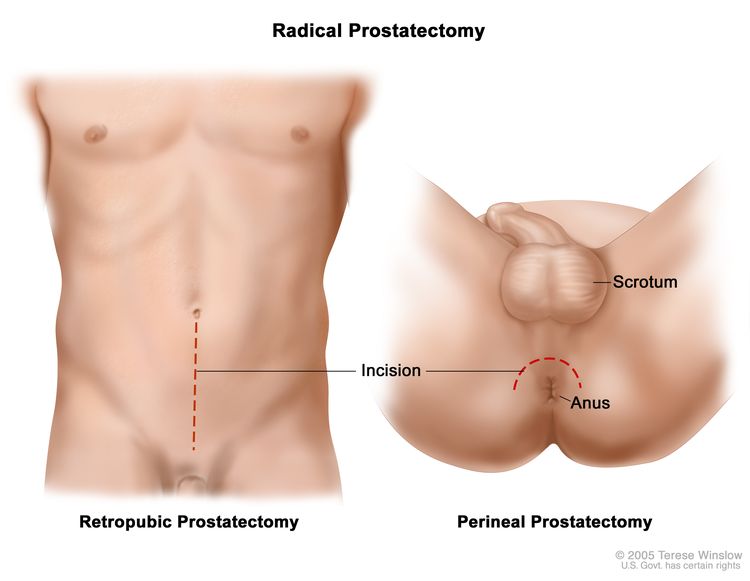
Dos tipos de prostatectomía radical. En una prostatectomía retropúbica, la próstata se extrae a través de una incisión en la pared del abdomen. En una prostatectomía perineal, la próstata se extrae a través de una incisión en la zona entre el escroto y el ano.
- Linfadenectomía pélvica: procedimiento quirúrgico para extirpar los ganglios linfáticos de la pelvis. Un patólogo examina el tejido bajo el microscopio para detectar células cancerosas. Si los ganglios linfáticos contienen cáncer, el médico no extirpará la próstata y puede recomendar otro tratamiento.
- Resección transuretral de la próstata (RTUP): procedimiento quirúrgico para extirpar tejido de la próstata mediante un resectoscopio (un tubo delgado e iluminado con una herramienta cortante) que se inserta a través del uretra. Este procedimiento se realiza para tratar la hipertrofia prostática benigna y a veces se hace para aliviar los síntomas causados por un tumor antes de que se administre otro tratamiento contra el cáncer. La TURP también se puede realizar en hombres cuyo tumor se encuentra solo en la próstata y que no pueden someterse a una prostatectomía radical.
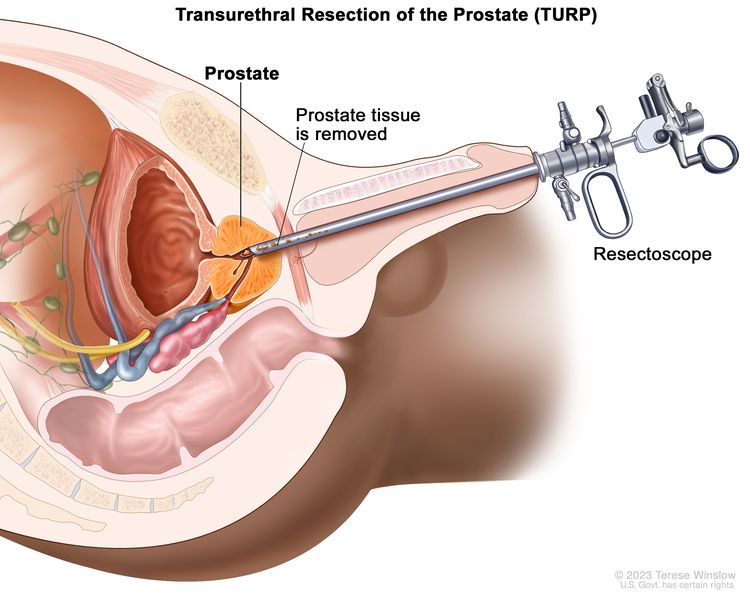
Resección transuretral de la próstata (RTUP). El tejido se extrae de la próstata con un resectoscopio, un tubo delgado e iluminado con una herramienta cortante en el extremo, que se inserta a través de la uretra. El tejido prostático que bloquea la uretra se corta y se extrae a través del resectoscopio.
En algunos casos, los nervios que controlan la erección del pene pueden salvarse con una cirugía que preserva los nervios. Sin embargo, esto puede no ser posible en hombres con tumores grandes o tumores que están muy cerca de los nervios.
Algunos problemas que pueden aparecer después de la cirugía de cáncer de próstata son:
- Impotencia.
- Pérdida involuntaria de orina de la vejiga o de heces del recto
- Acortamiento del pene (entre 1 y 2 centímetros). Se desconoce la razón exacta de este fenómeno.
- Hernia inguinal (abultamiento de grasa o parte del intestino delgado a través de músculos débiles hacia la ingle). La hernia inguinal puede darse con más frecuencia en hombres tratados con prostatectomía radical que en hombres que se someten a otros tipos de cirugía de próstata, radioterapia o biopsia de próstata. Es más probable que se dé dentro de los primeros dos años después de la prostatectomía radical.
Radioterapia y terapia radiofarmacéutica
La radioterapia es un tratamiento contra el cáncer que utiliza rayos X de alta energía u otros tipos de radiación para matar las células cancerosas o evitar que crezcan. Existen diferentes tipos de radioterapia:
- Radioterapia externa se usa una máquina que envía radiación desde el exterior del cuerpo hacía el área en la que se encuentra el cáncer. La radiación conformada es un tipo de radioterapia externa que usa una computadora para hacer una tridimensional imagen del tumor y adapta los haces de radiación para que se ajusten al tumor. Esto permite que llegue al tumor una dosis alta de radiación y cause menos daño al tejido sano circundante.
Se puede administrar radioterapia hipofraccionada porque tiene un programa de tratamiento más conveniente. La radioterapia hipofraccionada es un tratamiento de radiación en el que se administra una dosis total de radiación mayor a la habitual, una vez al día, durante un periodo de tiempo más corto (menos días) en comparación con la radioterapia estándar. La radioterapia hipofraccionada puede tener peores efectos secundarios que la radioterapia estándar, dependiendo de los programas utilizados.
- En la radioterapia interna se utiliza una sustancia radiactiva sellada en agujas, semillas, alambres o catéteres, que se colocan directamente dentro o cerca del cáncer. En el cáncer de próstata en estadio inicial, se colocan las semillas radiactivas en la próstata mediante agujas insertadas a través de la piel que hay entre el escroto y el recto. La colocación de las semillas radiactivas en la próstata se guía por imágenes de ecografía transrectal o tomografía computarizada (TC). Las agujas se retiran después de colocar las semillas radiactivas en la próstata.
- radiofarmacéutico terapia se utiliza una sustancia de origen radioactivo para tratar el cáncer. La terapia con radiofármacos incluye:
- En la radioterapia con emisores alfa se utiliza una sustancia radiactiva para tratar el cáncer de próstata que se ha diseminado al hueso. Se inyecta una sustancia radiactiva llamada radio-223 en una vena, y viaja a través del torrente sanguíneo. La radio-223 se acumula en zonas de hueso con cáncer y destruye las células cancerosas.
La forma en que se administra la radioterapia depende del tipo y estadio del cáncer que se está tratando. Para tratar el cáncer de próstata se utiliza la radioterapia externa, la radioterapia interna y la terapia radiofarmacéutica.
Los hombres con tratamiento de radioterapia para el cáncer de próstata tienen un mayor riesgo de desarrollar cáncer de vejiga y/o gastrointestinal.
La radioterapia puede causar impotencia y problemas urinarios, que pueden empeorar con la edad.
Terapia hormonal
La terapia hormonal es un tratamiento contra el cáncer que elimina hormonas o bloquea su acción, deteniendo así el crecimiento de las células cancerosas. Las hormonas son sustancias producidas por glándulas del cuerpo y que circulan por el torrente sanguíneo. En el cáncer de próstata, las hormonas sexuales masculinas pueden estimular el crecimiento del propio cáncer. Para reducir la cantidad de hormonas masculinas o impedir que funcionen, se utilizan medicamentos, cirugía u otras hormonas. A este enfoque se le conoce como terapia de privación de andrógenos (TPA).
En la terapia hormonal para el cáncer de próstata se puede utilizar:
- El acetato de abiraterona puede impedir que las células cancerosas de próstata produzcan andrógenos. Se utiliza en hombres con cáncer de próstata avanzado que no ha mejorado con otras terapias hormonales. También se emplea en hombres con cáncer de próstata de alto riesgo, que han respondido favorablemente a tratamientos que reducen los niveles hormonales.
- La orquiectomía es un procedimiento quirúrgico para extirpar uno o ambos testículos, la principal fuente de hormonas masculinas, como la testosterona, con el objetivo de disminuir la cantidad de hormona producida.
- Los estrógenos (hormonas que promueven las características sexuales femeninas) pueden impedir que los testículos produzcan testosterona. Sin embargo, los estrógenos rara vez se utilizan hoy en día en el tratamiento del cáncer de próstata, debido al riesgo de efectos secundarios graves.
- Los agonistas de la hormona liberadora de hormona luteinizante pueden impedir que los testículos produzcan testosterona. Algunos ejemplos son leuprolida, goserelina y buserelina.
- Los antiandrógenos pueden bloquear la acción de los andrógenos (hormonas que promueven las características sexuales masculinas), como la testosterona. Algunos ejemplos son la flutamida, la bicalutamida, la enzalutamida, la apalutamida, la nilutamida y la darolutamida .
- Los medicamentos que pueden impedir que las glándulas suprarrenales produzcan andrógenos son ketoconazol, aminoglutetimida, hidrocortisona y progesterona.
Los hombres tratados con terapia hormonal pueden experimentar sofocos, deterioro de la función sexual, pérdida del deseo sexual y debilitamiento óseo. Otros efectos secundarios incluyen diarrea, náuseas y picazón.
Para obtener más información, consulte Medicamentos aprobados para el cáncer de próstata.
Quimioterapia
La quimioterapia es un tratamiento contra el cáncer que emplea medicamentos para frenar el crecimiento de las células cancerosas, ya sea destruyéndolas o impidiendo su división. Cuando la quimioterapia se toma por vía oral o se inyecta en una vena o músculo, los medicamentos ingresan al torrente sanguíneo y pueden llegar a las células cancerosas de todo el cuerpo (quimioterapia sistémica).
Para obtener más información, consulte Medicamentos aprobados para el cáncer de próstata.
Terapia dirigida
La terapia dirigida es un tipo de tratamiento que utiliza medicamentos u otras sustancias para identificar y atacar células cancerosas específicas.
- Los inhibidores de PARP bloquean una enzima involucrada en muchas funciones celulares, incluida la reparación del daño del ADN. Al bloquear esta enzima, se puede impedir que las células cancerosas reparen su ADN dañado, provocando así su muerte. El olaparib es un inhibidor de PARP utilizado para tratar pacientes con cáncer de próstata que se ha extendido a otras partes del cuerpo y presenta mutaciones en ciertos genes, como BRCA1 o BRCA2.
Inmunoterapia
La inmunoterapia es un tratamiento que utiliza el sistema inmunitario del paciente para combatir el cáncer. Se utilizan sustancias producidas por el cuerpo o en un laboratorio para reforzar, dirigir o restaurar las defensas naturales del cuerpo contra el cáncer. La sipuleucel-T es un tipo de inmunoterapia que se utiliza para tratar el cáncer de próstata que ha producido metástasis (se ha extendido a otras partes del cuerpo).
Para obtener más información, consulte Medicamentos aprobados para el cáncer de próstata.
Terapia con bisfosfonatos
Los medicamentos bifosfonatos, como el clodronato o el zoledronato, ayudan a reducir la enfermedad ósea cuando el cáncer se ha diseminado al hueso. Los hombres que reciben tratamiento con terapia antiandrógena u orquiectomía tienen un mayor riesgo de pérdida ósea. En estos casos, los bifosfonatos pueden disminuir el riesgo de fracturas óseas. Actualmente, se están realizando ensayos clínicos para evaluar el uso de bifosfonatos en la prevención o ralentización del crecimiento de las metástasis óseas.
Existen tratamientos para el dolor de huesos causado por metástasis óseas o terapia hormonal.
El cáncer de próstata que se ha extendido a los huesos y ciertos tipos de terapia hormonal pueden debilitar los huesos y provocar dolor de huesos. Los tratamientos para el dolor de huesos son:
- Medicina para el dolor
- Radioterapia externa
- Estroncio-89 (un radioisótopo ).
- Terapia dirigida con un anticuerpo monoclonal, como denosumab
- Terapia con bisfosfonatos
- Corticosteroides.
Para obtener más información, consulte El dolor y el cáncer.
New types of treatment are being tested in clinical trials.
En esta sección se resumen los tratamientos que se están estudiando en ensayos clínicos. Es posible que no se mencionen todos los tratamientos nuevos que se están estudiando. La información sobre los ensayos clínicos está disponible en el sitio web del NCI.
Cryosurgery
La criocirugía es un tratamiento en el que se emplea un instrumento especializado para congelar y destruir las células cancerosas de la próstata. La ecografía se utiliza para localizar con precisión el área que será tratada. Este tipo de procedimiento también se conoce como crioterapia.
La criocirugía puede provocar impotencia y pérdida involuntaria de orina de la vejiga o heces del recto.
Terapia de ultrasonido focalizado de alta intensidad
La terapia con ultrasonido focalizado de alta intensidad es un tratamiento en el que se utiliza ultrasonidos (ondas sonoras de alta energía) para destruir las células cancerosas. Para tratar el cáncer de próstata, se utiliza una sonda endorrectal para crear las ondas sonoras.
Radioterapia con haz de protones
La radioterapia con haz de protones es un tipo de radioterapia externa de alta energía en el que se utilizan corrientes de protones (partículas diminutas con carga positiva) para destruir las células tumorales. Este tratamiento puede reducir el daño por radiación en el tejido sano cerca de un tumor.
Terapia fotodinámica
Un tratamiento contra el cáncer en el que se utiliza un medicamento y un tipo determinado de luz láser para destruir las células cancerosas. Se inyecta en una vena un medicamento que no es activo hasta que se expone a la luz. El medicamento se acumula más en las células cancerosas que en las normales. A continuación, se utilizan tubos de fibra óptica para llevar la luz láser a las células cancerosas, donde el medicamento se activa y destruye las células. La terapia fotodinámica causa poco daño al tejido sano. Se utiliza principalmente para tratar tumores en la piel o justo debajo de ella o en el revestimiento de los órganos internos.
El tratamiento para el cáncer de próstata puede causar efectos secundarios.
For information about side effects caused by treatment for cancer, visit our Side Effects page.
Patients may want to think about taking part in a clinical trial.
For some patients, taking part in a clinical trial may be the best treatment choice. Clinical trials are part of the cancer research process. Clinical trials are done to find out if new cancer treatments are safe and effective or better than the standard treatment.
Many of today's standard treatments for cancer are based on earlier clinical trials. Patients who take part in a clinical trial may receive the standard treatment or be among the first to receive a new treatment.
Patients who take part in clinical trials also help improve the way cancer will be treated in the future. Even when clinical trials do not lead to effective new treatments, they often answer important questions and help move research forward.
Patients can enter clinical trials before, during, or after starting their cancer treatment.
Some clinical trials only include patients who have not yet received treatment. Other trials test treatments for patients whose cancer has not gotten better. There are also clinical trials that test new ways to stop cancer from recurring (coming back) or reduce the side effects of cancer treatment.
Clinical trials are taking place in many parts of the country. Information about clinical trials supported by NCI can be found on NCI’s clinical trials search webpage. Clinical trials supported by other organizations can be found on the ClinicalTrials.gov website.
Es posible que se necesiten cuidados de seguimiento.
A medida que avanza el tratamiento, se le realizarán pruebas o controles de seguimiento. Es posible que se repitan algunas pruebas para diagnosticar o estadificar el cáncer con el fin de evaluar cómo está funcionando el tratamiento. Las decisiones sobre si continuar, modificar o suspender el tratamiento pueden basarse en los resultados de estas pruebas.
Algunas pruebas seguirán realizándose de manera periódica después de terminar el tratamiento. Los resultados pueden indicar si su afección ha cambiado o si el cáncer ha redicivado (regresado).
Tratamiento del cáncer de próstata en estadio I
For information about the treatments listed below, see the Treatment Option Overview section.
El tratamiento del cáncer de próstata en estadio I puede consistir en:
- Observación cuidadosa.
- Vigilancia activa. Si el cáncer comienza a crecer, se puede administrar terapia hormonal.
- Prostatectomía radical, generalmente con linfadenectomía pélvica. Se puede administrar radioterapia después de la cirugía.
- Radioterapia externa. Se puede administrar terapia hormonal después de la radioterapia.
- Radioterapia interna con semillas radiactivas
Puede utilizar la búsqueda de ensayos clínicos y encontrar ensayos clínicos sobre cáncer patrocinados por el NCI que acepten participantes. La búsqueda le permite filtrar los ensayos según el tipo de cáncer, la edad y el lugar donde se realizan los ensayos. También encontrará información general sobre los ensayos clínicos.
Tratamiento del cáncer de próstata en estadio II
For information about the treatments listed below, see the Treatment Option Overview section.
El tratamiento del cáncer de próstata en estadio II puede consistir en:
- Observación cuidadosa.
- Vigilancia activa. Si el cáncer comienza a crecer, se puede administrar terapia hormonal.
- Prostatectomía radical, generalmente con linfadenectomía pélvica. Se puede administrar radioterapia después de la cirugía.
- Radioterapia externa. Se puede administrar terapia hormonal después de la radioterapia.
- Radioterapia interna con semillas radiactivas
Puede utilizar la búsqueda de ensayos clínicos y encontrar ensayos clínicos sobre cáncer patrocinados por el NCI que acepten participantes. La búsqueda le permite filtrar los ensayos según el tipo de cáncer, la edad y el lugar donde se realizan los ensayos. También encontrará información general sobre los ensayos clínicos.
Tratamiento del cáncer de próstata en estadio III
For information about the treatments listed below, see the Treatment Option Overview section.
El tratamiento del cáncer de próstata en estadio III puede consistir en:
- Radioterapia externa. Se puede administrar terapia hormonal después de la radioterapia.
- Terapia hormonal. La radioterapia se puede administrar después de la terapia hormonal.
- Prostatectomía radical. Se puede administrar radioterapia después de la cirugía.
- Observación cuidadosa.
- Vigilancia activa. Si el cáncer comienza a crecer, se puede administrar terapia hormonal.
El tratamiento para controlar el cáncer localizado en la próstata y reducir los síntomas urinarios puede consistir en:
- Radioterapia externa
- Radioterapia interna con semillas radiactivas
- Terapia hormonal
- Resección transuretral de la próstata (RTUP)
Puede utilizar la búsqueda de ensayos clínicos y encontrar ensayos clínicos sobre cáncer patrocinados por el NCI que acepten participantes. La búsqueda le permite filtrar los ensayos según el tipo de cáncer, la edad y el lugar donde se realizan los ensayos. También encontrará información general sobre los ensayos clínicos.
Tratamiento del cáncer de próstata en estadio IV
For information about the treatments listed below, see the Treatment Option Overview section.
El tratamiento del cáncer de próstata en estadio IV puede consistir en:
- Terapia hormonal.
- Terapia hormonal combinada con quimioterapia
- Terapia con bifosfonatos
- Radioterapia externa. Se puede administrar terapia hormonal después de la radioterapia.
- Radioterapia con emisor alfa.
- Observación cuidadosa.
- Vigilancia activa. Si el cáncer comienza a crecer, se puede administrar terapia hormonal.
El tratamiento para controlar el cáncer localizado en la próstata y reducir los síntomas urinarios puede consistir en:
- Resección transuretral de la próstata (RTUP)
- Radioterapia
Puede utilizar la búsqueda de ensayos clínicos y encontrar ensayos clínicos sobre cáncer patrocinados por el NCI que acepten participantes. La búsqueda le permite filtrar los ensayos según el tipo de cáncer, la edad y el lugar donde se realizan los ensayos. También encontrará información general sobre los ensayos clínicos.
Tratamiento del cáncer de próstata recurrente sensible a las hormonas o resistente a las hormonas
For information about the treatments listed below, see the Treatment Option Overview section.
El tratamiento del cáncer de próstata recurrente sensible a las hormonas o resistente a las hormonas puede consistir en:
- Terapia hormonal.
- Quimioterapia para pacientes ya tratados con terapia hormonal
- Inmunoterapia con sipuleucel-T para pacientes ya tratados con terapia hormonal
- Radioterapia externa.
- Prostatectomía para pacientes ya tratados con radioterapia
- Radioterapia con emisor alfa.
- Terapia con inhibidores de PARP para pacientes que ya están tratados con terapia hormonal y que tienen mutaciones en ciertos genes, como BRCA1 o BRCA2
Puede utilizar la búsqueda de ensayos clínicos y encontrar ensayos clínicos sobre cáncer patrocinados por el NCI que acepten participantes. La búsqueda le permite filtrar los ensayos según el tipo de cáncer, la edad y el lugar donde se realizan los ensayos. También encontrará información general sobre los ensayos clínicos.
Más información sobre el cáncer de próstata
Para obtener más información del National Cancer Institute sobre el cáncer de próstata, consulte:
- Página principal sobre el cáncer de próstata
- Cáncer de próstata, nutrición y suplementos dietéticos
- Prevención del cáncer de próstata
- Detección del cáncer de próstata
- Medicamentos aprobados para el cáncer de próstata
- Prueba de antígeno prostático específico (PSA)
- Terapia hormonal para el cáncer de próstata
- Terapia dirigida para tratar el cáncer
- Immunotherapy to Treat Cancer
- Cryosurgery to Treat Cancer
For general cancer information and other resources from the National Cancer Institute, visit:
Sobre este resumen del PDQ
Acerca del PDQ
El Physician Data Query (PDQ) es la base de datos integral sobre el cáncer del National Cancer Institute (NCI). La base de datos del PDQ contiene resúmenes con la última información publicada sobre prevención, detección, genética, tratamiento, atención médica de apoyo y medicina complementaria y alternativa relacionada con el cáncer. La mayoría de los resúmenes se presentan en dos versiones. Las versiones para profesionales de la salud contienen información detallada escrita en lenguaje técnico. Las versiones para pacientes están escritas en un lenguaje fácil de entender y no tan técnico. Ambas versiones contienen información precisa y actualizada sobre el cáncer. La mayoría de las versiones también están disponibles en español.
El PDQ es un servicio del NCI. El NCI es parte de los Institutos Nacionales de Salud (NIH), que son el centro de investigación biomédica del Gobierno federal. Los resúmenes del PDQ se basan en una revisión independiente de la literatura médica. No son declaraciones de políticas del NCI ni de los NIH.
Propósito de este resumen
Este resumen del PDQ sobre el cáncer contiene información actualizada del tratamiento del cáncer de próstata. El propósito es informar y ayudar a los pacientes, sus familiares y cuidadores. No da pautas ni recomendaciones formales para tomar decisiones relacionadas con la atención médica.
Revisores y actualizaciones
Los comités editoriales escriben los resúmenes de información sobre el cáncer del PDQ y los mantienen actualizados. Estos comités están formados por equipos de especialistas en el tratamiento del cáncer y otras especialidades relacionadas con esta enfermedad. Los resúmenes se revisan periódicamente y se modifican cuando hay información nueva. La fecha de actualización al pie de cada resumen indica cuándo se realizó el cambio más reciente.
The information in this patient summary was taken from the health professional version, which is reviewed regularly and updated as needed, by the PDQ Adult Treatment Editorial Board.
Información sobre ensayos clínicos
Un ensayo clínico es un estudio para responder a una pregunta científica como, por ejemplo, si un tratamiento es mejor que otro. Los ensayos se basan en estudios anteriores y en lo aprendido en el laboratorio. Cada ensayo responde a determinadas preguntas científicas que permiten encontrar nuevas y mejores formas de ayudar a los pacientes con cáncer. Durante los ensayos clínicos de tratamiento, se recopila información sobre los efectos de un nuevo tratamiento y su eficacia. Si un ensayo clínico demuestra que un nuevo tratamiento es mejor que uno que se utiliza actualmente, el nuevo tratamiento puede convertirse en “estándar”. Los pacientes pueden valorar la posibilidad de participar en un ensayo clínico. Algunos ensayos clínicos solo están abiertos a pacientes que no hayan iniciado el tratamiento.
Los ensayos clínicos se pueden encontrar en línea en el sitio web del NCI. Para obtener más información, llame al Servicio de Información sobre el Cáncer (CIS, por sus siglas en inglés), el centro de contacto del NCI, al 1-800-4-CANCER (1-800-422-6237).
Permiso de uso de este resumen
Physician Data Query (PDQ) es una marca registrada. Se autoriza el libre uso del contenido de los documentos del PDQ como texto. Sin embargo, no se podrá identificar como un resumen de información sobre cáncer del PDQ del NCI, salvo que se reproduzca en su totalidad y se actualice con regularidad. Por otra parte, se permite que los autores incluyan una oración como “en el resumen del PDQ del NCI sobre la prevención del cáncer de mama se describen, de manera concisa, los siguientes riesgos: [incluir fragmento del resumen]”.
La forma recomendada para citar este resumen del PDQ es:
Comité editorial del PDQ® sobre el tratamiento de adultos. Tratamiento del cáncer de próstata (PDQ). Bethesda, MD: National Cancer Institute. Actualizado
Las imágenes de este resumen se utilizan con el permiso del autor, artista y/o editorial para uso exclusivo en los resúmenes del PDQ. Si desea usar una imagen de un resumen del PDQ sin incluir el resumen completo, debe obtener autorización del propietario. El National Cancer Institute no puede otorgar dicho permiso. Para obtener más información sobre el uso de las imágenes de este resumen o de otras ilustraciones relacionadas con el cáncer, consulte Visuals Online, una colección de más de 3,000 imágenes científicas.
Descargo de responsabilidad
La información de estos resúmenes no debe utilizarse para tomar decisiones sobre reembolsos de seguros. Puede encontrar más información sobre la cobertura de seguros en Cancer.gov en el sitio Manejo de la atención del cáncer.
Contáctenos
Puede encontrar más información sobre cómo contactarnos o recibir ayuda en el sitio web Cancer.gov en la página Comuníquese con el NCI. También puede enviar sus preguntas a Cancer.gov en el apartado Escríbanos del sitio web.
Actualizado:
URL de origen: https://www.cancer.gov/node/4328/syndication
Agencia de origen: National Cancer Institute (NCI)
Fecha de captura: 2013-09-14 09:02:09.0