





Detección del cáncer de testículo
Detectar el cáncer en su estadio inicial ofrece la mejor oportunidad de éxito en el tratamiento. Por eso, el Montefiore Einstein Comprehensive Cancer Center está comprometido con la detección temprana del cáncer testicular y de muchos otros tipos de cáncer en nuestro centro del cáncer designado por el NCI.
Detectar el cáncer testicular a tiempo puede facilitar su tratamiento. Si presenta ciertos factores de riesgo que aumentan la probabilidad de desarrollar cáncer testicular, como un testículo no descendido, un tumor de células germinales en un testículo o un historial de salud familiar, se recomienda realizar autoexámenes mensuales y consultar a su médico sobre la detección.
En nuestro centro del cáncer, estamos a la vanguardia de métodos innovadores para el tratamiento del cáncer testicular. Nuestro objetivo es erradicar la enfermedad, normalizar la función urinaria y restaurar la función sexual. Nuestro programa de recuperación para pacientes apoya estos objetivos y ofrece acceso a grupos de apoyo dirigidos por profesionales de enfermería.
Durante más de 50 años, Montefiore Einstein Comprehensive Cancer Center ha sido líder en la investigación, el diagnóstico y el tratamiento de más de 200 tipos de cáncer. Contáctenos para una detección integral del cáncer.
El Montefiore Einstein Comprehensive Cancer Center, designado como centro integral del cáncer por el National Cancer Institute (NCI), apoya la misión y las normas del NCI. La siguiente información sobre los tipos de cáncer, prevención y tratamientos ha sido facilitada por el NCI.
Detección del cáncer testicular (PDQ®): versión para pacientes
What Is Screening?
Las pruebas de detección consisten en identificar el cáncer antes de que la persona presente síntomas. Esto puede ayudar a encontrar el cáncer en un estadio temprano. Si el tejido anómalo o el cáncer se descubren a tiempo, puede que sea más fácil tratarlos. En cambio, cuando aparecen los síntomas, es posible que el cáncer ya haya comenzado a extenderse.
Los científicos están tratando de entender mejor qué personas son más propensas a tener ciertos tipos de cáncer. También estudian lo que hacemos y lo que nos rodea para ver si hay factores que puedan provocar cáncer. Esta información ayuda a los médicos a recomendar quiénes deben someterse a pruebas de detección del cáncer, qué pruebas de detección deben utilizarse y con qué frecuencia deben realizarse.
Es importante recordar que, si su médico le recomienda una prueba de detección, eso no significa necesariamente que sospeche que usted tiene cáncer. Las pruebas de detección se realizan cuando todavía no hay síntomas de la enfermedad.
Si el resultado de una prueba de detección es anómalo, es posible que deba someterse a más pruebas para determinar si tiene cáncer. Estos exámenes se denominan pruebas de diagnóstico.
Información general sobre el cáncer testicular
Puntos clave
- El cáncer testicular es una enfermedad en la que se forman células malignas (cancerosas) en los tejidos de uno o ambos testículos.
- El cáncer testicular es el tipo de cáncer más comúnmente diagnosticado en hombres de entre 20 y 39 años.
- Generalmente el cáncer testicular se puede curar.
- Un factor de riesgo en el cáncer testicular es la criptorquidia, una afección en la que un testículo no desciende correctamente.
El cáncer testicular es una enfermedad en la que se forman células malignas (cancerosas) en los tejidos de uno o ambos testículos.
Los testículos son dos glándulas ovaladas ubicadas dentro del escroto (una bolsa de piel suelta que se encuentra justo debajo del pene). Los testículos se mantienen dentro del escroto gracias al cordón espermático. Este cordón también contiene los conductos deferentes, los vasos y los nervios testiculares.
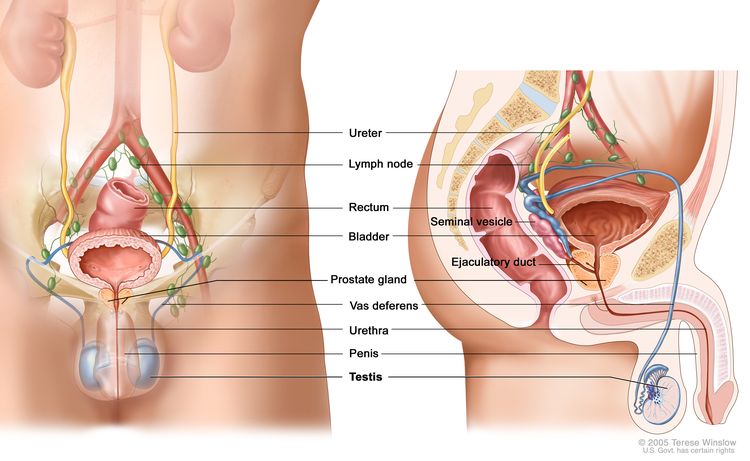
Anatomía de los sistemas reproductor y urinario masculinos; se muestran los testículos, la próstata, la vejiga y otros órganos.
Los testículos son las glándulas sexuales masculinas y producen testosterona y espermatozoides. Las células germinales de los testículos producen espermatozoides inmaduros. Estos espermatozoides viajan a través de una red de túbulos (tubos diminutos) y conductos más grandes hasta el epidídimo (un conducto largo y enrollado junto a los testículos). Aquí es donde los espermatozoides maduran y se almacenan.
Casi todos los cánceres testiculares se originan en las células germinales. Los dos tipos principales de tumores de células germinativas de testículo son los seminomas y los no seminomas.
Más información sobre el cáncer testicular en Tratamiento del cáncer testicular.
El cáncer testicular es el tipo de cáncer más comúnmente diagnosticado en hombres de entre 20 y 39 años.
El cáncer testicular es el cáncer más común en hombres de entre 20 y 39 años, registrando las tasas más altas entre los 25 y los 34 años. Los grupos raciales y étnicos con las tasas más altas de cáncer testicular incluyen a los hombres blancos no hispanos, los hombres nativos americanos no hispanos y los hombres nativos de Alaska.
Generalmente el cáncer testicular se puede curar.
Aunque el número de nuevos casos de cáncer testicular se ha duplicado en los últimos 40 años, el número de muertes causadas por este tipo de cáncer ha disminuido considerablemente gracias a la mejora de los tratamientos. El cáncer testicular normalmente se puede curar, incluso en los estadios avanzados de la enfermedad. Más información sobre el cáncer testicular en Tratamiento del cáncer testicular.
Un factor de riesgo en el cáncer testicular es la criptorquidia, una afección en la que un testículo no desciende correctamente.
Cualquier factor que aumente la probabilidad de padecer una enfermedad se denomina factor de riesgo. No todas las personas con uno o más de estos factores de riesgo desarrollarán cáncer testicular, y también se desarrollará en algunas personas que no tienen ningún factor de riesgo conocido. Hable con su médico si cree que puede estar en riesgo.
Algunos factores de riesgo del cáncer testicular son:
- Tener criptorquidia
- Tener un testículo que no es normal, como un testículo pequeño que no funciona como debería
- Tener carcinoma testicular in situ
- Ser un hombre blanco
- Tener un historial de salud personal o familiar de cáncer testicular
- Tener el síndrome de Klinefelter
Los hombres con criptorquidia, un testículo anómalo o carcinoma testicular in situ tienen un mayor riesgo de padecer cáncer testicular en uno o ambos testículos y deben ser objeto de un seguimiento exhaustivo.
Detección del cáncer de testículo
Puntos clave
- Tests are used to screen for different types of cancer when a person does not have symptoms.
- No existe una prueba de detección estándar o rutinaria para el cáncer testicular.
- Se están estudiando pruebas de detección del cáncer testicular en ensayos clínicos.
Tests are used to screen for different types of cancer when a person does not have symptoms.
Los científicos estudian pruebas de detección para encontrar aquellas que causan menos daños y aportan más beneficios. Los ensayos de detección del cáncer también tienen como objetivo demostrar si la detección temprana (detectar el cáncer antes de que cause síntomas) ayuda a las personas a vivir más tiempo o reduce las probabilidades de morir a causa de la enfermedad. En algunos tipos de cáncer, las posibilidades de recuperación son mayores si la enfermedad se detecta y se trata en un estadio temprano.
No existe una prueba de detección estándar o rutinaria para el cáncer testicular.
No existe una prueba de detección estándar o rutinaria para la detección temprana del cáncer testicular. En la mayoría de los casos, el cáncer testicular es detectado por los propios hombres, ya sea por casualidad o durante un autoexamen. A veces, el cáncer es detectado por un médico durante un examen físico rutinario.
No se han realizado estudios para determinar si el autoexamen testicular, los exámenes médicos regulares u otras pruebas de detección en hombres asintomáticos disminuirían el riesgo de morir por esta enfermedad. Sin embargo, las pruebas de detección rutinarias probablemente no disminuirían el riesgo de morir por cáncer testicular. Esto se debe, en parte, a que el cáncer testicular generalmente se puede curar en cualquier estadio. Detectar el cáncer testicular en sus estadios iniciales puede facilitar su tratamiento. Los pacientes diagnosticados con cáncer testicular que no se haya extendido a otras partes del cuerpo pueden necesitar menos quimioterapia y cirugía, lo que resulta en menos efectos secundarios.
Si el paciente encuentra un bulto en el testículo o se detecta durante un examen físico rutinario, se pueden realizar pruebas para detectar cáncer. Algunas pruebas tienen riesgos y pueden causar ansiedad.
Se están estudiando pruebas de detección del cáncer testicular en ensayos clínicos.
Puede encontrar información sobre los ensayos clínicos financiados por el NCI en la página web de búsqueda de ensayos clínicos del NCI. Los ensayos clínicos financiados por otras organizaciones se pueden encontrar en el sitio web ClinicalTrials.gov.
Sobre este resumen del PDQ
Acerca del PDQ
El Physician Data Query (PDQ) es la base de datos integral sobre el cáncer del National Cancer Institute (NCI). La base de datos del PDQ contiene resúmenes con la última información publicada sobre prevención, detección, genética, tratamiento, atención médica de apoyo y medicina complementaria y alternativa relacionada con el cáncer. La mayoría de los resúmenes se presentan en dos versiones. Las versiones para profesionales de la salud contienen información detallada escrita en lenguaje técnico. Las versiones para pacientes están escritas en un lenguaje fácil de entender y no tan técnico. Ambas versiones contienen información precisa y actualizada sobre el cáncer. La mayoría de las versiones también están disponibles en español.
El PDQ es un servicio del NCI. El NCI es parte de los Institutos Nacionales de Salud (NIH), que son el centro de investigación biomédica del Gobierno federal. Los resúmenes del PDQ se basan en una revisión independiente de la literatura médica. No son declaraciones de políticas del NCI ni de los NIH.
Propósito de este resumen
Este resumen del PDQ sobre el cáncer contiene información actualizada de la detección del cáncer testicular. El propósito es informar y ayudar a los pacientes, sus familiares y cuidadores. No da pautas ni recomendaciones formales para tomar decisiones relacionadas con la atención médica.
Revisores y actualizaciones
Los comités editoriales escriben los resúmenes de información sobre el cáncer del PDQ y los mantienen actualizados. Estos comités están formados por equipos de especialistas en el tratamiento del cáncer y otras especialidades relacionadas con esta enfermedad. Los resúmenes se revisan periódicamente y se modifican cuando hay información nueva. La fecha de actualización al pie de cada resumen indica cuándo se realizó el cambio más reciente.
La información de este resumen para pacientes se tomó de la versión para profesionales de la salud, la cual el comité editorial del PDQ sobre detección y prevención revisa y actualiza con regularidad según sea necesario.
Información sobre ensayos clínicos
Un ensayo clínico es un estudio para responder a una pregunta científica como, por ejemplo, si un tratamiento es mejor que otro. Los ensayos se basan en estudios anteriores y en lo aprendido en el laboratorio. Cada ensayo responde a determinadas preguntas científicas que permiten encontrar nuevas y mejores formas de ayudar a los pacientes con cáncer. Durante los ensayos clínicos de tratamiento, se recopila información sobre los efectos de un nuevo tratamiento y su eficacia. Si un ensayo clínico demuestra que un nuevo tratamiento es mejor que uno que se utiliza actualmente, el nuevo tratamiento puede convertirse en “estándar”. Los pacientes pueden valorar la posibilidad de participar en un ensayo clínico. Algunos ensayos clínicos solo están abiertos a pacientes que no hayan iniciado el tratamiento.
Los ensayos clínicos se pueden encontrar en línea en el sitio web del NCI. Para obtener más información, llame al Servicio de Información sobre el Cáncer (CIS, por sus siglas en inglés), el centro de contacto del NCI, al 1-800-4-CANCER (1-800-422-6237).
Permiso de uso de este resumen
Physician Data Query (PDQ) es una marca registrada. Se autoriza el libre uso del contenido de los documentos del PDQ como texto. Sin embargo, no se podrá identificar como un resumen de información sobre cáncer del PDQ del NCI, salvo que se reproduzca en su totalidad y se actualice con regularidad. Por otra parte, se permite que los autores incluyan una oración como “en el resumen del PDQ del NCI sobre la prevención del cáncer de mama se describen, de manera concisa, los siguientes riesgos: [incluir fragmento del resumen]”.
La forma recomendada para citar este resumen del PDQ es:
Comité editorial del PDQ® sobre detección y prevención. Detección del cáncer testicular (PDQ). Bethesda, MD: National Cancer Institute. Actualizado el [DD/MM/AAAA]
Las imágenes de este resumen se utilizan con el permiso del autor, artista y/o editorial para uso exclusivo en los resúmenes del PDQ. Si desea usar una imagen de un resumen del PDQ sin incluir el resumen completo, debe obtener autorización del propietario. El National Cancer Institute no puede otorgar dicho permiso. Para obtener más información sobre el uso de las imágenes de este resumen o de otras ilustraciones relacionadas con el cáncer, consulte Visuals Online, una colección de más de 3,000 imágenes científicas.
Descargo de responsabilidad
La información de estos resúmenes no debe utilizarse para tomar decisiones sobre reembolsos de seguros. Puede encontrar más información sobre la cobertura de seguros en Cancer.gov en el sitio Manejo de la atención del cáncer.
Contáctenos
Puede encontrar más información sobre cómo contactarnos o recibir ayuda en el sitio web Cancer.gov en la página Comuníquese con el NCI. También puede enviar sus preguntas a Cancer.gov en el apartado Escríbanos del sitio web.
Actualizado:
URL de origen: https://www.cancer.gov/node/6439/syndication
Agencia de origen: National Cancer Institute (NCI)
Fecha de captura: 14/09/2013 09:03:30.0