


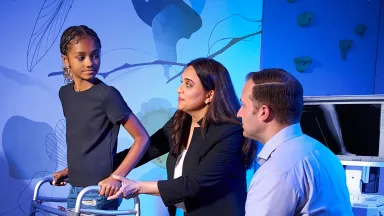


What Is Aphasia?
Aphasia is a disorder that damages portions of the brain responsible for language and affects an individual’s ability to communicate. For most people, these areas are on the left side of the brain. Aphasia usually occurs suddenly, often following a stroke or head injury, but it may develop slowly as the result of a brain tumor or a progressive neurological disease, such as dementia. The disorder impairs language, reading, writing, expression and understanding. Aphasia may co-occur with speech disorders, such as dysarthria or apraxia of speech, which also result from brain damage.
Types of Aphasia
There are two broad categories of aphasia, fluent and nonfluent, and several types of aphasia exist within these categories.
Fluent Aphasia
Damage to the brain’s temporal lobe may result in Wernicke’s aphasia, the most common type of fluent aphasia. People with Wernicke’s aphasia may speak in long, complete sentences that have no meaning, adding unnecessary words and even creating made-up words. For example, someone with Wernicke’s aphasia may say, “You know that smoodle pinkered and that I want to get him round and take care of him like you want before.” As a result, it is often difficult to follow what the person is trying to say. People with Wernicke’s aphasia are often unaware of their spoken mistakes. Another hallmark of this type of aphasia is difficulty understanding speech.
Nonfluent Aphasia
Broca’s aphasia is the most common type of nonfluent aphasia. People with Broca’s aphasia have damage that primarily affects the frontal lobe of the brain. They often have right-sided weakness or paralysis of the arm and leg because the frontal lobe is also important for motor movements.
People with Broca’s aphasia may understand speech and know what they want to say, but they frequently speak in short phrases produced with great effort. They often omit small words, such as “is,” “and” and “the.” For example, a person with Broca’s aphasia may say, “Walk dog,” meaning, “I will take the dog for a walk,” or “book book two table,” for “There are two books on the table.” People with Broca’s aphasia typically understand the speech of others fairly well. Because of this, they are often aware of their difficulties and can become easily frustrated.
Another type of nonfluent aphasia, global aphasia, results from damage to extensive portions of the brain’s language centers. Individuals with global aphasia have severe communication difficulties and may be extremely limited in their ability to speak or comprehend language. They may be unable to say even a few words or may repeat the same words or phrases over and over again. They may have trouble understanding even simple words and sentences.
There are other types of aphasia, each resulting from damage to different language areas in the brain. Some people may have difficulty repeating words and sentences even though they understand them and can speak fluently (conduction aphasia). Others may have difficulty naming objects even though they know what the object is and what it may be used for (anomic aphasia).
Sometimes, blood flow to the brain is temporarily interrupted and quickly restored. This type of injury is called a transient ischemic attack (TIA). Following TIAs, language abilities may return in a few hours or days.
Causes of Aphasia
Aphasia is caused by damage to one or more of the brain’s language areas. Most often, the cause of the brain injury is a stroke. A stroke occurs when a blood clot or a leaking or burst vessel cuts off blood flow to part of the brain. Brain cells die when they do not receive their normal blood supply, which carries oxygen and essential nutrients. Other causes of brain injury and aphasia are severe blows to the head, brain tumors, gunshot wounds, brain infections and progressive neurological disorders, such as Alzheimer’s disease.
Risk Factors for Aphasia
Most people who have aphasia are middle-aged or older, but anyone can acquire it, including young children. Several conditions, including stroke, head trauma, brain tumors and dementia, can cause aphasia. About one million people in the United States currently have aphasia, and nearly 180,000 Americans acquire it each year, according to the National Aphasia Association.
Screening for & Preventing Aphasia
Several conditions, including stroke, head trauma, brain tumors and dementia, can cause aphasia. It is important to note that aphasia cannot be prevented. However, reducing the risk factors associated with stroke or other causes of aphasia may help reduce its occurrence. This can be done by maintaining a healthy lifestyle through regular physical activity and avoiding smoking and excessive alcohol consumption.
Signs & Symptoms of Aphasia
Symptoms of aphasia can vary widely, depending on the cause and severity of the damage. Generally speaking, patients may experience difficulty forming sentences, remembering words or names, understanding spoken language, speaking clearly (without stuttering or slurring) and finding the right words when communicating.
Diagnosing Aphasia
Aphasia is usually diagnosed through a physical examination, imaging scans and language assessments. During the assessment, the care team will test the patient’s ability to understand speech, speak, read and write. Your doctor may also use imaging tests, such as computed tomography (CT) or magnetic resonance imaging (MRI) scans, to determine if aphasia has been caused by damage to the brain.
Treating Aphasia
Tremendous changes occur in the brain following a brain injury, helping it recover. As a result, people with aphasia often see dramatic improvements in their language and communication abilities in the first few months, even without treatment. When aphasia remains following this initial recovery period, speech-language therapy is used to help patients regain their ability to communicate.
Research has shown that language and communication abilities can continue to improve for many years and are sometimes accompanied by new activity in brain tissue near the damaged area. Some factors that may influence the improvement include the cause of the brain injury, the area of the brain that was damaged, the extent of the damage, and the individual’s age and health.
Aphasia therapy aims to improve a person’s communication skills by helping them use their remaining language abilities, restoring language abilities as much as possible and teaching them other communication methods, such as gestures and the use of pictures and electronic devices. Individual therapy focuses on the individual’s specific needs, while group therapy offers the opportunity to use new communication skills in a small group setting.
Recent technologies have provided new tools for people with aphasia. “Virtual speech pathologists” offer patients the flexibility and convenience of in-home therapy through a computer. Speech-generating applications on mobile devices like tablets can also provide an alternative communication method for people who struggle with spoken language.
Increasingly, patients with aphasia participate in activities such as book clubs, technology groups and art and drama clubs. Such experiences help patients regain their confidence and social self-esteem and improve their communication skills. Stroke clubs, which are regional support groups formed by people who have had a stroke, are available in most major cities. These clubs can help a person and their family adjust to the life changes that accompany stroke and aphasia.
Treatments we offer:
- Patients work closely with our speech-language pathologists to enhance communication skills and abilities regardless of the cause of their aphasia.
- Patients are taught to use communication devices such as computers, communication boards and other assistive strategies.
Living with Aphasia
Family involvement is often a crucial component of aphasia treatment because it enables family members to learn the best way to communicate with their loved ones.
Family members are encouraged to:
- Allow the person plenty of time to talk
- Ask for and value the opinion of the person with aphasia, especially regarding family matters
- Avoid correcting the person’s speech
- Encourage any type of communication, whether speech, gesture, pointing or drawing
- Help the person become involved outside the home and seek out support groups, such as stroke clubs
- Include the person with aphasia in conversations
- Maintain a natural conversational manner appropriate for an adult
- Minimize distractions, such as a loud radio or TV, whenever possible
- Participate in therapy sessions, if possible
- Repeat the content words or write down keywords to clarify meaning as needed
- Simplify language by using short, uncomplicated sentences
Researchers are testing new types of speech-language therapy in people with both recent and chronic aphasia to see if new methods can help them recover word retrieval, grammar, prosody (tone), and other aspects of speech. Some new techniques involve improving cognitive abilities that support language processing, such as short-term memory and attention. Others include activities that stimulate the mental representations of sounds, words and sentences, making them easier to access and retrieve.
Researchers are also exploring drug therapy as an experimental approach to treating aphasia. Some studies are testing whether drugs that affect the chemical neurotransmitters in the brain can be used in combination with speech-language therapy to improve the recovery of various language functions.
Other research is focused on using advanced imaging methods, such as functional magnetic resonance imaging (fMRI), to explore how language is processed in the normal and damaged brain and to understand recovery processes. This research may advance our knowledge of how the areas involved in speech and understanding language reorganize after a brain injury. The results could have implications for diagnosing and treating aphasia and other neurological disorders.
A relatively new area of interest in aphasia research is noninvasive brain stimulation in combination with speech-language therapy. Two such brain stimulation techniques, transcranial magnetic stimulation (TMS) and transcranial direct current stimulation (tDCS), temporarily alter normal brain activity in the stimulated region. Researchers initially used these techniques to help them understand the parts of the brain that played a role in language and recovery after a stroke. Recently, scientists have been studying if this temporary alteration of brain activity might help people re-learn language use.
To further your understanding of your diagnosis and to contribute to cutting-edge research, consider participating in a clinical trial so clinicians and scientists can learn more about the causes, symptoms, treatment and prevention of aphasia. Clinical research uses volunteers to help researchers learn more about a disorder and perhaps find better ways to safely detect, treat or prevent disease.
All types of volunteers are needed—those who are healthy or may have an illness or disease—of all different ages, sexes, races and ethnicities to ensure that study results apply to as many people as possible, and that treatments will be safe and effective for everyone who will use them.
For information about participating in clinical research, visit NIH Clinical Research Trials and You. Learn about clinical trials currently looking for participants at Clinicaltrials.gov.