



About Our Program
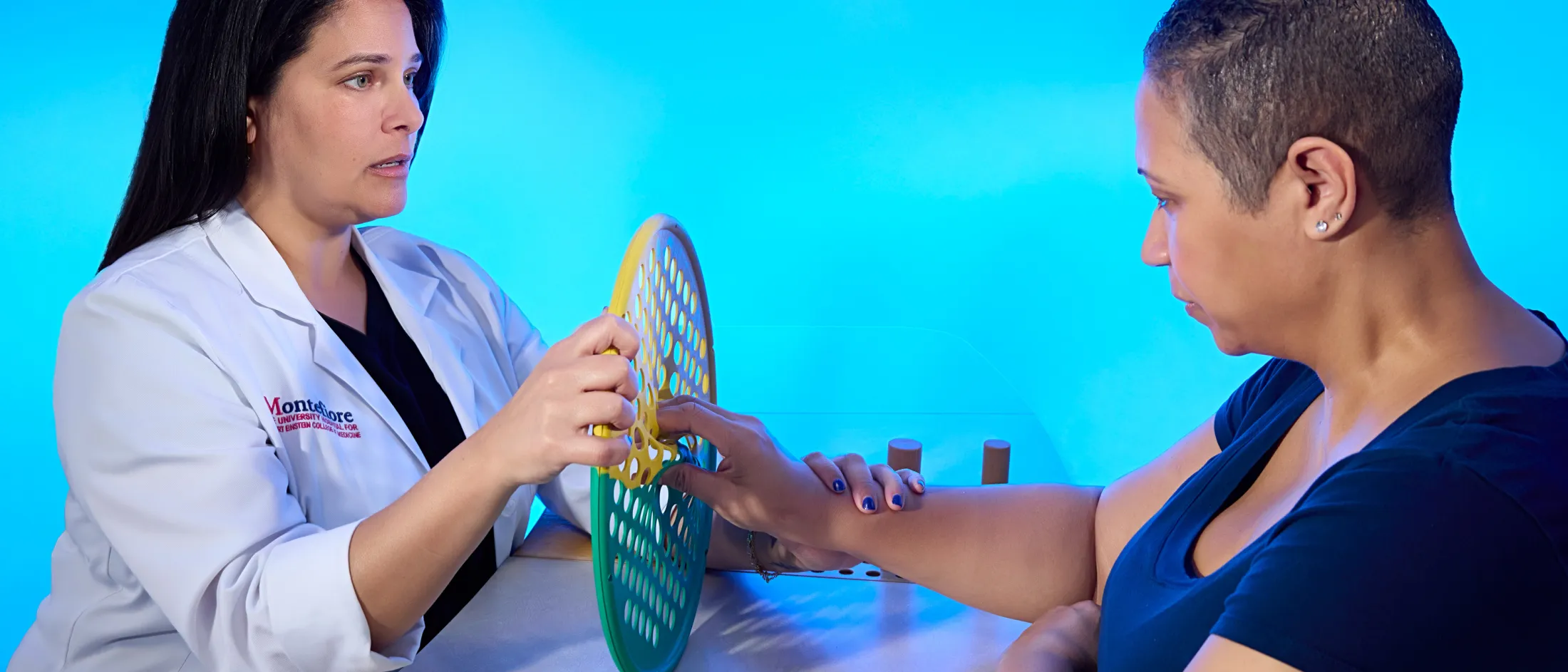
The renowned team of occupational therapists at the Montefiore Einstein Department of Physical Medicine and Rehabilitation will collaborate with your physician to design and implement an individually tailored rehabilitation program. We serve people of all ages who are coping with physical limitations due to injury or chronic conditions, or who are adapting to living with a disability, enabling them to better perform personal care routines and household chores, as well as work- school- and leisure-related activities.
Our team of highly trained occupational therapists includes certified hand therapists (CHTs) with advanced study and experience, who specialize in treating individuals with conditions affecting the hands and upper extremities. Our therapists are also integral team members of The Joint Commission Ventricular Assist Device (VAD), Comprehensive Stroke Center (CSC), Primary Stroke Center (PSC) and Advanced Total Hip and Total Knee Replacement certified services.
Video could not be played
Our Occupational Therapy Services
The Montefiore Einstein Occupational Therapy (OT) team provides evidence-based treatment that supports patient recovery. The team offers a wide range of treatment options that an occupational therapist may integrate into the therapeutic program, including manual therapy (hands-on mobilization of soft tissue), therapeutic modalities, neuromuscular re-education, splinting, orthotic/prosthetic training, wheelchair and mobility device evaluations, medical equipment assessment and training, lymphedema management, cognitive re-education and ongoing patient and family education.
Our professionals are skilled at managing a wide range of conditions that affect movement, function and overall physical health. Conditions we treat include:
Arthritis causes inflammation in the joints, leading to pain, stiffness, swelling and reduced mobility. Although there is no cure for arthritis, occupational therapy can help alleviate symptoms and enhance function.
The upper extremities, including the hands, wrists, elbows and shoulders, are essential for functional activities such as work, self-care and recreation. Occupational therapy helps individuals regain function, strength and dexterity in these areas, enabling them to return to daily routines with minimal disruption.
Developmental delays can impact motor skills, language, social abilities and learning capacity. Early intervention, including occupational therapy, is crucial for helping children overcome developmental challenges and improve their functioning. Occupational therapy helps children enhance their fine motor, gross motor, sensory processing, cognitive and social skills, enabling them to become more independent and capable in their daily lives.
Cognitive disabilities refer to impairments in cognition, including memory, attention, problem-solving, executive function and reasoning. These disabilities can result from a range of conditions, such as brain injuries, neurological disorders, developmental disabilities, dementia and stroke. Occupational therapy aims to improve individuals’ ability to engage in daily activities, enhance independence and manage cognitive challenges in both personal and work environments.
Nerve damage can result from injuries, medical conditions (such as diabetes or multiple sclerosis), or surgeries that impact the nervous system. Also known as neuropathy, this condition can affect both motor and sensory functions, leading to loss of sensation, weakness, pain or impaired coordination in the affected area. Occupational therapy focuses on helping individuals recover lost functions, adapt to physical limitations and improve independence in daily activities.
A dislocation occurs when a bone is forced out of its normal position in a joint. Dislocations can occur in various parts of the body, most commonly in the shoulder or fingers. They often result in pain, swelling, a limited range of motion and difficulty performing everyday activities. Occupational therapy helps individuals regain function, alleviate pain and enhance mobility following a dislocation, ultimately assisting them in returning to their regular routines.
Occupational therapy is essential in the recovery process after a bone fracture. While the bone heals, occupational therapy helps improve one’s ability to perform the activities of daily living, such as dressing, cooking and working. By guiding patients through recovery with tailored interventions, occupational therapy helps patients recover function, manage pain, prevent complications and restore independence.
Joint replacements are often necessary when a joint becomes severely damaged due to conditions like osteoarthritis, rheumatoid arthritis or trauma. These procedures are designed to improve mobility, reduce pain and enhance quality of life. However, the recovery process can be challenging and requires occupational therapy to ensure proper healing, prevent complications and enable the individual to regain full function and independence.
Occupational therapy helps individuals regain as much functionality and independence as possible in their daily lives following an amputation. Working with our team of specialists, you will learn adaptive techniques, receive training on prosthetic use, manage pain, strengthen muscle groups, improve range of motion and implement home and workplace modifications to make daily tasks easier and safer. You’ll also obtain emotional support tools and educational support to prevent further injury and strategies for overcoming complications.
Neurological conditions are disorders that affect the nervous system, including the brain, spinal cord and peripheral nerves. They can lead to weakness, loss of coordination, difficulty walking and changes in balance or posture. Occupational therapy is vital in rehabilitating and managing neurological conditions, helping patients regain independence, improve mobility and manage symptoms more effectively.
A stroke is brain damage that occurs when a blood vessel bursts or is blocked by a blood clot. Without blood and the oxygen it carries, part of the brain starts to die. As a result, the part of the body controlled by the damaged area of the brain can't function properly. Occupational therapy can help improve coordination and muscle strength, restoring movement, balance, coordination and range of motion.
A spinal cord injury (SCI) is damage to the spinal cord, a soft bundle of nerves that runs from the base of the brain to the lower back. It runs through the spinal canal, a tunnel formed by holes in the spine’s bones. The bony spine helps protect the spinal cord. Occupational therapy aims to optimize physical abilities and reduce the effects of an SCI. Our specialists will help you maximize everyday activities, including self-care, work and leisure, to support greater independence.
Osteoporosis is a disease that affects your bones, resulting in bones that are thin, brittle and porous like a sponge. Osteoporosis can lead to broken bones (fractures) in the hip, spine and wrist. These fractures can be disabling and may make it hard for you to live on your own. Occupational therapy can improve quality of life, maximize function, prevent fractures and enhance safety.
Sports injuries occur during physical activity or sports and affect athletes at any level, from amateur to professional. They can involve muscles, ligaments, tendons, bones and joints and may result from acute trauma or repetitive stress over time. Occupational therapy focuses on helping individuals return to everyday activities and functional roles. This may include returning to work, school or recreational activities. The primary goal of OT in sports injury rehabilitation is to promote recovery, enhance functional independence and prevent reinjury by focusing on activities that are meaningful to the individual.
Occupational therapy is crucial to postsurgical recovery. Working with an occupational therapist enables individuals to regain their independence, improve functional ability and adapt to changes following surgery. Occupational therapy emphasizes restoring an individual’s ability to perform daily tasks and routines essential for maintaining their quality of life. It addresses the physical and psychological aspects of recovery, providing strategies for long-term independence and success after surgery. Combining surgery and occupational therapy optimizes recovery, enabling patients to achieve the best possible outcome.