




Video could not be played
Neurodevelopmental Research Program
About Our Program
The Neurodevelopmental Research Program at the Psychiatry Research Institute at Montefiore Einstein (PRIME) aims to identify key developmental processes, elucidate fundamental mechanisms by which sensory information guides behavior and potentially provide new biomarkers for neuropsychiatric disorders.
Video could not be played
Areas of Concentration
Research at our lab focuses on accurate perception that depends on the adaptive function of brain areas comprising many types of cells and synaptic connections that develop over a long period. During development, neural networks grow from zero connectivity to the precisely interconnected circuits characteristic of the adult brain. The activity of GABAergic inhibitory neurons during postnatal development is likely to mediate synaptic refinement, enhancing precision in the mature network. Accordingly, recent evidence suggests disruption of inhibitory function as a mechanism underlying neurodevelopmental disorders such as autism and schizophrenia.
Our Working Hypotheses
Addressing the following questions will identify critical developmental processes, elucidate fundamental mechanisms by which sensory information guides behavior, and potentially provide new biomarkers for neuropsychiatric disorders.
- Postnatal changes in interneurons’ connectivity and activity patterns instruct how sensory information is processed in the mature brain.
- Developmental dysfunction of inhibitory neurons impairs cortical circuits and is a key mechanism for neurodevelopmental disorders such as autism and schizophrenia.
Current Projects & Research
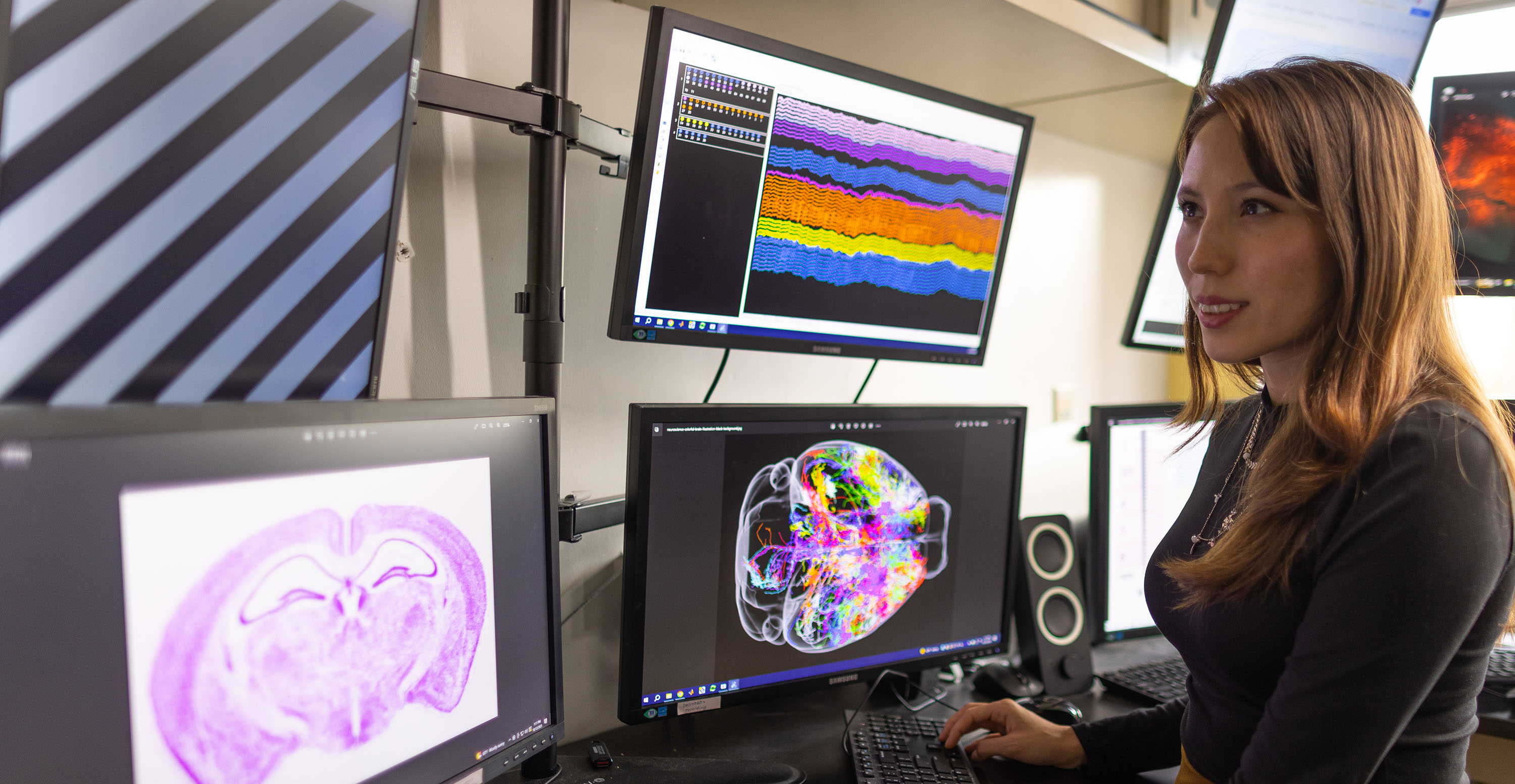
Our team is actively involved in clinical research, evaluations and collaborations. Our lab combines cell-type-specific manipulation of neuronal activity, in vivo electrophysiology, in vivo two-photon imaging, and behavioral analysis to understand how the postnatal development of inhibition shapes sensory representation in the mature brain and how this process is altered in neurodevelopmental disorders.
About Renata A. Batista-Brito, PhD

Video could not be played
Renata A. Batista-Brito, PhD
Associate Professor, Dominick P. Purpura Department of Neuroscience
Associate Professor, Department of Genetics
Associate Professor, Department of Psychiatry and Behavioral Sciences
Dr. Renata A. Batista-Brito is a geneticist and systems neuroscientist interested in bridging knowledge from genes to circuits and behavior. She is an associate professor at Albert Einstein College of Medicine with the Dominick P. Purpura Department of Neuroscience, the Department of Genetics and the Department of Psychiatry and Behavioral Sciences. Her work thus far has focused on how inhibition shapes cortical activity in health and disease. In these roles, her work focuses on cortical development, inhibitory circuits, visual processing and neurodevelopmental disorders.
As a graduate student in the laboratory of Gordon Fishell at the New York University School of Medicine, Dr. Batista-Brito conducted a series of studies to understand the role of genetic factors in interneuron development. This work resulted in identifying a set of genes required for the specification and maturation of cortical interneurons. Later studies of these genes by Dr. Batista-Brito and others in the Fishell lab demonstrated a potential causal link between genetic disruption of inhibition and psychiatric disorders.