




Our Approach to Pediatric Ophthalmology

Video could not be played

Video could not be played
Video could not be played
Video could not be played
Video could not be played
Video could not be played
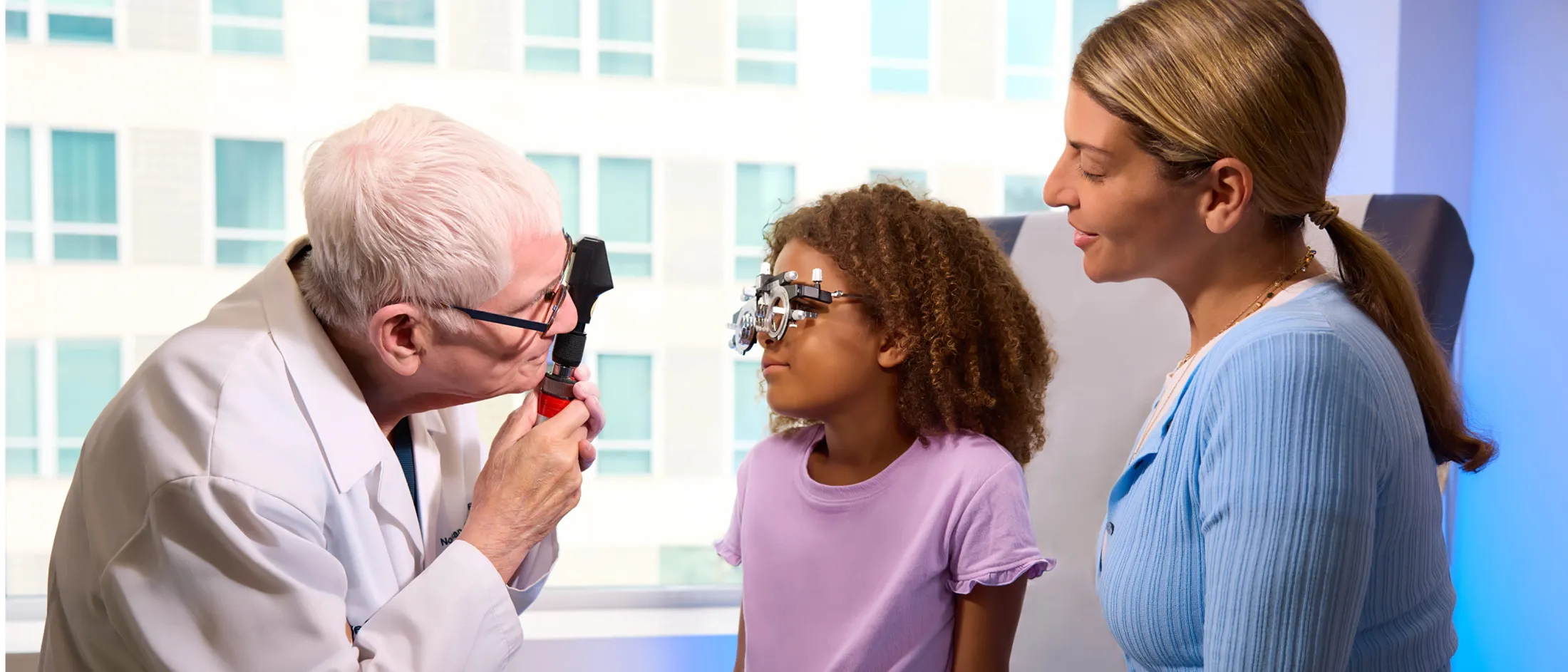
Pediatric Ophthalmology at Montefiore Einstein is a leader in children’s eye care, providing comprehensive, personalized care for infants, children and adolescents with the full range of pediatric eye and vision conditions, from the common to the complex. This includes refractive errors, amblyopia, strabismus, corneal disorders, pediatric cataracts, congenital glaucoma, retinopathy of prematurity, eyelid and tear duct abnormalities and inherited eye diseases. Our multidisciplinary team of world-renowned doctors includes board certified, fellowship-trained ophthalmologists with expertise in pediatric ophthalmology. We collaborate closely with experts across every subspecialty of ophthalmology as well as with pediatricians from the Children’s Hospital at Montefiore Einstein (CHAM), neonatologists, geneticists, neurologists, oncologists and other pediatric experts to deliver seamless, coordinated care tailored to each child. CHAM is consistently recognized among the best children’s hospitals in the nation according to U.S. News & World Report.
We offer access to advanced diagnostics and treatments. From the earliest newborn screenings to the care of adolescents with complex conditions, our Program delivers comprehensive care designed to meet children’s ophthalmic needs at every stage of development. Our specialists provide preventative eye exams, prescription eyeglasses, specialty contact lens evaluations and the full range of medical, laser and surgical treatments.
We are committed to helping children improve and maintain their vision, preventing disease progression and enhancing quality of life. Whether your child has been newly diagnosed with an eye condition, is experiencing symptoms such as eye pain, redness, blurred or decreased vision, requires care for a congenital or genetic eye disease or needs ongoing management for an eye problem related to a systemic condition, our Pediatric Ophthalmology team is here to provide expert care and guidance at every stage of your child’s eye health.
Global Leaders in Early Detection & Treatment to Protect Children’s Vision
As part of our commitment to preventing vision loss and improving outcomes for children with retinal diseases, we lead initiatives to accelerate the diagnosis of retinopathy of prematurity (ROP) and broaden access to care. By integrating advanced imaging technologies with remote screening and expert review, we have developed programs that enable earlier detection, timely intervention and improved access for vulnerable infants and children, often before surgical treatment becomes necessary.
Multidisciplinary Vision-Sparing Care for Retinoblastoma & Childhood Eye Tumors
At the forefront of pediatric ocular oncology, our Program provides eye- and vision-sparing treatment for retinoblastoma and other rare childhood eye tumors. These include intra-arterial and intravitreal chemotherapy, focal laser therapy and cryotherapy, as well as advanced vitreoretinal techniques. CHAM is ranked by U.S. News & World Report in pediatric cancer and is fully integrated with Montefiore Einstein Comprehensive Cancer Center, which is among the elite 1% of National Cancer Institute (NCI)-designated comprehensive cancer centers in the U.S. We offer seamless access to pediatric medical and radiation oncology, genetics and long-term follow-up care for coordinated management and support from diagnosis through adulthood.
Video could not be played
Advanced Diagnostics & Treatments
We offer access to the latest diagnostic technologies and the most advanced treatments for the prevention, early detection and management of the full spectrum of eye conditions in children. Because children’s eyes are still developing, precise and age-appropriate diagnostic tools are essential.
Our specialists use advanced imaging techniques, including high-resolution optical coherence tomography (OCT) to evaluate the cornea, retina and optic nerve, as well as wide-field retinal imaging to detect sight-threatening conditions such as ROP. Additional capabilities, such as corneal mapping, electrophysiology testing, three-dimensional (3D) ultrasound and genetic testing using next-generation sequencing, allow us to diagnose both common conditions and complex inherited or neurologic eye diseases with accuracy and efficiency.
Our Program offers the full spectrum of advanced treatments tailored to each child’s unique needs, beginning with the least invasive therapies whenever possible. Medical treatments include prescription glasses, specialized pediatric contact lenses, targeted eye drops, oral medications and injections. Advanced therapies include anti-vascular endothelial growth factor (VEGF) injections such as Eylea® (aflibercept).
When laser therapy is indicated, our specialists use state-of-the-art techniques for conditions such as pediatric glaucoma and ROP to help slow disease progression and preserve vision. For children who need surgery, we provide highly specialized expertise across a wide range of conditions. Our surgeons perform sophisticated microsurgery for pediatric cataracts, strabismus procedures for adults and children, pediatric glaucoma surgery and advanced interventions for complex conditions such as retinoblastoma and pediatric retinal detachments. We also specialize in pediatric corneal transplantation, offering therapeutic and optical penetrating keratoplasty (PKP) for children with vision-threatening congenital or acquired corneal disease to preserve sight and prevent irreversible vision loss.
We offer a comprehensive suite of advanced diagnostics and treatments for the full range of pediatric eye conditions, as well as strabismus in children and adults, including:
We use state-of-the-art imaging technologies and testing to detect and monitor pediatric eye conditions with precision.
- Multimodal retinal and choroidal imaging
- High-resolution optical coherence tomography (OCT)
- OCT angiography (OCTA)
- Ultra-widefield fundus photography and fluorescein angiography (including ROP imaging)
- Pediatric visual acuity testing (Teller cards, Lea symbols, age-appropriate methods)
- Cycloplegic refraction for accurate refractive error assessment
- Corneal topography and tomography
- Anterior segment OCT
- Diopsys Multifocal Electroretinography
- Ultrasound biomicroscopy and B-scan ultrasonography (for opaque media or intraocular tumors such as retinoblastoma)
- Pediatric visual field testing (kinetic and automated, age-adapted)
- Genetic testing and counseling for inherited ocular diseases
- AI-assisted image analysis for precision monitoring
We offer a full range of individualized medical therapies tailored to each child’s needs, using the least invasive methods whenever possible.
- Prescription glasses
- Specialized pediatric contact lenses
- Topical therapies (eye drops/ointments)
- Lubricants; anti-allergy; antibiotic/antiviral; anti-inflammatory; cycloplegics (e.g., atropine)
- IOP-lowering medications for pediatric glaucoma
- Amblyopia therapies
- Patching and/or atropine penalization
- Anti-VEGF injections for ROP and pediatric retinal disease
- Topical and systemic immunomodulatory therapy for pediatric uveitis
- Ocular gene therapy, including Luxturna® (voretigene neparvovec-rzyl) for RPE65-mediated inherited retinal dystrophy
Our specialists use advanced laser therapies, when appropriate, to prevent or slow disease progression and help preserve vision.
- Retinal laser photocoagulation for ROP and other retinal vascular disease (e.g., Coats disease)
- Laser therapy for pediatric glaucoma (including transscleral cyclophotocoagulation and laser trabeculoplasty)
- Retinal barrier laser for retinal tears
We perform advanced surgical procedures using specialized techniques tailored to the unique needs of each child.
- Strabismus surgery (including reoperations and adjustable sutures for older children, adolescents, and adults)
- Pediatric cataract surgery with intraocular lens implantation
- Pediatric glaucoma surgery
- Goniotomy, trabeculotomy including 360° trabeculotomy and gonioscopy-assisted transluminal trabeculotomy (GATT), trabeculectomy, and glaucoma drainage devices including tube shunts
- Select minimally invasive glaucoma surgery (MIGS) techniques
- Pediatric corneal transplantation
- Penetrating and lamellar keratoplasty
- Retinoblastoma management
- Advanced vitreoretinal techniques including focal laser therapy and cryotherapy, intra-arterial and intravitreal chemotherapy, plaque brachytherapy, or enucleation when necessary)
- Retinal detachment repair
- Scleral buckle, pars plana vitrectomy, and pediatric vitrectomy for complex retinal disease
- Oculoplastic, eyelid, and orbital surgery (ptosis repair, dermoid cyst removal, fracture repair, tumors)
- Nasolacrimal duct procedures
- Probing, intubation, and dacryocystorhinostomy (DCR) for tear duct obstruction
- Surgical management of congenital ocular malformations
- Minimally invasive and laser-assisted approaches whenever possible

Video could not be played
Research & Publications
Montefiore Einstein Pediatric Ophthalmology is leading collaborative research and numerous studies, including several funded by the National Eye Institute (NEI)/National Institutes of Health (NIH), translating novel scientific discoveries into new diagnostics and treatments that improve outcomes for children with eye conditions. We helped establish new standards of care in pediatric ophthalmology, spearheading clinical trials that have led to the development of FDA-approved medications and devices, such as Eylea® (aflibercept), the first approved pharmacologic treatment for preterm infants with retinopathy of prematurity (ROP). Through clinical trials, our patients can access emerging technologies and innovative treatments that may otherwise be unavailable to the general public.
Our research spans basic, translational, and clinical science, with a focus on advancing understanding of the mechanisms, diagnosis, and treatment of pediatric eye diseases. Core areas of investigation include retinal diseases of infancy, strabismus and amblyopia, pediatric cataracts, congenital glaucoma, corneal dystrophies, progressive myopia and orthokeratology, and the impact of systemic and genetic disorders on vision. Investigators are uncovering the genetic and molecular mechanisms that regulate lens formation, transparency, and vision, while also studying how genetic changes in the key transcription factors affect early eye development, with the aim of informing future treatments for congenital eye conditions.
We are internationally recognized for advancing research in ROP, with studies addressing the clinical, logistical, and systemic factors that influence diagnosis, management, and outcomes for premature infants. In strabismus and amblyopia research, our team has advanced surgical techniques such as the Swan incision, refined perioperative management, and explored innovative approaches such as mobile device–based vision screening for unilateral amblyopia. Beyond disease-specific research, our faculty are also shaping the field through scholarship in medical education and leadership in advancing pediatric ophthalmology worldwide.
Trusted Global Leaders in Evidence-Based Vision Care
We are one of only 13 centers worldwide designated as a Cochrane Eyes and Vision (CEV) Center for Evidence-Based Vision Care, a National Eye Institute (NEI)/National Institutes of Health (NIH)-funded distinction recognizing our commitment to advancing evidence-based medicine and eye care. Our contributions to research and determining the most effective treatments in patient care serve as a model for clinical sites around the world.

Video could not be played
Our Pediatric Ophthalmology Team
Our multidisciplinary team of world-renowned pediatric ophthalmologists specializes in the prevention, diagnosis and management of the full range of pediatric eye conditions, as well as strabismus in children and adults, delivering compassionate, patient- and family-centered care to help protect and preserve vision, prevent disease progression, and enhance quality of life.

Video could not be played
Norman B. Medow, MD

Video could not be played
Jamie B. Rosenberg, MD

Video could not be played
Sunju Park, MD

Video could not be played
Jacob S. Rosenberg, OD
Transformative Community Programs & Initiatives
Our program is recognized for its collaborative approach and comprehensive clinical care, extending beyond the walls of Montefiore Einstein into the community through targeted outreach initiatives designed to preserve vision, slow disease progression, prevent both vision loss and blindness, and enhance quality of life, particularly among vulnerable populations. Key efforts include community education, telemedicine-based strategies for the early detection and management of retinopathy of prematurity, diabetic retinopathy, and other pediatric eye conditions, and our partnership with Lighthouse Guild International’s Technology Peers for Accessible Living (Tech Pals) program, which bridges generations through personalized technology mentorship for individuals with vision loss. This unique initiative pairs blind or visually impaired young adults with older adults to foster digital literacy and independence. Through these and other initiatives, we continue to expand access to care, preserve continuity, and reduce disparities, advancing eye health across the communities we serve.
About Pediatric Eye Conditions
Pediatric eye conditions encompass a wide range of disorders that can affect vision, eye alignment and visual development in infants, children and adolescents. Some conditions are common, such as refractive errors (nearsightedness, farsightedness and astigmatism), amblyopia (“lazy eye”) and strabismus (misaligned eyes). Others are more complex or vision-threatening, including congenital cataracts, glaucoma, retinopathy of prematurity, inherited retinal diseases and ocular tumors such as retinoblastoma. Children may also experience disorders of the eyelids and tear ducts, corneal disease, or neuro-ophthalmologic conditions that affect the connection between the eyes and the brain. In addition, inflammatory eye diseases and vision problems related to systemic or genetic disorders, such as autoimmune disease, diabetes or craniofacial syndromes, can significantly impact eye health and development.
Vision plays a critical role in a child’s learning, social interaction and emotional growth. Certain eye conditions, if left untreated, can cause lifelong vision impairment or blindness. Because many pediatric eye diseases may progress silently before symptoms are noticed, routine vision screening and comprehensive eye examinations are essential for early detection, timely treatment and the protection of healthy visual development.
Learn More About Screening, Prevention & Treatment of Pediatric Eye Conditions
Location details: Greene Medical Arts Pavilion (MAP), Henkind Eye Institute
Greene Medical Arts Pavilion (MAP), Henkind Eye Institute
Location details: Bronx East Ophthalmology
Bronx East Ophthalmology
Location details: Hutchinson Campus Ophthalmology - Tower 2
Hutchinson Campus Ophthalmology - Tower 2
Location details: LASIK & Eye Care Center
LASIK & Eye Care Center
Location details: Wakefield Ophthalmology
Wakefield Ophthalmology