


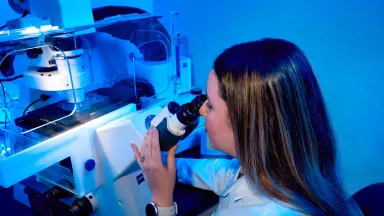
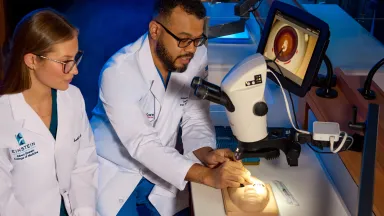

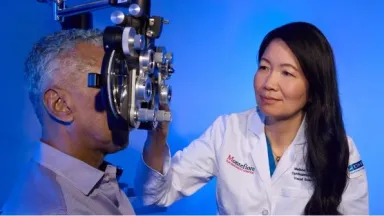

Our Approach to Cornea, Refractive & Laser Eye Surgery
Video could not be played
Video could not be played
Video could not be played
Montefiore Einstein’s Department of Ophthalmology and Visual Sciences is an internationally recognized leader, providing comprehensive, personalized care for individuals of all ages with the full spectrum of vision problems associated with corneal, refractive and anterior segment eye conditions. These range from common refractive errors, such as myopia, hyperopia, astigmatism and presbyopia, to complex corneal disorders, including keratoconus, corneal scars, dry eye disease and advanced ocular surface diseases, such as refractory ulcers and corneal melts. Our multidisciplinary team of world-renowned doctors comprises board certified ophthalmologists with subspecialized expertise in cornea and external eye disease who collaborate closely with optometrists, retina, glaucoma, pediatric and oculoplastics specialists, primary care physicians and other experts to deliver seamless, coordinated care and ensure the best possible outcomes for each patient. Using the latest digital imaging, advanced nonoperative therapies, such as corneal cross-linking, scleral lenses, amniotic membrane therapy and regenerative eye drops, along with the most advanced laser and surgical technologies, we offer a research-based, individualized care approach tailored to the unique needs of each patient.
Our ophthalmic surgeons have unparalleled expertise in advanced laser vision correction and refractive surgery techniques, including laser-assisted in situ keratomileusis (LASIK), photorefractive keratectomy (PRK), and wavefront-optimized and topography-guided procedures to precisely reshape the cornea and reduce or eliminate the need for glasses or contact lenses. We are a referral center for the most complex and high-risk cases. Our Cornea specialists perform the full range of corneal transplantation procedures to ensure the customized care needed to achieve the best patient outcomes. Our specialists prioritize minimally invasive approaches, using leading-edge technology to minimize pain, shorten recovery time and enhance long-term outcomes. Most of our procedures are also conveniently performed on an outpatient basis. We are committed to delivering the highest quality, patient-centered care to preserve, restore and enhance vision, prevent vision loss and improve quality of life. Whether you’re considering laser vision correction for the first time, managing a complex corneal condition, recovering from surgery or seeking a second opinion, our team is here to provide expert care and guidance at every stage of your vision care journey.
At the Forefront of Corneal Transplantation & Anterior Segment Reconstruction
Montefiore Einstein Ophthalmology and Visual Sciences’ corneal specialists have helped shape the field of corneal transplantation and anterior segment reconstruction, leading innovations that have set new standards of care. Our experts’ pursuit of innovative approaches to corneal transplantation led to the development of AmbioDry™, a preserved dry amniotic membrane allograft which simplifies and optimizes amniotic membrane transplantation for ocular surface repair. Our ophthalmologists were also instrumental in developing technology that modernized eye banking practices enabling the preparation, storage and national distribution of tissue for endothelial lamellar corneal transplantation. We continue to push the boundaries in corneal and anterior segment surgery, advancing care for patients worldwide.
At the Forefront of LASIK & Advanced Vision Correction
At our state-of-the-art LASIK and Eye Care Center, we offer concierge-level service using the most advanced technologies available today. As one of the few academic medical centers nationwide equipped with the latest LASIK laser vision correction platforms, we are an internationally recognized leader in the field of keratorefractive surgery, advancing the field through innovation, developing new techniques and setting the standard for safety, precision and visual outcomes.
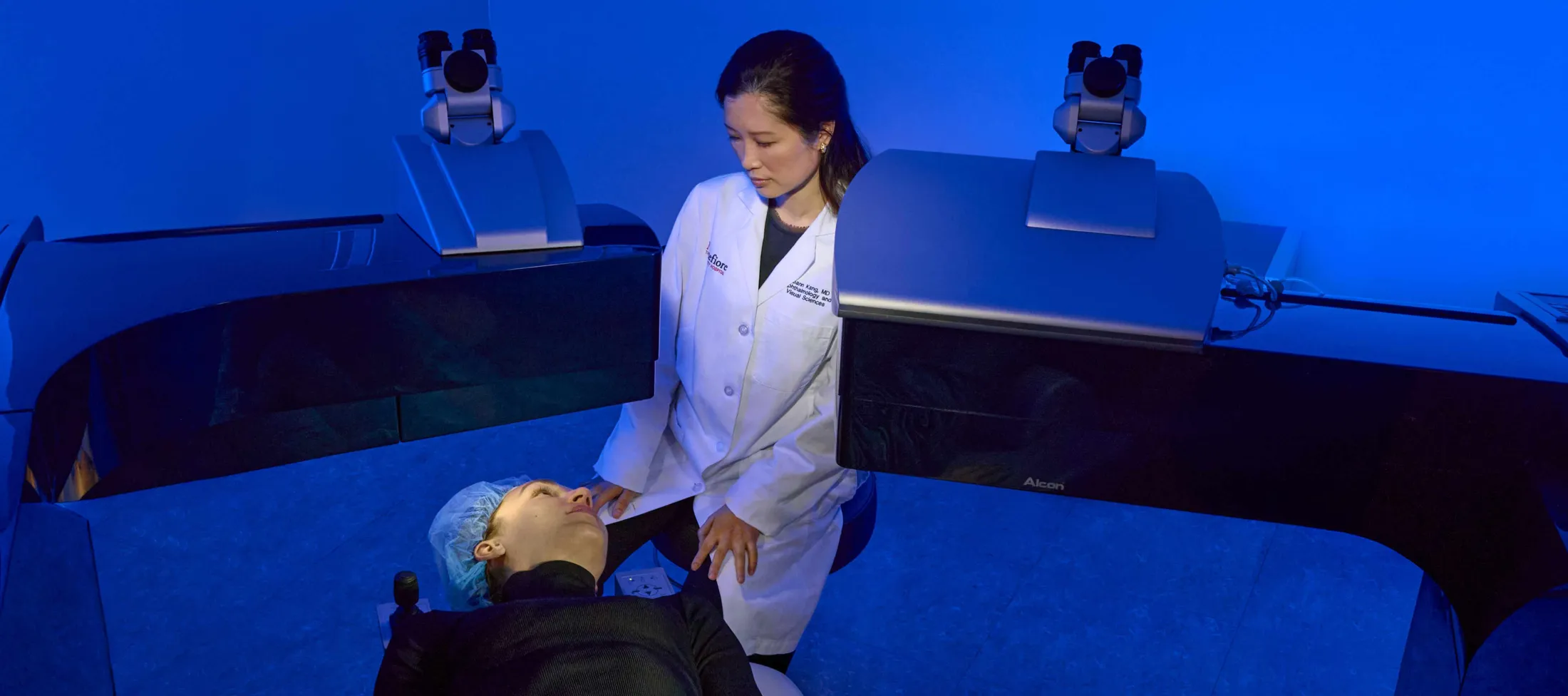
Our LASIK and Eye Care Center is designed to enhance both convenience and the patient experience, which features customized operating suites equipped with the most advanced refractive and laser surgical technologies available, including devices invented and pioneered by our own faculty. Our suites are equipped with the latest femtosecond and excimer laser technologies, including the WaveLight® FS200, a femtosecond laser designed for rapid and highly precise corneal flap creation. It also includes topography-guided excimer lasers such as the Allegretto Wave® Eye-Q Excimer Laser System, which enables customized treatments based on each patient’s unique corneal shape and optical measurements.
These next-generation technologies allow our surgeons to deliver fully personalized LASIK procedures, tailored to each individual’s eye anatomy, enhancing safety and efficacy, improving surgical precision and optimizing visual outcomes. For patients with presbyopia, early lens changes or cataracts, we offer a wide range of advanced lens-based refractive solutions, including presbyopia-correcting cataract surgery, post-refractive and post-cataract enhancement procedures. Our surgical suites are continuously updated with the latest phacoemulsification platforms and high-definition operating microscopes. Our LASIK and Eye Care Center expands access to world-renowned vision care for patients across the tristate area and beyond. Nearly all procedures are performed on an outpatient basis, enabling patients to receive leading-edge care in a comfortable, accessible setting close to home. Whether correcting nearsightedness, farsightedness, astigmatism or age-related vision changes, we are committed to helping patients reduce or eliminate their dependence on glasses and contact lenses, while enhancing both visual acuity and quality of vision through the most advanced refractive procedures available.
Trusted Global Leaders in Evidence-Based Eye Care
Montefiore Einstein is one of only 13 centers worldwide designated as a Cochrane Eyes and Vision (CEV) Center for Evidence-Based Vision Care—a prestigious distinction funded by the National Eye Institute/National Institutes of Health (NEI/NIH). This recognition reflects our commitment to advancing evidence-based medicine and eye care while also establishing the most effective treatments in patient care. Our research contributions serve as a global model for clinical sites worldwide.
Video could not be played
Advanced Diagnostics & Treatments
We offer access to the latest diagnostics and treatments for the prevention, detection and management of the full range of corneal, refractive and anterior segment conditions.
Advanced Diagnostics for Precision Eye Care
Montefiore Einstein Ophthalmology and Visual Science leading-edge diagnostic technologies include state-of-the-art corneal imaging, wavefront analysis and ocular surface evaluation tools that enable precise assessment and early detection of complex ophthalmic conditions. Through advanced corneal topography and tomography, anterior segment optical coherence tomography (AS-OCT), specular and confocal microscopy, our world-renowned specialists detect even the most subtle abnormalities in corneal structure, thickness and surface quality. These sophisticated technologies support customized treatment planning, comprehensive preoperative screening and real-time monitoring for conditions, such as keratoconus, corneal dystrophies, ocular surface disease and laser vision correction candidacy.
Leading-Edge Nonsurgical Therapies for Corneal Health & Vision Correction
Montefiore Einstein provides a comprehensive range of personalized, nonsurgical therapies designed to manage corneal and ocular surface conditions while optimizing vision correction for adults and children.
State-of-the-Art Surgical Treatments for Vision Restoration & Correction
When surgery is indicated, we offer the most advanced laser vision correction options available today, using the latest femtosecond and excimer laser technologies to deliver highly precise, personalized treatments. Our minimally invasive procedures include LASIK and PRK.
For advanced corneal disease, we offer the full spectrum of the latest corneal transplantation procedures, including descemet membrane endothelial keratoplasty (DMEK), descemet stripping (automated) endothelial keratoplasty (DSEK/DSAEK), deep anterior lamellar keratoplasty (DALK), penetrating keratoplasty (PK) and keratoprosthesis, as well as emerging cell-based and regenerative therapies. In partnership with our Pediatric Ophthalmology and Strabismus team, we provide seamless, multidisciplinary care for children with genetic corneal conditions, such as corneal dystrophy, or traumatic eye injuries requiring corneal transplantation to restore vision.
We offer the full range of keratoconus treatments, including customized contact lens fitting, corneal cross-linking and DALK. The entire spectrum of anterior segment reconstruction is also offered, including IOL exchange, iris and scleral-fixated IOLs and iridoplasty, as well as interventions for complex ocular surface diseases such as refractory ulcers and corneal melts. Additional expertise includes amniotic membrane therapy, and customized refractive enhancements following previous surgeries.
We also lead innovations in ocular surface restoration and are advancing the use of AI-assisted diagnostics to improve risk prediction, imaging interpretation and surgical planning.
We offer a comprehensive suite of advanced diagnostics and treatments, including:
Advanced Diagnostics
- Corneal topography (Placido disc-based and Scheimpflug imaging)
- Adaptive topography
- Corneal tomography (e.g. Pentacam, Orbscan)
- High-resolution 3D corneal mapping
- Anterior segment optical coherence tomography (AS-OCT)
- Specular microscopy (endothelial cell count and morphology)
- In vivo confocal microscopy
- Wavefront aberrometry
- Pachymetry (ultrasound and optical)
- Keratometry and automated refractometry
- Tear breakup time (TBUT)
- Ocular surface staining (fluorescein, lissamine green, rose bengal)
- Schirmer test
- Tear osmolarity testing
Advanced Treatments
- Vision correction and refractive management
- Eyeglasses
- Contact lenses
- Soft lenses (standard correction)
- Rigid gas permeable (RGP) lenses
- Eye drops for presbyopia (Vuity, Qlosi)
- Dry eye disease and ocular surface management
- Artificial tears and lubricating eye drops
- Anti-inflammatory eye drops (e.g. cyclosporine, lifitegrast)
- Moisture goggles or sleep masks
- Lid hygiene and eyelid scrubs
- Topical antibiotics or steroids for ocular surface inflammation
- Nasolacrimal Occlusion (Punctal Plugs)
- Corneal disease and ectasia management
- Scleral lenses (for keratoconus, postsurgical ectasia or irregular astigmatism)
- Bandage contact lenses (for epithelial healing in corneal erosions or abrasions)
- Topical lubricants and anti-inflammatory therapy (for corneal dystrophies)
- Topical antivirals (for herpetic keratitis)
- Topical antibiotics or antifungals (for infectious keratitis)
- Additional therapies
- Ultraviolet (UV)-protective eyewear and environmental management for ocular surface protection
- Nutritional supplements
- Allergy management with antihistamine or mast cell stabilizer eye drops
- Flap or lamellar procedures
- Laser-assisted in situ keratomileusis (LASIK)
- Surface procedures
- Photorefractive keratectomy (PRK)
- Laser-assisted sub-epithelial keratomileusis (LASEK)
- Epithelial laser keratomileusis (Epi-LASIK)
- Topography-guided LASIK or PRK
- Wavefront-guided or wavefront-optimized ablation
- Refractive enhancement or revision surgery
- Custom laser vision correction for postsurgical or irregular corneas
- Corneal collagen cross-linking (CXL) for keratoconus or ectasia
- Phototherapeutic keratectomy (PTK) for superficial corneal opacities or dystrophies
- Pterygium excision with conjunctival autograft or amniotic membrane
- Superficial keratectomy (e.g. for recurrent erosions, Salzmann’s nodules)
- Amniotic membrane transplantation
- Penetrating keratoplasty (PK)
- Deep anterior lamellar keratoplasty (DALK)
- Descemet stripping (automated) endothelial keratoplasty (DSEK/DSAEK)
- Descemet membrane endothelial keratoplasty (DMEK)
For patients with severe or refractory ocular surface disease and advanced dry eye, surgical intervention may be necessary when conservative therapies are no longer sufficient. These procedures aim to restore surface integrity, reduce symptoms, protect vision and improve long-term ocular health.
- Punctal occlusion (e.g. punctal plugs or thermal cautery)
- Amniotic membrane therapy (AmbioDry™, Prokera®)
- Conjunctival flap surgery
- Tarsorrhaphy (partial closure of eyelids for severe dry eye disease or exposure keratopathy)
- Limbal stem cell transplantation
- Salivary gland autotransplantation
- Pterygium excision with ocular surface reconstruction
- Eyelid malposition repair (entropion/ectropion surgery)
- Corneal neurotization (for severe neurotrophic keratopathy)
- Intraocular lens (IOL) implantation
- Refractive lens exchange
- IOL exchange
- Scleral-fixated and iris-fixated IOLs
Anterior segment reconstruction addresses complex cases involving traumatic injury, surgical complications or congenital abnormalities that affect the cornea, iris, lens and surrounding structures. These highly specialized procedures can be performed to restore ocular integrity, function and vision in patients with complex anterior segment eye conditions.
- IOL exchange or repositioning
- Iris reconstruction (e.g. iris suturing)
- Iris- and scleral-fixated IOL placement (e.g. glued IOLs, Yamane technique)
- Anterior vitrectomy with secondary lens placement
- Anterior chamber reconstruction after trauma or surgical complications
- Iridoplasty and pupilloplasty (for traumatic or congenital iris defects)
- Management of complex cataract cases with zonular weakness (e.g. capsular tension rings, devices)
- Corneal transplantation combined with lens or iris repair
- Endothelial keratoplasty combined with lens or IOL procedures
- Autologous scleral patch grafts
- Management of postsurgical complications, such as wound dehiscence or anterior chamber instability
- Minimally invasive anterior chamber revision with minimally invasive glaucoma surgery (in complex glaucoma cases)
We offer advanced cataract and lens-based surgery, using the latest technologies to restore or enhance vision while minimizing recovery time.
- Cataract surgery with monofocal IOL implantation
- Refractive cataract surgery with presbyopia-correcting IOLs (multifocal, extended depth of focus—EDOF)
- Toric IOLs for astigmatism correction
- Refractive lens exchange (RLE) for patients seeking vision correction beyond LASIK candidacy
- Intraocular lens exchange and secondary IOL implantation
- Management of complex cataracts (e.g. traumatic, zonular instability)

Video could not be played
Research & Publications
Montefiore Einstein leads collaborative research teams and spearheads numerous studies and clinical trials, including several funded by the National Eye Institute/National Institutes of Health (NEI/NIH), that translate novel scientific discoveries into new diagnostics and treatments to improve clinical outcomes. Through our clinical trials, patients gain access to emerging technologies and innovative treatments that may otherwise be unavailable to the general public.
Our research spans basic, translational and clinical science, with a focus on advancing the understanding and management of complex corneal, refractive and anterior segment conditions. Core areas of investigation include the development of novel surgical technologies and techniques; strategies to optimize outcomes in corneal transplantation and refractive surgery; innovations in ocular surface regeneration, and the use of artificial intelligence in cornea, refractive and cataract surgery.
We established new standards of care in cornea, refractive and laser eye surgery, spearheading clinical trials that have led to the development of novel U.S. Food and Drug Administration (FDA)-approved medications and devices. Our experts’ pursuit of innovative approaches to corneal transplantation led to the development of AmbioDry™—a preserved dry amniotic membrane allograft for ocular surface repair. Our physician-scientists were instrumental in developing technology that modernized eye banking practices enabling the preparation, storage and national distribution of tissue for endothelial lamellar corneal transplantation. Our collaborative network has helped bring major therapeutic advancements in the management of anterior segment diseases.
Our investigations are advancing the understanding of corneal biomechanics before, during and after refractive surgery, assessing long-term outcomes of next-generation laser platforms and femtosecond LASIK and developing novel crosslinking techniques in refractive correction. Our research includes examining the advances and limitations of scleral lenses for the correction of irregular astigmatism, and leveraging two-photon excited fluorescence microscopy to improve our understanding of the peripheral corneal architecture. We are also studying the effectiveness of emerging biologics and regenerative therapies—including growth factors, autologous plasma products, hyaluronic acid membranes and umbilical cord grafts—as potential treatments for ocular surface disease and neurotrophic keratopathy.
Montefiore Einstein initiated a novel hyaluronic acid membrane (HAM), using a 1,4-butanediol diglycidyl ether (BDDE) cross-linker, a potentially valid treatment for several ocular surface diseases. We also published the first pilot study demonstrating the feasibility of an ultraviolet light-emitting corneal cross-linking (CXL) contact lens device for the treatment of keratoconus.
Our team is advancing eye banking science through studies that assess donor-related factors influencing corneal transplant success. Recent investigations have examined the impact of donor diabetes mellitus severity on corneal transplant suitability; analyzed corneal endothelial cell loss in eye bank donors who experienced head trauma-related deaths and explored national trends in the screening and utilization of corneas from donors who had undergone prior refractive surgery, leveraging data from the Eye Bank Association of America (EBBA) to inform evolving standards of practice.
-
Prognostic indicators of corneal ulcer clinical outcomes at a tertiary care center in the Bronx, New York.
Kodali S, Khan B, Zong AM, Moon JY, Shrivastava A, Daily JP, Gibralter RP. J Ophthalmic Inflamm Infect. 2024 Apr 24;14(1):18. doi: 10.1186/s12348-024-00392-3. PMCID: PMC11043278
The study aimed to identify specific risk factors and clinical characteristics associated with poor prognosis and the need for surgical intervention. It sought to fill a research gap regarding corneal ulcer outcomes in regions affected by low socioeconomic status, where access to specialty care may be challenged -
Assessing an Exposure Keratopathy Prevention Strategy in Mechanically Ventilated Patients: A Retrospective Study.
Adebayo A, Tauber J, Tingley J, Eisen LA, Young Moon J, Rosenberg JB. Assessing an Exposure Keratopathy Prevention Strategy in Mechanically Ventilated Patients: A Retrospective Study. Eye Contact Lens. 2024 Feb 1;50(2):70-72. doi: 10.1097/ICL.0000000000001055. Epub 2023 Nov 7. PMID: 37934177.
The study aimed to determine the effectiveness of a specific exposure keratopathy (EK) prevention bundle in patients undergoing mechanical ventilation. These patients are at high risk for corneal damage because sedation and paralytics often prevent normal blinking and complete eyelid closure (lagophthalmos), leading to the cornea drying out. We analyzed whether a systematic approach—including lubrication and eyelid taping—reduced the incidence of corneal ulcers and scarring. -
Corneal Complications Related to Dupilumab Use.
Tauber J, Ritterband DC, Kang JJ.Eye Contact Lens. 2024 Jun 1;50(6):270-273. doi: 10.1097/ICL.0000000000001093. Epub 2024 Apr 25.PMID: 38661491
The study describes a series of four clinical cases to alert ophthalmologists and dermatologists to a specific, atypical ocular side effect of dupilumab (Dupixent). While dupilumab-induced conjunctivitis is a well-known side effect, this paper focuses on more severe and less common corneal complications, specifically infiltrative and ulcerative keratitis. -
Umbilical Cord Graft for Refractory Neurotrophic Keratopathy.
Joiner D, Steinberg Y, Kang JJ. Umbilical Cord Graft for Refractory Neurotrophic Keratopathy. Cornea. 2023 Oct 1;42(10):1263-1267. PMID: 36730432.
The study aimed to evaluate the safety and clinical effectiveness of using cryopreserved umbilical cord (UC) grafts to treat patients with severe, "refractory" neurotrophic keratopathy (NK). These are cases where the cornea has lost sensory innervation, leading to non-healing ulcers that have failed conventional treatments like lubrication, bandage lenses, or amniotic membrane transplants. -
Ocular adverse events associated with antibody-drug conjugates for cancer: evidence and management strategies - PubMed
Dy GK, Farooq AV, Kang JJ. Ocular adverse events associated with antibody-drug conjugates for cancer: evidence and management strategies. Oncologist. 2024 Nov 4;29(11):e1435-e1451. doi: 10.1093/oncolo/oyae177. PMID: 39046895; PMCID: PMC11546764.
We assessed the incidence, underlying mechanisms, and clinical presentation of ocular adverse events (OAEs) caused by Antibody-Drug Conjugates (ADCs). Because ADCs deliver potent cytotoxic "payloads" directly to cells, they often cause unintended damage to the ocular surface. The researchers sought to provide both oncologists and ophthalmologists with standardized management and mitigation strategies to ensure patients can continue their life-saving cancer treatments without suffering permanent vision loss. -
Eye & Contact Lens: Origins and Evolution of this Journal - PubMed
Kang JJ, Forstot SL. Eye & Contact Lens: Origins and Evolution of this Journal. Eye Contact Lens. 2024 Dec 1;50(12):502-504. doi: 10.1097/ICL.0000000000001127. PMID: 39774548.
This article commemorates the legacy and growth of the journal, which serves as the official publication of the Contact Lens Association of Ophthalmologists (CLAO). The purpose was to document how the journal evolved from its early focus on basic contact lens fitting to becoming a premier peer-reviewed source for complex research on the ocular surface, cornea, and anterior segment. -
Scleral lenses for correction of irregular astigmatism: advances and limitations - PubMed
Gindina S, Kang JJ, Jacobs DS. Scleral lenses for correction of irregular astigmatism: advances and limitations. Curr Opin Ophthalmol. 2025 Jul 1;36(4):282-287. doi: 10.1097/ICU.0000000000001149. Epub 2025 Apr 21. PMID: 40279320.
The review was written to synthesize recent technological breakthroughs in scleral lens design and fitting and to critically evaluate the remaining hurdles in treating irregular astigmatism (vision distortion that cannot be corrected with standard glasses or soft contacts). The authors aimed to provide clinicians with a clear understanding of when to utilize these lenses and how to troubleshoot common failures. -
Management of ocular surface disease: current and future directions - Kang - Annals of Eye Science
Kang JJ, Chuck RS. Management of Ocular Surface Disease: Current and Future Directions. Ann Eye Sci. 2024;9:15.
We aimed to bridge the gap between traditional "lubrication-based" treatments and the newer, more targeted biological and technological therapies. The review serves as both a clinical guide for current best practices and a forecast of how personalized medicine and regenerative therapies will transform the management of the ocular surface over the next decade.

Video could not be played
Our Cornea, Refractive & Laser Eye Surgery Team
Our multidisciplinary team of world-renowned ophthalmologists specializes in the diagnosis and management of the full spectrum of corneal, refractive and anterior segment conditions. We use the most advanced medical and surgical techniques to preserve, restore and enhance vision, prevent vision loss and improve quality of life for each patient.

Video could not be played
Roy S. Chuck, MD, PhD

Video could not be played
Joann J. Kang, MD

Video could not be played
Viral V. Juthani, MD

Video could not be played
Richard P. Gibralter, MD
About Corneal, Refractive & Anterior Segment Conditions
Corneal, refractive and anterior segment conditions encompass a wide range of disorders that affect the front portion of the eye, including the cornea, iris, lens and the fluid-filled anterior chamber. These structures work together to focus light, maintain eye health and support clear vision, making conditions in this region particularly impactful on visual function and quality of life. Corneal conditions such as keratoconus, Fuchs dystrophy and corneal infections can lead to pain, light sensitivity and vision distortion due to changes in the clarity or shape of the cornea. Refractive errors, including myopia (nearsightedness), hyperopia (farsightedness), astigmatism (uneven focusing) and presbyopia (age-related loss of near focus), occur when the eye cannot properly focus light, resulting in blurred vision. Anterior segment disorders involve structural or functional abnormalities of the front portion of the eye, including the cornea, iris, lens and surrounding tissues and may include conditions such as cataracts, lens dislocation, corneal disease and ocular surface disorders such as dry eye. These conditions can arise from genetic, degenerative, infectious or traumatic causes and may impact vision quality, eye comfort or overall ocular health. Accurate diagnosis and timely management are essential to preserve vision and prevent long-term complications.
Learn More About Screening, Prevention & Treatment of a Wide Range of Cornea, Refractive and Laser Eye Surgery Conditions
Location details: Greene Medical Arts Pavilion (MAP), Henkind Eye Institute
Greene Medical Arts Pavilion (MAP), Henkind Eye Institute
Location details: Bronx East Ophthalmology
Bronx East Ophthalmology
Location details: Hutchinson Campus Ophthalmology - Tower 2
Hutchinson Campus Ophthalmology - Tower 2
Location details: LASIK & Eye Care Center
LASIK & Eye Care Center