

Video could not be played
Facilities
About Our Facilities
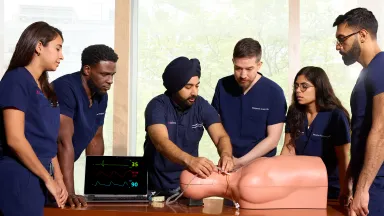
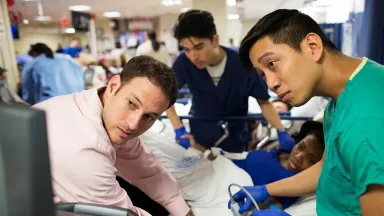
At Montefiore Einstein, residents learn and practice in state-of-the-art hospital facilities, benefiting from access to cutting-edge technology, comprehensive clinical resources and a collaborative learning environment designed to support excellence in patient care and professional development. Fellows are immersed in a fast-paced, high-acuity environment that offers exceptional opportunities for clinical growth and development. Our facilities are equipped with the latest and most advanced diagnostic and therapeutic technologies that enhance rapid decision-making and patient care. Residents gain hands-on experience managing a wide range of emergent conditions—from trauma and cardiac emergencies to complex medical and pediatric cases—under the guidance of experienced Emergency Medicine faculty. With multidisciplinary support teams, Montefiore Einstein Emergency Departments (EDs) create an ideal learning environment where residents develop critical thinking, procedural skills and the confidence needed to perform effectively in high-stress situations. Residents collaborate with nationally recognized physicians, researchers and advanced practice providers, gaining exposure to a diverse patient population and complex cases. The integration of research, innovation and evidence-based practice ensures that residents not only refine their clinical skills but also contribute to the advancement of medical knowledge and the provision of high-quality care.
Montefiore Hospital, Moses Campus
Montefiore Hospital, Moses Campus serves as the University Hospital for Albert Einstein College of Medicine. This 745-bed facility is located in the north-central Bronx and provides a full range of services, from primary to tertiary care. The Emergency Department is among the busiest in the United States and serves as the gateway to the hospital’s extensive tertiary care services, which include diagnostic and interventional cardiology, oncology, gerontology, critical care and various surgical subspecialties, such as reimplantation, cardiothoracic surgery, transplant surgery and neurosurgery. The Children’s Hospital at Montefiore Einstein (CHAM), a state-of-the-art tertiary care facility for children, includes a dedicated pediatric Emergency Department. The pediatric Emergency Department serves as a training site for a Montefiore Einstein-based Pediatric Emergency Medicine Fellowship and provides care to a population of children with a relatively high level of acuity and a significant proportion of tertiary care issues.
Special services and programs at the Moses Campus:
- Tertiary referral center with a broad spectrum of subspecialties (e.g., cardiothoracic surgery, transplant, neurosurgery, geriatrics)
- Children’s Hospital at Montefiore Einstein (CHAM), a dedicated pediatric Emergency Department and the site of Montefiore Einstein’s Pediatric Emergency Medicine Fellowship
- Divided Emergency Department workflow, including Critical Care, Acute Care and Urgent Care sections, with a dedicated Pediatric ED
- One of the busiest Emergency Departments in the U.S., serving more than 138,000 patients per year
- Clinical Research Fellowship (with opportunity to earn a master’s degree)
Jack D. Weiler Hospital, Einstein Campus
The Jack D. Weiler Hospital, Einstein Campus is situated on the campus of the medical school and serves as a 403-bed tertiary care facility. In the Emergency Department, adult and pediatric patients are treated side by side. An active interventional cardiology program offers residents exposure to complex cardiac cases. This hospital is the latest addition to the residency program’s clinical sites, enabling residents to manage intricate, high-acuity cases early in their training.
Special services at the Einstein Campus:
- 403-bed tertiary care hospital integrated into the Montefiore Einstein academic campus
- Interventional cardiology program with 24/7 cardiac catheterization laboratory (cath lab) access
- Mixed adult and pediatric Emergency Department with a diverse patient population
- Early high-acuity exposure for Emergency Medicine residents
- Active site for medical student teaching and procedural training