Comunicado de prensa
El Montefiore Einstein Comprehensive Cancer Center establece un nuevo instituto de inmunoterapia
16 de septiembre de 2024 (BRONX, NY)
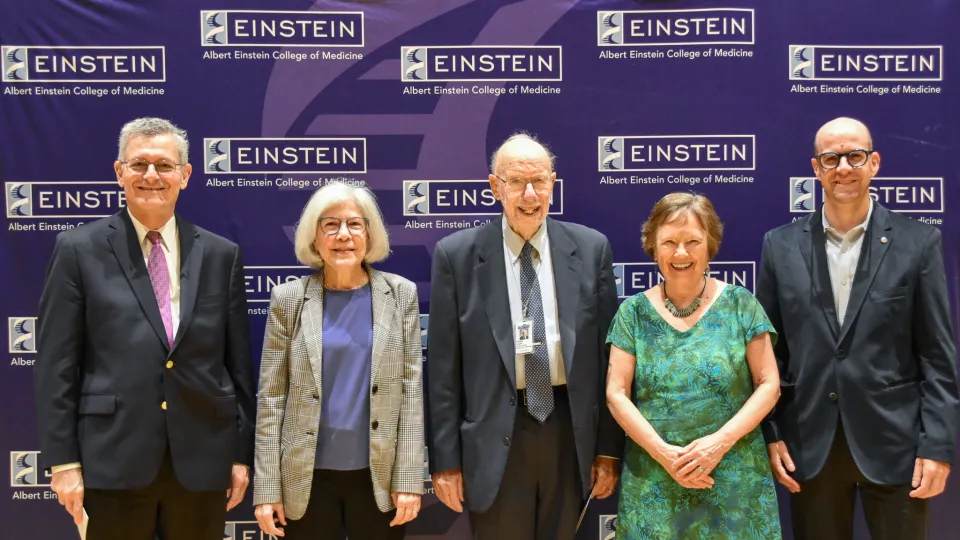
El Montefiore Einstein Comprehensive Cancer Center (MECCC), designado por el Instituto Nacional del Cáncer, anunció el nuevo Instituto Marilyn y Stanley M. Katz de Inmunoterapia para el Cáncer y los Trastornos Inflamatorios . El PhD Xingxing Zang, líder internacional en el desarrollo de nuevas inmunoterapias, fue nombrado su director inaugural.
“Nuestro objetivo es estar a la vanguardia del desarrollo de nuevas tecnologías de inmunoterapia y avanzarlas hacia ensayos clínicos, y en última instancia, tratamientos efectivos para el cáncer y otras enfermedades”, dijo el Dr. Zang, profesor de microbiología e inmunología, de oncología, de medicamento y de urología, la Chair Louis Goldstein Swan en Investigación del Cáncer en el Albert Einstein College of Medicine, y miembro sénior del programa de investigación de Terapéutica del Cáncer del MECCC. “Nuestro instituto es un entorno colaborativo que reúne a más de 45 científicos y médicos líderes de una variedad de campos en un enfoque interdisciplinario para descubrir nuevos objetivos de inmunoterapia y nuevas estrategias para el desarrollo de medicina ”.
Aprovechar el poder del sistema inmunológico

La inmunoterapia, que implica activar y reforzar el sistema inmunitario para eliminar enfermedades, ha revolucionado el tratamiento del cáncer en los últimos 20 años. Existen varios tipos de inmunoterapias contra el cáncer: terapia celular adoptiva, que toma las células inmunitarias de un paciente, las multiplica o altera en el laboratorio y las infunde de nuevo en el paciente; vacunas contra el cáncer, que "entrenan" al sistema inmunitario para combatir una malignidad existente; activadores de células inmunitarias, que redirigen las células inmunitarias del paciente hacia las células cancerosas; conjugados anticuerpo-fármaco, en los que los anticuerpos que se dirigen a las células cancerosas se unen con moléculas de quimioterapia que destruyen las células; e inhibidores de puestos de control inmunitarios que liberan los "frenos" del sistema inmunitario. En 2018, James Allison, PhD, mentor del Dr. Zang, recibió el Premio Nobel por desarrollar el primer inhibidor de puntos de control. Actualmente, nueve inhibidores de puestos de control están aprobados para el tratamiento de diferentes tipos de cáncer y han revolucionado el tratamiento de trastornos malignos.
A lo largo de su carrera, el Dr. Zang ha descubierto varios puntos de control inmunitario nuevos y ha desarrollado numerosos inhibidores de puestos de control, centrados principalmente en la inhibición de las familias B7-CD28, proteínas que desempeñan papeles importantes en la evasión y progresión inmunitario del cáncer. Dos de sus inhibidores de puestos de control se están evaluando actualmente en ensayos clínicos de fase 1 y fase 2 en 12 tipos diferentes de cánceres sólidos y tres tipos diferentes de cánceres de la sangre. También ha formado su propia empresa para seguir desarrollando nuevos inhibidores contra cánceres metastásicos que no responden a los fármacos actuales. A principios de este año, dirigió un equipo en MECCC que demostró que CAR-T, un tipo de terapia celular adoptiva que ahora se utiliza contra los cánceres de la sangre, puede tratar con éxito los tumores sólidos.
“La experiencia, los conocimientos, la creatividad, la productividad y el espíritu de colaboración del Dr. Zang lo han convertido en un verdadero líder en el campo”, afirmó el MD Edward Chu, MMS, director del MECCC. “Nos complace enormemente que lidere esta importante nueva iniciativa”.
Apoyo crítico de sostenimiento
El apoyo filantrópico ha sido fundamental para la creación del nuevo instituto. «Esto no habría sido posible sin la generosidad de Marilyn y Stanley Katz», declaró el MD Yaron Tomer, decano de Marilyn y Stanley M. Katz en Einstein y director académico de Montefiore Einstein. «Su donación de 4,5 millones de dólares será un motor de apoyo continuo para el instituto, brindándonos la oportunidad y la flexibilidad para invertir en la prometedora ciencia que puede conducir a nuevos descubrimientos y tratamientos».
Gregoire Lauvau, PhD, profesor de microbiología e inmunología y becario Sylvia y Robert S. Olnick en investigación del cáncer en Einstein, además de miembro del programa de investigación en Terapia Oncológica del MECCC, es director asociado de investigación básica del instituto. Chandan Guha, MBBS, PhD, vicepresidente de oncología radioterápica en Einstein y Montefiore, profesor de oncología radioterápica, urología y patología en Einstein, y director asociado de innovación y transferencia tecnológica en el MECCC, es director asociado de investigación clínica y traslacional.