
News Release
Montefiore Einstein Kidney Stone Clinic Offers Bronx Patients Multispecialty Coordinated Care
March 13, 2025
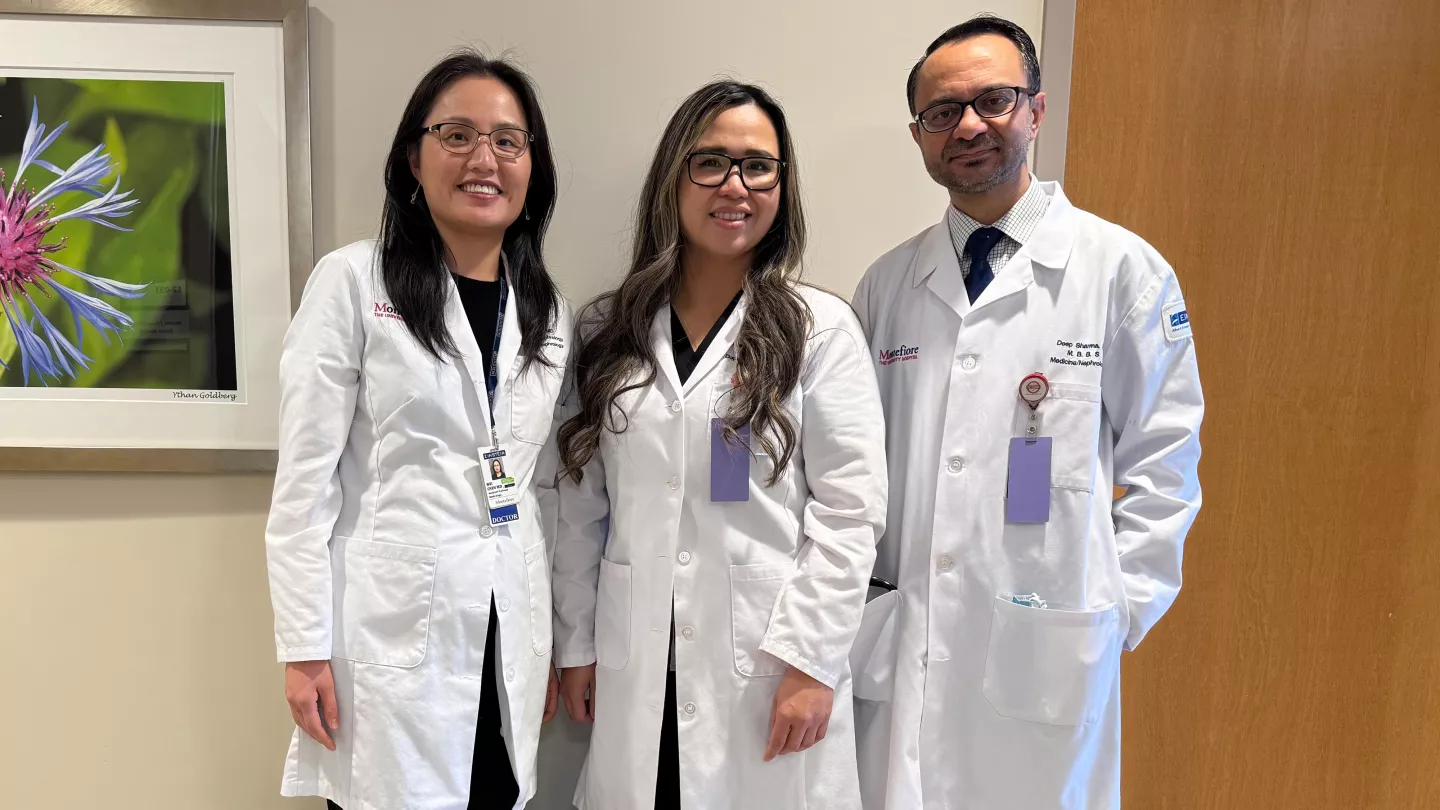
From left, Dr. Wei Chen, Raeleen Dejesus, NP, and Dr. Deep Sharma, all members of the Department of Medicine’s Division of Nephrology who care for patients at Montefiore Einstein’s Kidney Stone Clinic, located at the Hutchinson campus.
One in 10 people will experience a kidney stone, according to the National Kidney Foundation. Caused by mineral deposits that can build up in the highly sensitive lining of the kidneys, kidney stones can cause debilitating pain that often sends people to the emergency department. Urologists are trained to provide interventions to remove stones the body can’t pass, but they often don’t have the expertise to help patients avoid forming stones again.
“There is a whole medical aspect of treating kidney stones, where we discuss dietary changes, medications, fluid intake, and how we can manage these factors over the long term. Especially for patients who have risk factors for forming recurrent kidney stones, it's important to see a nephrologist,” says Deep Sharma, MBBS, clinical director of nephrology at Weiler Hospital and director of the Montefiore Einstein Kidney Stone Clinic.
Because urologists have traditionally taken the lead from a treatment perspective, many nephrologists don’t get a lot of training around kidney stones. Gradually there has been greater recognition of the benefits of providing multidisciplinary care for kidney stone patients. Dr. Sharma, in collaboration with colleagues in the Department of Urology, opened Montefiore Einstein’s Kidney Stone Clinic at the Hutchinson campus in 2017.
Today, in addition to Dr. Sharma, the service includes nephrologist and researcher Wei Chen, MD, MS; and Raeleen Dejesus, NP. They work in close collaboration with urologists Alexander Small, MD, and Dima Raskolnikov, MD. Patients can see one of the urologists on the ninth floor and Dr. Sharma and his team on the twelfth floor.
“Being in the same building, just a few floors away, makes it easier for patients to access care,” says Dr. Sharma. The strong relationships between the physicians also helps ensure patients get referred to the right place quickly for follow-up, whether they are seen first by a urologist or a nephrologist.
For those at risk of recurring kidney stones, an ounce of prevention
While anyone who has experienced kidney stones can benefit from seeing a nephrologist, it’s especially critical for those at risk for recurrent kidney stones. Genetic conditions like hypercalciuria, which causes excess calcium in the urine, and cystinuria, which causes kidneys to excrete too much cystine, an amino acid, are two examples.
Helping patients get a better sense of their risk factors is a big part of what the nephrologists at the Kidney Stone Clinic do. The team works with a specialized lab located in Chicago called Litholink that provides 24-hour urine analysis designed specifically for kidney stone patients. “The patients get a kit that goes to their home, where they collect the urine and send in the specimen,” says Dr. Sharma. “The results give us a lot of information about the patient's fluid intake, dietary intake, or any other abnormalities that can put them at risk for recurrent kidney stones. This in-depth analysis helps us tailor our medical recommendations around prevention for each individual patient.”
Dr. Wei Chen holds a dual appointment in the Department of Medicine’s Division of Nephrology and the Department of Developmental and Molecular Biology. She sees patients at the Kidney Stone Clinic in addition to her research, which focuses on calcium build-up in the blood vessels of people with kidney disease. In collaboration with colleagues in urology and a genetic testing company called Natera that tests for nearly 400 genes associated with chronic kidney disease, Dr. Sharma and Dr. Chen recently published a study examining the genetic causes of kidney stones. “This study helps us understand the genetic factors that could contribute to kidney stone disease in a diverse group of patients,” says Dr. Chen. “Specifically, we found that kidney stone disease is often caused by a combination of multiple genetic factors rather than a single genetic mutation.”
Many kidney stone patients also have other chronic diseases, another reason consulting with a nephrologist is so important. “There are certain medications for high blood pressure, for instance, that can be beneficial for patients with kidney stones,” says Dr. Sharma. “We have the training to manage their other conditions and optimize care for both their kidney stones and any comorbidities.”
Helping patients get back to their lives
While the incidence of kidney stones increases with age, and men experience them at higher rates than women, they can occur in otherwise young, healthy people. “A lot of the patients I see are in their 30s and 40s,” says Dr. Sharma. “Kidney stones cause a lot of pain and can lead to a lot of missed time from work and school. Generally, we like to check in with our patients at least once a year to make sure everything is okay and evaluate whether any interventions, tests, or procedures need to be repeated.”
One young patient with cystinuria followed up at the clinic after having an intervention with one of the urologists. Dr. Sharma started him on medications that helped to manage his condition. After a time, he stopped following up and the stones came back with greater frequency. “He ended up back at the urology office for another intervention,” says Dr. Sharma. “Urology sent us a message and we got him in quickly. We re-evaluated his condition, discussed the medications he needed, and impressed on him the importance of regular follow-up. As a team, engaging with the patient, we were able to get his kidney stones under control.”
In addition to receiving referrals from urology, patients also come to Dr. Sharma and the team from general nephrologists, primary care physicians, and Montefiore’s Patient Access Center, which flags patients who may have undiagnosed kidney stones. Once a patient is in the door, the collaboration with urology makes for a seamless process. “We are in constant communication and help make sure patients get seen quickly, whether they need a procedure or a medical evaluation,” says Dr. Sharma. “It’s great to be able to offer this level of comprehensive care to our patients here in the Bronx.”