
Video could not be played
Feature
Dr. Allan Wolkoff on Five Decades as a Physician-Scientist
July 8, 2026
Video could not be played
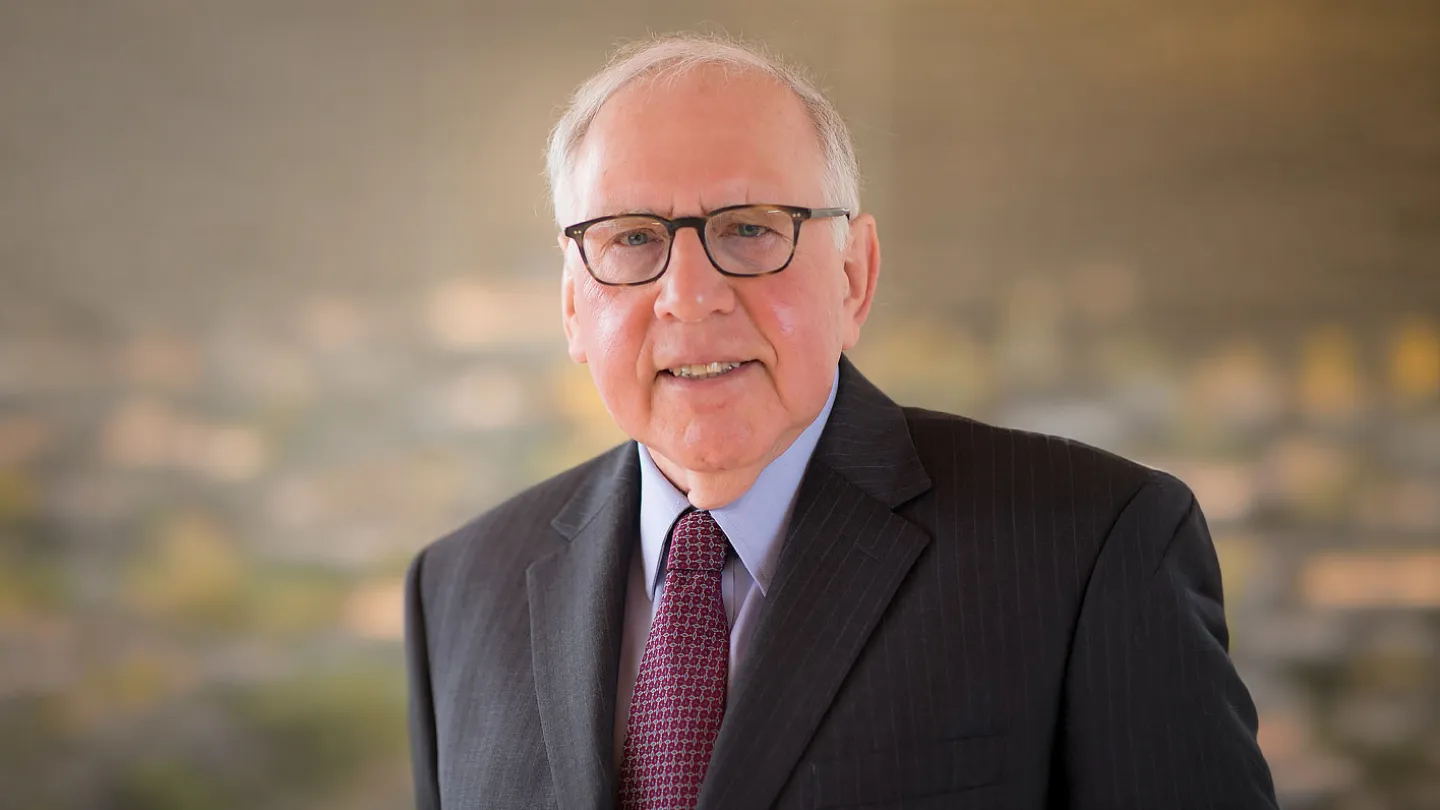
Dr. Allan Wolkoff, who is becoming professor emeritus after 50 years at Einstein as a division chief and a preeminent researcher on the liver and liver disease.
On July 1, 2026, Allan Wolkoff, MD, officially transitioned to professor emeritus after an incredible 50 years on the faculty at Montefiore Einstein, during which he earned a global reputation as a researcher, scholar, and mentor. He helped found the Marion Bessin Liver Research Center at Einstein in 1974, the very first research institute in the U.S. devoted entirely to the liver and liver disease, and served as a division chief for nearly 20 years. Here, in a Q & A interview, he shares some highlights and takeaways from a prolific career, and what’s still ahead.
How did you get interested in medicine?
Dr. Allan Wolkoff: I was actually a math major at Dartmouth. I wrote a thesis and did graduate level courses, and worked my way through college in a biochemistry lab at the medical school there. When it came time to graduate, I realized the math I liked was so abstract, I wasn’t sure what I would do with it. I decided to apply to the medical school at Dartmouth, which at the time was a two-year school that offered only the preclinical courses. It was very rural area then, so there weren't a lot of patients.
What were your first impressions of medicine?
AW: In my first year in medical school, I was not particularly fond of it. You had to memorize this and that. I said, that's what books are for and why do I need to do that? The second year we did pathophysiology of disease and that really turned me on. The chair of medicine, Tom Almy, was almost a founding father of gastroenterology, and that’s how I got interested in that field.
How did you get started in research?
AW: I transferred to Einstein and moved to the Bronx for my second two years and did my clinical work here. To this day there's a Sam Rosen Teaching Award and he was my advisor. Thinking back to my time working in the biochemistry lab, I went up to him one day and said that I'd really like to do some research. And all he said to me was, ‘Go see Win Arias.’ I said, ‘Who in the world is that?’ And he said, ‘Just go see Win Arias.’ Win was the chief of GI. He was one of the fathers of hepatology and his great interest was in bilirubin and how the liver worked. I did go see him and we hit it off. Now, at age 100, he is still a collaborator of mine on an NIH–funded project I’ll continue into my retirement.
What would you consider your first breakthrough?
AW: Right away, Win sent me to gather data on a rare inherited disorder of the liver called Dubin-Johnson syndrome, named for the physicians who first described it. I was analyzing urine and working out the genetics to see how it was passed down. Win sent me and my wife to Puerto Rico to collect specimens from a big family there. Once we returned, I got all the data together, and it led to my first published paper. It was the lead article in the New England Journal of Medicine.
What did the paper describe?
AW: Patients with Dubin-Johnson syndrome are mildly jaundiced from high bilirubin levels, but it's the non-toxic form of bilirubin. It is unable to be excreted into bile and backs up into the blood. There was a report from Finland of a strange pattern of porphyrins in the urine of patients with this. I started examining urine, extracting porphyrins and analyzing them. I discovered the pattern in those with Dubin Johnson syndrome was very different from those without the disorder. This porphyria is called coproporphyrin and there are two varieties, type one and type three. Normal urine is 80 percent or more type three, and Dubin Johnson syndrome is 80 percent or more type one.
To see how the syndrome is inherited, I analyzed urine from all the family members I met in Puerto Rico. People who didn't have the disorder, or in whom bilirubin didn’t rise, had an intermediate pattern of porphyrins in their urine—not so predominantly type one or type three. Based on this, we demonstrated that it was an autosomal recessive trait, and we laid it all out with family trees.
So this was all while you were still in medical school. How did you come to join the faculty at Einstein?
AW: I graduated from Einstein in 1972 and matched in medicine at Jacobi Hospital, which was one of the strongest programs in the country at the time.
There was a war in Vietnam and many of us weren't keen to pay a visit there. There was an NIH program where you could be on active duty in the public health service during your fourth year of medical school and some of your internship and residency, and then go to the NIH. One of the people who had just started the liver unit at the NIH, Dr. Paul Berk, knew of me and of Dr. Arias and really wanted me to come there. After a couple years at Jacobi, I went off to the NIH and worked with Dr. Berk and that was a dream place. I was a clinical associate, seeing some patients, doing research, and inveigling myself into other people's labs, including in very basic science areas.
I came back to Einstein as a faculty member in 1976, and I’ve been here ever since, with the exception of a sabbatical in 1984 when I went to the NIH again.
Fast forward: what is the research you’re excited about right now?
AW: For five years I’ve been working with the National Center for Advancing Translational Sciences (NCATS) at the NIH. There was an idea that woke me up one night about bilirubin, which is a breakdown product of heme, the core molecule of hemoglobin. In low amounts bilirubin might be helpful, but in high amounts it causes jaundice and is still a major cause of cerebral palsy and learning disorders. And then there's another heritable disorder that I've been interested in for at least 50 years, called Crigler-Najjar syndrome, where the liver is unable to detoxify bilirubin.
In the days before liver transplants, individuals with this syndrome would die as babies. A liver transplant is a serious thing and patients have to take immunosuppressive drugs for the rest of their lives.
As a physician-scientist, I look at biological mechanisms, and I thought about the biochemistry involved. When you break down heme, you get a green pigment called biliverdin, which then gets converted by an enzyme to bilirubin, a yellow pigment. You see this reaction when you get a bruise. Some areas are reddish, that’s the blood. Later on, it gets a greenish tinge, that's the biliverdin. When it turns yellow, that’s the bilirubin. It happens in the macrophages under your skin throughout your body. It's biochemistry in action.
I woke up in the middle of the night, thinking, what if we could inhibit the conversion of biliverdin to bilirubin? Instead of yellow jaundice, there would be green jaundice, and instead of jaundice it would be called “vertice” or something like that. Biliverdin, as far as we can tell, is not toxic. The liver doesn't need to do anything to metabolize it. It can be excreted by the liver and the kidneys.
It turns out there are people who are born without the enzyme that converts biliverdin to bilirubin, and its absence seems to have no ill effects on them or their children. So my colleagues, Jayanta Roy-Chowdhury, Win Arias, and I have been working with NCATS at the NIH to develop a drug that will inhibit the enzyme that converts biliverdin to bilirubin. We don't need to inhibit it entirely. If you think of the statins that inhibit cholesterol synthesis, you're not trying to drive cholesterol synthesis to zero, just low enough to make you a little healthier. So we've been working on that, and we've made some really fantastic progress.
The team at NCATS is the dream team. You can't imagine the talent. I visited them recently and was amazed that they've got robots going through the lab, setting up experiments and culturing cells, and it feels right out of science fiction. I’ll definitely keep going with that project into the future.
Will you still see patients?
AW: I specifically wanted to continue seeing patients, some of whom I've cared for over decades now. I’ll also continue to teach and do rounds at Weiler Hospital. I enjoy doing all of these immensely and this phase of my career allows me to focus on what I enjoy most.
When you look back at your career, what stands out?
AW: I think as an MD doing research, I look at the world a little differently perhaps than somebody with a PhD. I’ve tried to act as a bridge to bring more basic science and clinical problems together. I've always had this theory that clinical people don't talk to basic science people because they're afraid to. They think they're going to come across as ignorant, and the basic science people have the same feelings towards the clinical people. Not that they don't like each other, but there is some hesitation there.
If you as a leader can catalyze an interaction, it's amazing that they both start appreciating each other. They have complimentary expertise and can really accomplish things. So that's always been one of my goals, to have people with different training work together, and for a while our division was able to support a series of these interdisciplinary projects and programs. It really has been satisfying.
What advice to you have for aspiring researchers?
AW: If someone is interested in research, they should do what makes them happy. Finding a mentor who can help guide you as a young physician or scientist is critically important. I’ve got two grown children and we like to say in our family, there's nothing wrong with being happy. It may not necessarily pay as well as doing something else, but if you're happy doing it, you can find ways to make a positive impact. My daughter became a psychotherapist after first pursuing law, and my son is a visual artist, both guided by this philosophy.
Tell us a little about your upbringing and life outside of work.
AW: I was born in Brooklyn and my family moved to Long Island when I was in fifth grade. My father was a teacher in the New York City public schools and worked his way up to principal. My mother stayed home and took care of my two brothers and me. I’m the oldest and I think of myself as the mutant in the family. Both my brothers became lawyers. One became CEO of the American Stock Exchange for a time, and the other is a well-known litigator in Boston.
I met my wife, Claire, on a blind date when I was at Dartmouth and she was at Smith, which was about 120 miles away. She was also a math major, but unlike me who was abstract, she is a very concrete thinker and keeps me down to earth. She became an actuary and my clinical training helped her enormously, because when I was an intern at Jacobi, I was on service every third night. I'd come home exhausted and more or less fall asleep, giving her sufficient time to study for all 10 of her actuary exams, which she passed with flying colors. She still volunteers as an actuary and was honored as volunteer of the year at a banquet in Washington, D.C. a year ago.
You volunteer with the Coast Guard. How did you get started with that?
AW: Yes, I've been voted recently to be commander of division seven of the Coast Guard Auxiliary. I get an extra stripe on my sleeves.
When we moved to Mamaroneck, my wife only entertained my interest in getting a boat because she knew there was a 10-year waiting list to get a slip at the village marina. So, she put my name on the list and then they fooled her. A few weeks later, they called and said, ‘Your slip is ready. Where's your boat?’ We got a 19-foot boat and called it the Hepatocyte. Now we’ve worked our way up to a 36-foot Hepatocyte IV and we go cruising. I've been volunteering myself and the boat now for many years in the Coast Guard auxiliary, doing drills and patrols and training others. It's a very different world out there on the water.
I’m looking forward to a lot of boating and fishing in the days and years ahead.
After more than 50 years here, what defines Einstein?
AW: In one word, collegiality. In my generation, there are many of us who spent our entire careers here. People stay because it’s a wonderful place to be. It’s a very warm, personable, and supportive community.