
Video could not be played
Feature
Improving Care for HIV and Beyond: Clinical Trials at Montefiore Einstein’s AIDS Center
June 4, 2026
Video could not be played
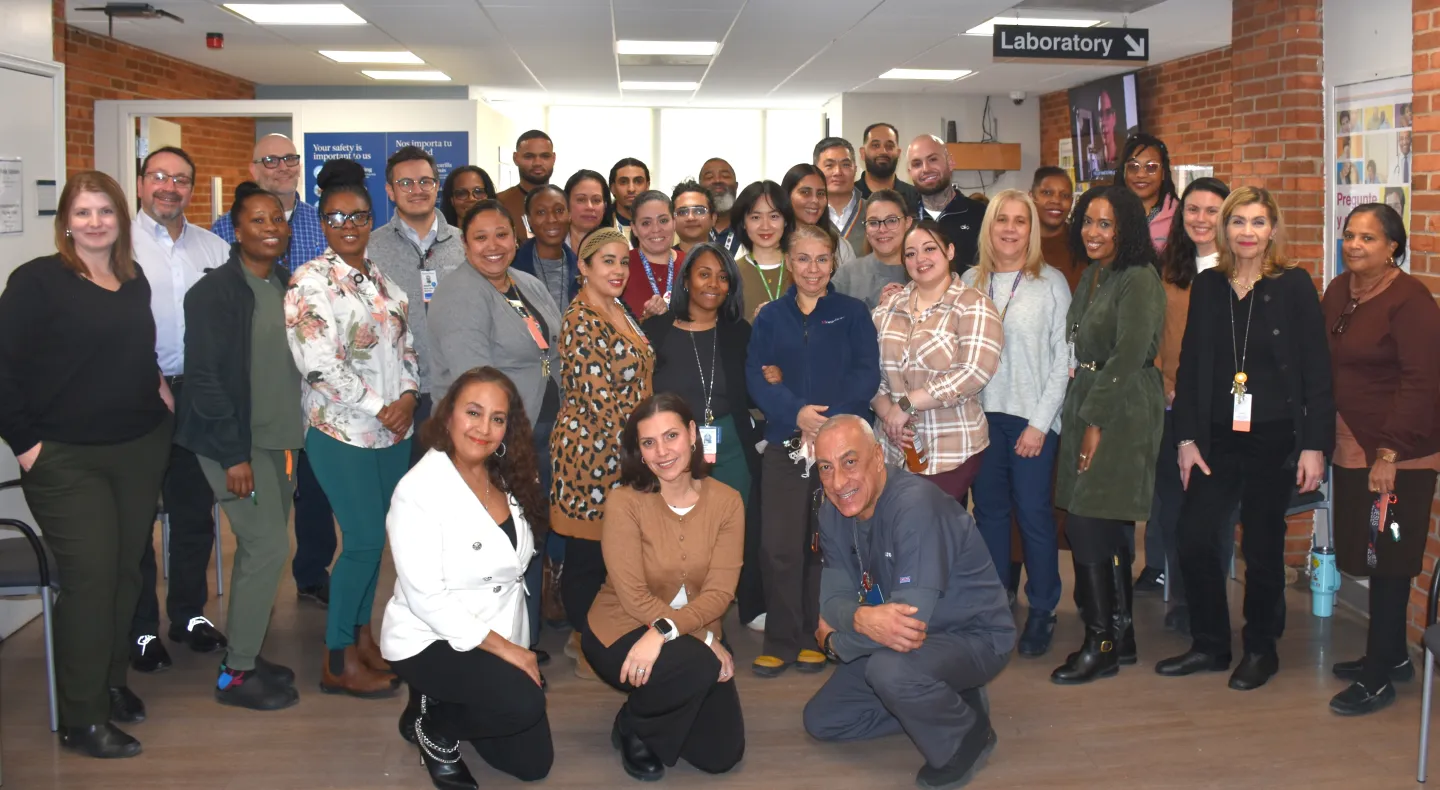
The team at the Montefiore Einstein AIDS Center, including medical director Dr. Barry Zingman, second from left, and Dr. Robert Grossberg, medical director at the Center for Positive Living, next to Dr. Zingman in the back row.
When a never-before-seen disease emerges, clinical trials are the only way forward, toward a treatment doctors and patients can pin their hopes on. Perhaps it’s not surprising then that Montefiore Einstein’s AIDS Center, one of the largest in New York State and a longstanding leader in clinical care and research, broadened its expertise in conducting clinical trials when an urgent need arose—in 2020, during the early months of what became the COVID-19 pandemic.
“Every advance that we've ever had, to the point where HIV is now a chronic illness that can be managed so that people can live normal lives—all of those advances have come from clinical trials,” says Barry Zingman, MD, infectious disease specialist and medical director of Montefiore Einstein’s AIDS Center. “As a site for clinical trials, the AIDS Center at Montefiore has been involved with the development of just about every agent that has been ever approved for HIV therapy.”
Dr. Zingman remembers a Sunday in early March 2020, doing online research about COVID. That week, the first patient in the New York City–area tested positive and was admitted to Montefiore.
Dr. Zingman immediately put out an email to the NIH, expressing interest in becoming a site for a newly developing national clinical trial of the antiviral medication remdesivir. “Within a week, we had this experimental drug in our pharmacy and were giving it to our first patients, and it ended up being very successful,” he says now. “The AIDS Center’s entire clinical trials unit changed over to a COVID trials unit in just days.”
Dr. Zingman was the lead investigator at Montefiore on that study, and his team enrolled the second most patients of any site in the world. Of those, 86 percent were Black or Latino—accounting for 20 percent of all the people of color who participated in the study in the U.S. “We made sure that our patients in the Bronx, who often couldn’t advocate for themselves and are frequently not significant participants in major clinical trials, had access to this promising, potentially life-saving therapy,” says Dr. Zingman.
Building capacity
AIDS and COVID have a striking number of similarities. Both are caused by novel viruses, both can affect many systems throughout the body, and both had especially devastating impacts on populations already facing significant needs and differences with respect to their health and access to care. In this sense, Montefiore’s AIDS Center was unusually well positioned to play an important role in clinical trials during COVID.
The infrastructure the AIDS Center has built around offering clinical trials, and the added experience in offering vaccine trials during the pandemic, has led to the continued expansion of the number and types of trials being conducted there.
Recent studies unrelated to HIV include a clinical trial of a vaccine to prevent gonorrhea, and another to prevent serious E. Coli infections in older individuals. Neither therapy proved effective enough to move forward, but the AIDS Center team was very successful in enrolling patients in these studies.
They recently began enrolling patients in an international trial of a vaccine against C. difficile colitis. “We've been enrolling patients almost every day since the study opened,” says Dr. Zingman. They are on target to sign up 250 study participants over the next 18 months.
The AIDS Center’s clinical trials unit, overseen by Dr. Zingman and administrator Singh Nair, has gradually expanded to include a full-time regulatory coordinator, six study coordinators, and two outreach staff who have been cross-trained to also handle all the blood work and specimens. It has refrigeration equipment, an onsite research lab, and dedicated research exam rooms.
“Funding and investment we received from the NIH and Montefiore during the COVID pandemic really brought us to a whole other level,” says Dr. Zingman.
He adds, “There are potential investigators in the Department of Medicine, and in other departments at Montefiore Einstein, who are being offered clinical trials and are interested in leading studies. But they don't always have the staffing or the experience, the equipment, the space, the infrastructure. The clinical trials infrastructure we’ve built allows us to help others in the department and around Montefiore as well, which is great for all.”
A priority from the start
Dr. Zingman saw some of the first patients with AIDS as a medical student at NYU in the 1980s, at Bellevue Hospital, and it shaped his decision to later pursue a fellowship in infectious diseases. At Boston City Hospital, he was the first fellow there to provide ambulatory care for patients with HIV.
“Two years later, it became routine that you must work in an HIV clinic as part of an infectious diseases fellowship,” Dr. Zingman recalls. “For me, it seemed so natural to ask to be involved, but at the time my fellowship director was surprised that I wanted to, as there were no treatments yet.”
It was during this period that he got early exposure to clinical trials of AZT, the first FDA–approved treatment for HIV, as well as other early antiretrovirals. “Those were dark days, but the clinical trials and new medications coming out gave people hope,” he says. “It was so powerful, seeing this illness beginning to be transformed by clinical trials. The pace of experimental medications and trials at that time was just incredible—much like what we saw in the early days of COVID.”
His fellowship experience won him the position of assistant director of HIV clinical trials at Montefiore’s Moses Hospital. It was 1991, and Montefiore was the top infectious diseases program in New York City, and an early leader in HIV care.
“Offering clinical trials was a part of giving really excellent care,” says Dr. Zingman. “We continue to maintain that to this day. Sometimes there weren't new drugs being studied, and it would be kind of tough. And other times we had really exciting new agents and combination therapies. Patients were eager to sign up for these trials, and we helped support them.”
Having the right team
A key to the AIDS Center’s success in clinical trials has been ensuring that research staff are able to engage with the community and develop trust. “That level of trust that has enabled us to typically enroll patients who are people of color, Black and Latino in particular, and that's relatively unique,” says Dr. Zingman. “Sometimes these groups account for nearly all of our participants in a given trial.
“That's something we’re proud of—to be offering our patients these studies, but also to be including populations that still tend to be underrepresented in clinical trials. It benefits our patients and also improves trial results.”
They also have clinical faculty who are deeply committed to this work. “Our attending physicians are very motivated,” says Dr. Zingman. “We have faculty here who are really supportive of clinical trials and are themselves on the cutting edge of new therapies that are coming out. They have a level of excitement when we're able to offer a new study, and that gets passed on to the study team and the patients.”
One of those faculty is Robert Grossberg, MD, who will be marking 22 years at Montefiore Einstein in July 2026, all of it at the AIDS Center. Dr. Grossberg is the medical director of the Center for Positive Living and Infectious Diseases Clinic. He leads many of the HIV-related clinical trials there.
“Part of what drew me to HIV care in general, including research, is just how new it is,” Dr. Grossberg says. “Even small developments can feel big because the disease is only 50 years old. When something's new, things tend to change and evolve quickly.”
He continues, “HIV disproportionately affects marginalized populations, or people who may be disadvantaged in life and society. The opportunity to care for these patients and develop better treatments is deeply important to me.”
Starting in 2013, under Dr. Zingman, together with other key faculty in Montefiore Einstein’s Division of Infectious Diseases including Julian Torres-Isasiga, MD, and Eric Meyerowitz, MD, the Oval Center—previously a specialty clinic for sexually transmitted diseases—became a more comprehensive sexual health program. “We added advanced contraceptive care, including Nexplanon and IUD insertion there,” says Dr. Zingman. “We added mental health and substance use services, social work, nutrition. If we really want to help people to lower their risk of HIV and other sexually transmitted diseases, then we need to help them address some of the other issues some of our patients are facing, like domestic violence, food insecurity, and housing issues.”
The transformation of the Oval Center also took into account the changing faces of HIV and AIDS in the Bronx. When Dr. Zingman first arrived at Montefiore in the early 90s, the primary risk factors for HIV in the Bronx were heterosexual contact and injection drug use. “Those factors accounted for about 80 percent of the HIV-positive individuals who were infected in our borough at that time,” he recalls.
Over the next 15 to 20 years, “it flipped completely on its head,” he says. “The Bronx epidemic became about 80 percent men who had sex with men or transgender women having sex with men. The other reason to form the Oval Center was to create a clinic that from the beginning could be focused on that new, at-risk LGBTQ+ population in the Bronx.”
The result was, in Dr. Zingman’s words, “a site that was completely unique at Montefiore, and in fact, unique in the city of New York.” It was the first of its kind, an LGBTQ-friendly clinic focused on sexual health services that was “status neutral.” “Whether you're HIV positive or HIV negative, we have services for you,” says Dr. Zingman.
The Oval Center has received numerous awards and other recognition from both the city and state for the care model Dr. Zingman and team developed there. Both have provided support for the center ever since. In June 2026, it was awarded a new major grant from the New York City Department of Health and Mental Hygiene to provide services, including screening and care for sexually transmitted infections, as well as access to HIV PrEP, which stands for pre-exposure prophylaxis, and HIV PEP (post-exposure prophylaxis) for those at risk for sexually transmitted diseases and HIV.
The Center for Positive Living and the AIDS Center have also been continuously funded, including by the federal government’s Health Resources and Services Administration (HRSA) through its Ryan White program, which supports care for people living with HIV and AIDS.
Still plenty to do, in HIV and beyond
Another factor that has contributed to the center’s success in clinical trials: being highly selective. “My philosophy is that we should never host a clinical trial that we don't believe could make a big difference,” says Dr. Zingman. “That’s why we've never really offered early stage trials that are too theoretical. The clinical trials we offer have significant potential gain for our patients, society, and the world. That is part of how we earn patients’ trust.”
Some of the up-and-coming trials at the center related to HIV involve long-acting therapies, including injectable options, both for keeping the virus in check for patients who are living with HIV, and new long-acting forms of PrEP, for preventing infection.
“Drug treatment for HIV is getting better and better, and that's been the case for a while. Sometimes there is this feeling of, how much better can it get?” says Dr. Grossberg. “But it's still advancing. There is still room for new drugs, new strategies, new delivery systems.
“COVID definitely pushed us to broaden our scope and engage in different types of clinical trials, but there is plenty to do and explore on the HIV treatment side,” he continues.
Long-acting, injectable therapies for HIV treatment and prevention have the potential to make treatment more successful and sustainable for many patients. “There is a lot of appeal for patients who don't want the burden of taking a pill every day, or more than one pill,” says Dr. Grossberg. “If they could get treatment every six months, that would be a game-changer. That's where the field is headed.”
As one example, Dr. Zingman is the principal investigator on a study comparing the standard daily PrEP medication, Truvada (TDF/FTC), to an experimental pill that can be taken just once a month. “Twice already, the drug manufacturer has increased our enrollment cap because we've been so successful in signing patients up for the study,” says Dr. Zingman. If the therapy works, “it will revolutionize oral PrEP treatment.”
For all the enthusiasm and commitment to clinical trials, perspective is key, says Dr. Zingman. “You do a clinical trial because you don't know if it's going to work yet. You have to accept that all you have under your control is to do it well, and help patients make the best decision possible about whether or not to participate, based on the risks and benefits.”
The team continues to be energized by their vaccine trials and is eager to share their expertise with investigators in the Department of Medicine and beyond. “We're interested in collaborating,” says Dr. Grossberg. “We have the staff to support it. And one of the nice things about infectious diseases as a specialty is that it's very broad-based and not focused on one particular system in the body. In that way, it gives us a natural connection to many different areas of medicine.”
“The evolution of our clinical trials unit over time has been really incredibly satisfying, and I think we have the potential to keep on making a big difference,” says Dr. Zingman. “We’re thrilled to be able to offer this to our patients here in the Bronx and to be able to support other investigators at Montefiore Einstein’s Department of Medicine and other departments in doing their important research.”
Related Faculty

Video could not be played

Video could not be played