
Video could not be played
Feature
Finding Her Voice in Science
August 26, 2025
Q&A with Dr. Madeline DeLuca, graduating Einstein PhD student
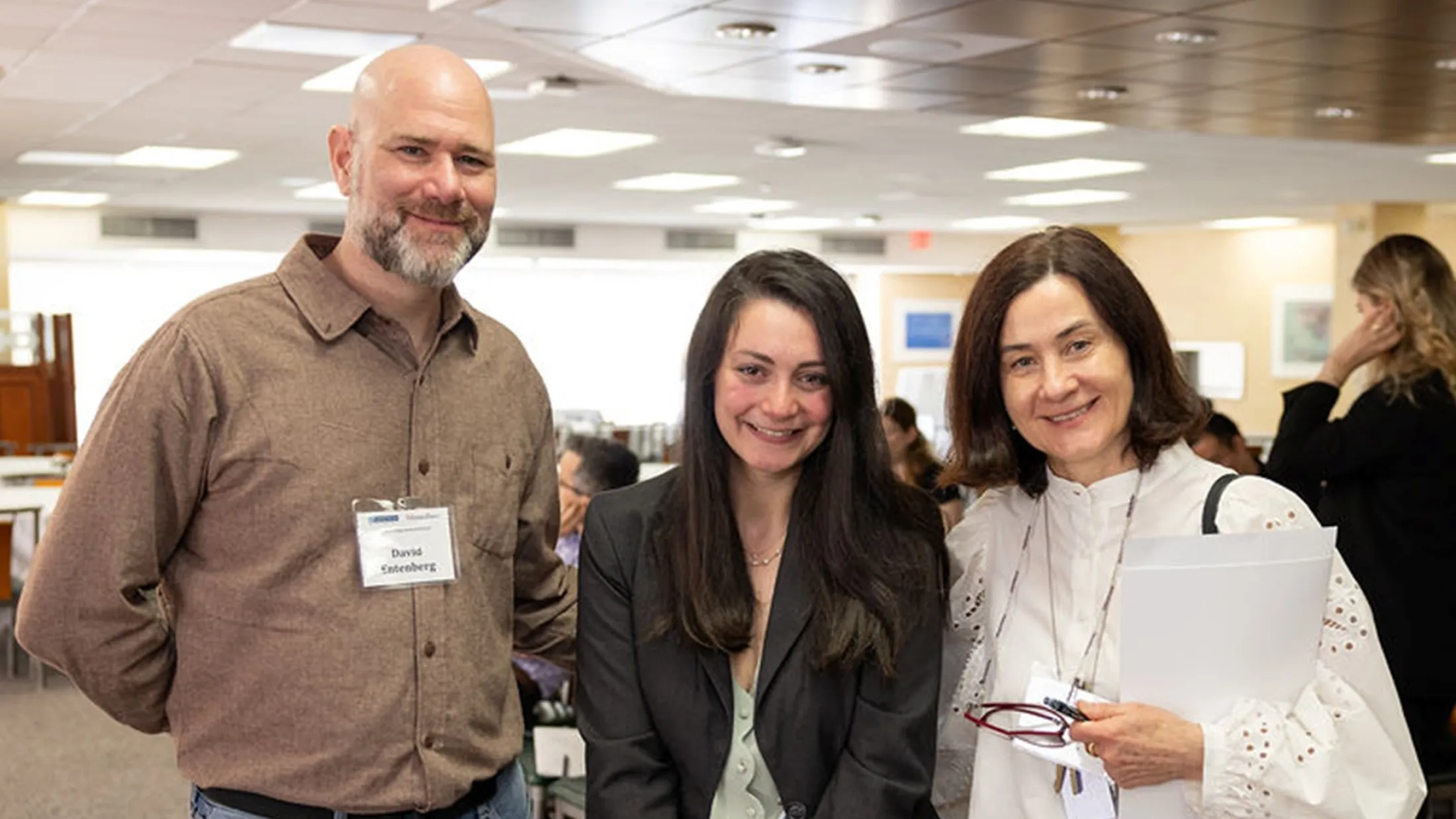
Video could not be played
On August 4, 2025, Madeline DeLuca, PhD, successfully defended her doctoral thesis in Biomedical Sciences at Einstein. Working in the department of pathology under the mentorship of David Entenberg, PhD, an associate professor of pathology, and Maja Oktay, MD, PhD, a professor of pathology and surgery, her research examined how the chemotherapy drug paclitaxel can paradoxically promote metastasis in triple-negative breast cancer.
In addition to her research, Maddie built an outstanding record of scholarship and communication during her training at Einstein. She authored nine peer-reviewed publications — including four as first author — and distinguished herself as a speaker and educator. In 2024, she was invited to present at the Regeneron Science to Medicine Forum and won the Flash Talk competition at the Montefiore Einstein Cancer Center Retreat; this year, she received the Outstanding Speaker Award at the pathology department’s Annual Research Symposium. Maddie was also deeply engaged in teaching and mentorship, developing curricula for medical students and public-school children and guiding high school and medical trainees in research projects.
Dr. Entenberg, co-director of the Gruss-Lipper Biophotonics Center and director of the Integrated Imaging Program, praised her transformation from a hesitant newcomer to a confident scientific voice. “Maddie’s generosity as a collaborator, her thoughtful mentorship, and her passion for science have made a lasting impact on our lab,” Dr. Entenberg said in his remarks at her thesis defense. “It has been both a privilege and a pleasure to witness her growth.”
Looking ahead, Maddie hopes to channel her passion for communication into a career in medical and scientific writing, helping make complex research more accessible and impactful for broader audiences.
In this Q&A, she reflects on her research, scholarship, and mentorship at Einstein, the value of failure in the lab and the challenge of overcoming it — and shares how art and even studying a foreign language help her recharge beyond the bench.
Where did you grow up, and what early experiences or influences steered you toward a career in science?
I grew up in the suburbs of Boston, and I have been interested in science for as long as I can remember. As a kid, I learned somewhere that some plants could be used as medicines, and I was fascinated by that. I went around my yard collecting leaves and tried to squeeze the liquid out thinking that I could discover the next great treatment for something. Funnily, my thesis work focused on the drug paclitaxel, which comes from the Pacific yew tree.
Your thesis examined the effect of paclitaxel on the pro-metastatic microenvironment in triple-negative breast cancer. How would you describe your research to a non-scientist?
Breast cancer is one of the leading causes of cancer-related death among women, but no one really dies from breast cancer if the cancer stays in the breast. People die of breast cancer when it spreads to more vital organs, like the brain, liver, and lung. Paclitaxel – a type of chemotherapy – often does a fantastic job at controlling tumor growth and extending the lives of breast cancer patients. However, for a small subset of patients, paclitaxel can lead to worse outcomes. I studied how that happens. Paclitaxel causes the tumor to become inflamed, and I found that this inflammation can sometimes make the remaining tumor cells better able to spread to distant organs, which can then lead to poor outcomes. These findings suggest that limiting inflammation during and after chemotherapy may help improve outcomes, but more research is needed to know for sure.
Your mentor, Dr. David Entenberg, played a big role in your doctoral journey. What’s the most valuable lesson or piece of advice you’ve taken from working with him?
Dave always told me to fail faster, and it’s so true. I like that piece of advice because it acknowledges that failure in research is inevitable, implies that failure still has value in telling you what doesn’t work, and keeps the timeline relevant during what can sometimes feel like an endless journey.
What was the toughest part of your PhD journey, and how did you overcome it?
This is not a hot take, but the toughest part for me was persevering through all the failed experiments. Everyone tells you that failure is expected, so I was prepared for this and made it through the first 3.5 years without getting too down about it. But the 3.5 to 4.0-year period was really difficult for me because by that point, I had been working on my projects for several years and still nothing was working enough to get a publication out of it.
During that time, I took about a month off from working on those projects to write a review article. I’m not sure that would be the best choice for everyone, but it was helpful for me to focus on something else for a while. I like writing, and I especially liked that I felt productive and had something to show for myself (more words on the page) nearly every day that month. It was a nice change after going so long with no new data.
You earned your undergraduate degree in nutrition at UMass Amherst. While at Einstein, you put that background to good use, teaching school children in the Bronx about healthy eating through the Bronx Obesity Diabetes & You program.
Eating nutritious foods has a huge impact on our overall health, but it can be difficult for people – especially kids – to figure out how to easily incorporate more nutritious foods into their lives. Teaching kids how to do this was rewarding because, at such a formative age, even small lessons can have a lasting impact. During one of those classes, I asked the kids if they (or their parents/caregivers) liked to do anything to make fruits and vegetables more fun to eat. I started them off with a couple of my childhood favorites (melting cheese onto broccoli; putting peanut butter on apples) and then opened it up to the class. The kids were so excited to share the “special” ways they like to eat fruits and vegetables, and it was so cute to see them give each other ideas. One kid said he put Tajin seasoning on all the fruit he ate. I had never tried it before, but I bought some and tried it on watermelon. He was right – it was delicious!
You’ve built an impressive track record in writing and science communication — from mentoring students on grant proposals to developing public health curricula. Why is communicating science to broader audiences important to you?
There are so many important scientific discoveries being made that have the potential to change the landscape of health and clinical care. However, those discoveries are only as impactful as they are accessible to their intended audiences, and science can be very inaccessible due to its complexity. It’s important to communicate science to broader audiences to maximize the impact of new discoveries and ensure they help the most people as possible.
What advice would you give to future PhD students just starting out?
Create a paper (or digital) trail of everything you do. Find a good reference library/manager and save every paper you read with notes on what information from that reference is important to you – especially things that aren’t in the abstract. Do this for research findings and methodologies (i.e. this paper used X antibody at Y concentration for Z experiment; this paper used drug A at B concentration). Creating your own library will save you lots of time looking for references later.
What will you miss most about your time at Einstein? I will miss the Einstein community! So many people at Einstein made my time here really special. I will miss the kindness, collegiality, and support of everyone in my network here. The members of the Pathology Department – students, postdocs, faculty, and administrators – have been particularly amazing. Many of the faculty members have been so generous giving their time to help me, several students helped me practice for my defense seminar, and it was so nice to be part of such a friendly and supportive group.
Video could not be played
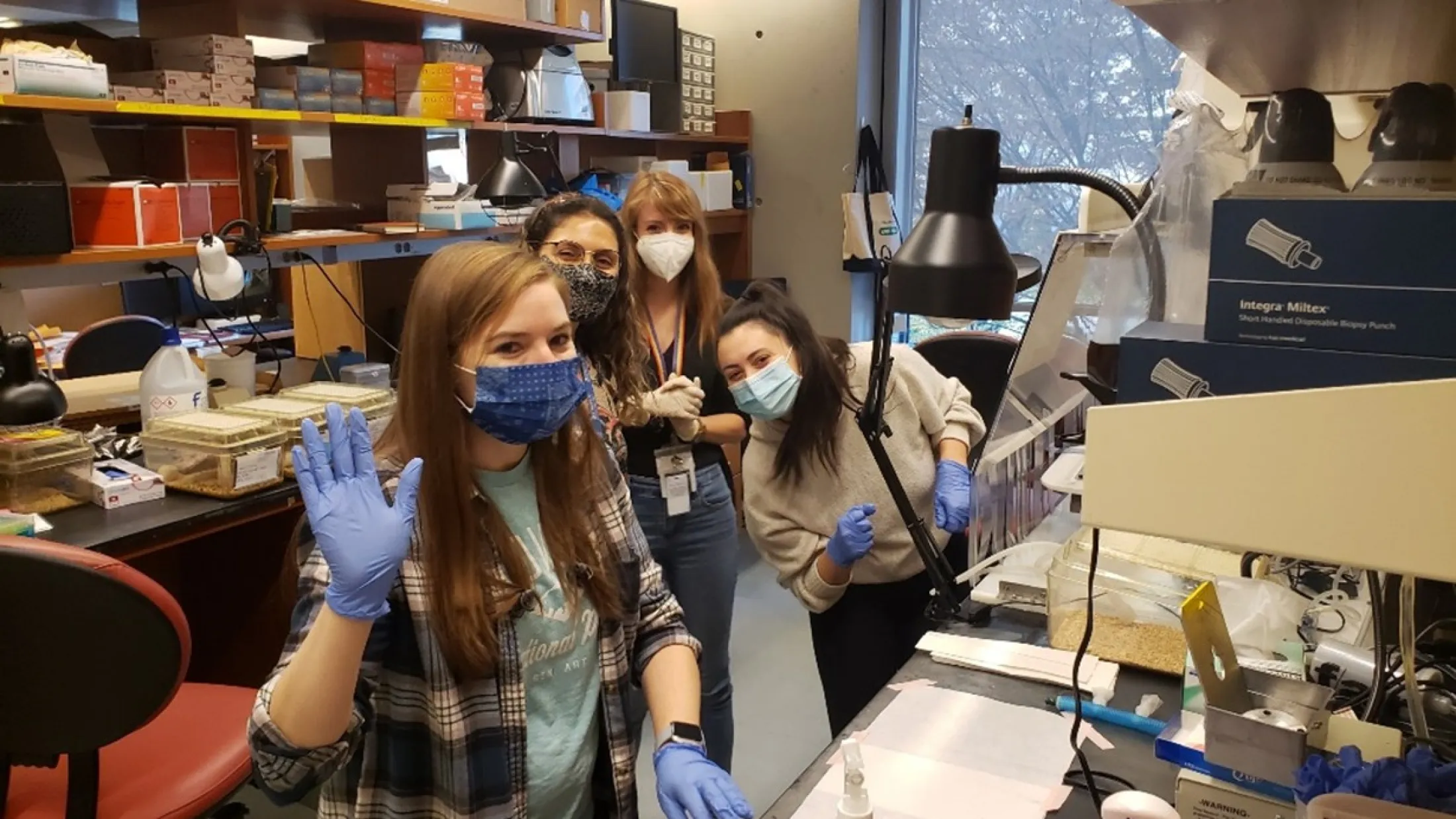
Madeline DeLuca (far right) working with lab mates (left to right) Camille Duran, Burcu Karadal-Ferrena, and Nicole Barth (2021)
What do you enjoy doing outside of the lab?
I like doing art! I really enjoy painting, (though I’m not very good at it), and I recently started doing a little graphic design and am excited to get more into that.
What’s something fun or unexpected your colleagues might not know about you?
I’m learning Italian and have a 297-day learning streak on Babbel!