
Video could not be played
Feature
Introducing the Patricia Bauman Center for Integrated Geriatrics Care, Offering Comprehensive Geriatrics Services to Older Patients in the Bronx
July 18, 2025
Video could not be played
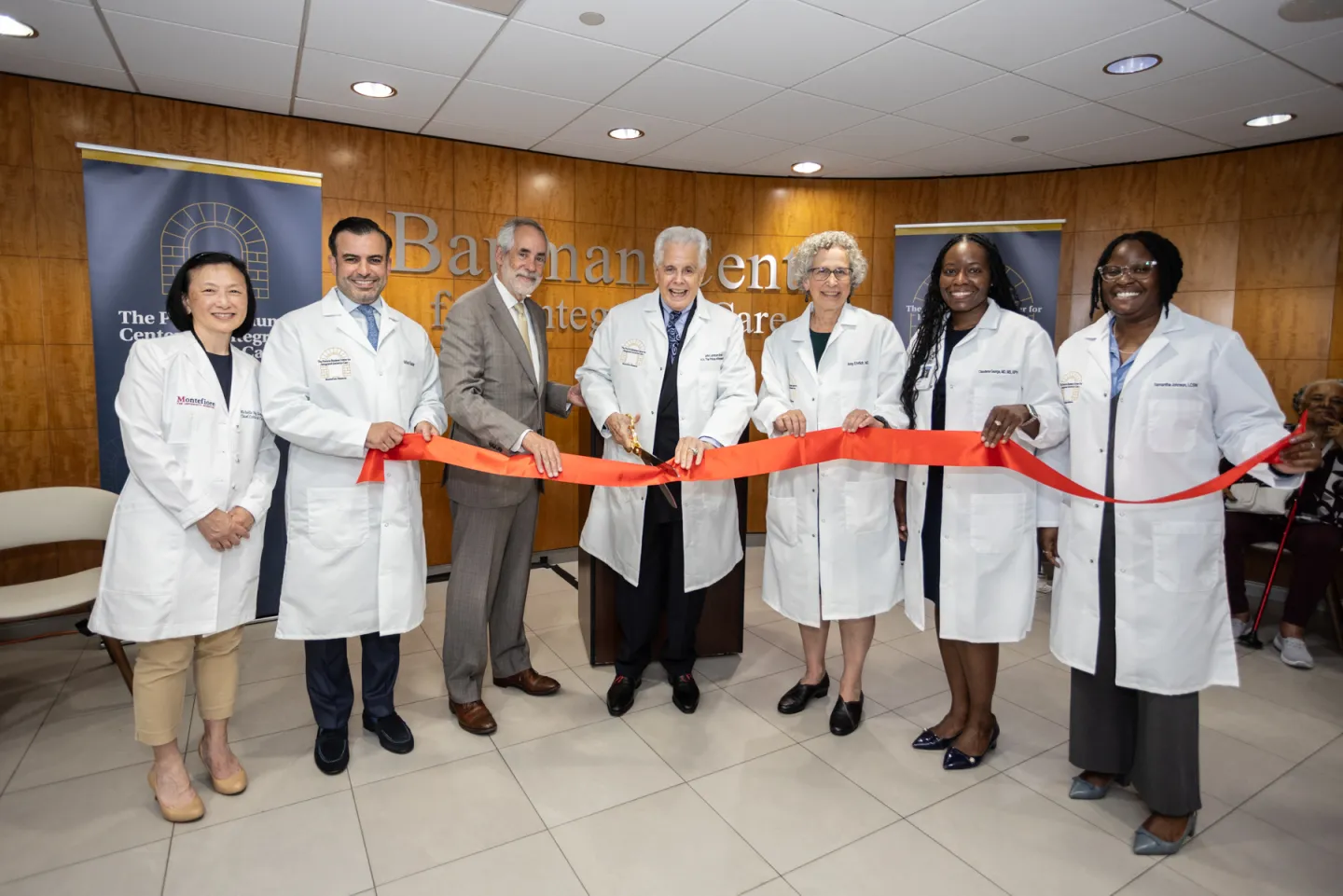
At the ribbon-cutting on July 16, from left: Dr. Michelle Gong, Milad Bader, Dr. Andrew Racine, Prince John Landrum Bryant, Dr. Amy Ehrlich, Dr. Claudene George, and Samantha Johnson.
On Wednesday, July 16, Montefiore Einstein held a ribbon-cutting ceremony for the official launch of the Patricia Bauman Center for Integrated Geriatrics Care. Located at 3400 Bainbridge Avenue, this new, expanded geriatrics practice will enhance the patient experience for older adults in the Bronx and improve access to comprehensive team-based care. Read more about the new center—made possible by a contribution from Prince John Landrum Bryant, husband of the late Patricia Bauman—and the extraordinary woman for whom it is named.
Prince John Landrum Bryant became aware of the value of expert geriatrics care the way many people do—when a loved one needed it the most.
His late wife, philanthropist and social justice advocate Patricia Bauman, a longtime member of Montefiore Health System’s Board of Trustees, had a dramatic recovery from lung cancer only to be diagnosed with Parkinson’s Disease not long after.
Amy Ehrlich, MD, professor of medicine and chief of the Division of Geriatrics at Montefiore Einstein, was among the doctors who eased the way in her final days. “What was most touching was that her doctors paid a visit to give their condolences after her death,” says Bryant, who goes by Prince John.
Video could not be played
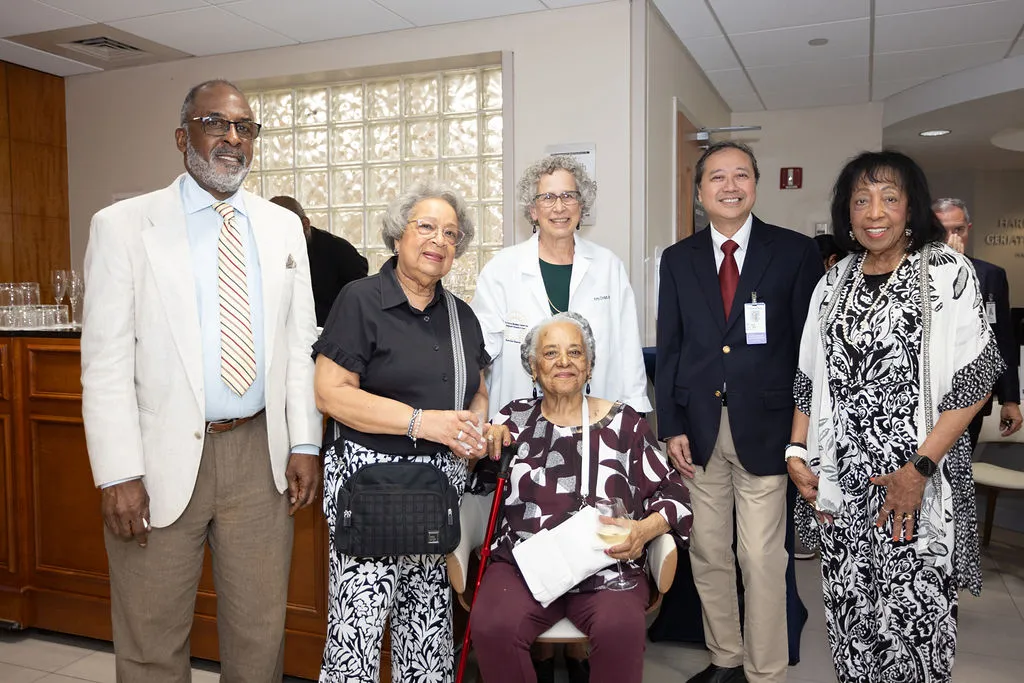
From left, standing, patients Frank Barrett and Jennie Romero, Dr. Amy Ehrlich, Dr. Wayne Lee, and patients Danette Queen, standing, and Hilda Romero, seated. The patients are all members of the Bauman Center Patient Engagement Committee.
He himself has had extensive experience with navigating complex medical diagnoses and procedures. Prior to his wife’s passing, he had open heart surgery performed by Robert Michler, MD, cardiothoracic surgeon and chair of surgery and cardiothoracic surgery at Montefiore Einstein, and spent time at Burke Rehabilitation. He developed a keen appreciation for the challenges of accessing high quality healthcare, even for people with significant resources.
After his wife’s passing, he transferred his own primary care to Dr. Ehrlich. Between his own experiences and witnessing the care provided to his late wife, he knew firsthand the benefits of a comprehensive approach to geriatric care, and he knew the need was growing exponentially.
“I began to think about what has become as known as the silver tsunami,” says Bryant. “I thought, how frightened people are going to be as they get older. Even those who have taken scrupulous care of themselves may wake up one day and find they can't tell you what the days of the week are. And even once they or a family member recognizes they require specialized care, they may not be able to get it as quickly as they need it.”
He continues, “As Patricia reached the end of her journey, I began again to think about how we could enhance the experience for older patients, and allow more people to get really excellent care.”
He became keenly interested in focusing his philanthropic efforts on galvanizing other foundations around the need for improvements in geriatric care and research. After getting to know Dr. Ehrlich, he realized he already had a perfect partner in starting to realize his goals. “She lives and breathes to bring world-class medicine to the people of the Bronx,” says Bryant.
A growing need meets a bold vision
The needs of patients in the Bronx are also tremendous. It’s estimated that the borough is one of three counties with the highest rates of dementia in the U.S. Many older patients here also have language barriers and financial and environmental factors that have been shown to contribute to worse outcomes, even when patients are able to access the care they need.
The Patricia Bauman Center for Integrated Geriatrics Care is the product of Dr. Ehrlich and Bryant’s joint vision of expanding access to comprehensive geriatrics care in the Bronx. The center will add a new nurse practitioner; new specialized services, including one for complex management of patients taking many medications, known as polypharmacy; an updated clinical space designed with patients’ needs at the forefront; and increased support for clinical research aimed at improving patient outcomes. It will also include a Patient Engagement Committee to get invaluable input from the people the center serves.
“Older adults everywhere, including here in the Bronx, face many challenges in obtaining patient-centered care that takes into account the multiple conditions that affect so many of our aging patients,” says Dr. Ehrlich. “A center like this will give us greater resources to address core geriatric issues such as dementia, weight loss, malnutrition, polypharmacy, sensory deficits, gait and balance problems, sleep dysfunction, and other chronic illnesses.” The center will offer primary geriatrics care and also provide expert consultations to physicians from other disciplines who have patients with complex needs and would benefit from a geriatrics specialist.
A dedicated Bauman Geriatric Social Worker, Samantha Johnson, MSW, already part of the team at Montefiore Einstein, will take the lead in coordinating the screening of all patients for risk factors related to housing, transportation, access to food, and more, and help ensure they receive all the services they are eligible for. “Research shows that access to quality healthcare is only 20 percent of what influences patients’ outcomes, while the remaining 80 percent is determined by social elements and risk factors that are difficult to address during medical visits,” says Dr. Ehrlich.
Early on as the new center took shape, Bryant met with Dr. Ehrlich and her team, including Claudene George, MD, MS, RPh, who will serve as the center’s inaugural medical director. “Every time one of them opened their mouths and said what they did and how they would work with the center, I knew this was the group that could accomplish this,” says Bryant. “They know exactly what patients and families need.” Milad Bader, Bryant’s longtime righthand and executive vice president of the L. R. Bauman and Bauman Family Foundations, of which Bryant is the president, has also been closely involved in the center’s development and will continue to play an active role.
As part of the focus on clinical research, each year a faculty member will be designated a Bauman Scholar. Randi Rothbaum, DO, assistant professor in the division, will be the first to hold that title. Her current investigations are focused on delirium and frailty and on the benefits of collaboration between geriatrics and orthopedics in caring for older adults with mobility concerns. She recently spent a year as a quality improvement fellow as part of the Montefiore Health System Performance Improvement Fellowship. “We will need expertise in frailty, delirium, and quality improvement, because we're going to want to evaluate our patients’ outcomes over time, with a goal of constantly refining and improving our clinical practices,” says Dr. Ehrlich. “Randi’s ongoing work in these areas made her a perfect choice to be the first Bauman Scholar.”
Amid a national shortage of geriatricians, Dr. Ehrlich also hopes that creating a robust clinical and research center will help draw exceptional new faculty to Montefiore Einstein. “Faculty who want to be future Bauman Scholars, and are committed to providing excellent geriatric care in a comprehensive setting—these are the physicians and providers we hope will join us,” says Dr. Ehrlich.
Bryant calls Dr. Ehrlich “a creative genius,” in this regard. “Her leadership will draw in exceptional people,” he says. “For the right doctors, caring for patients in this kind of environment is the most satisfying work one could have.”
A heartfelt tribute to an enduring love
Prince John Landrum Bryant met Patricia Bauman at a party thrown by a mutual friend. He was 43 and she was about to turn 40. They had both separately asked the friend if he knew of anyone he could set them up with, and he said he didn’t. “Little did he know,” jokes Bryant. “We both arrived early and began talking, and that was it.”
Bauman was about to complete a juris doctorate, and Bryant was president of the National Park Foundation, the philanthropic arm of the National Park Service, where he worked with eight successive secretaries of the interior and five National Park Service directors. A true Renaissance man, he also holds a JD from Georgetown, and has founded a one-of-a-kind jewelry business and line of decorative home fixtures and décor among many other endeavors. “In midlife, I discovered I had an enormous passion to create beautiful things. I had no background, mentorship, or training, just an abundance of ideas, and I learned by doing,” he recalls.
Video could not be played
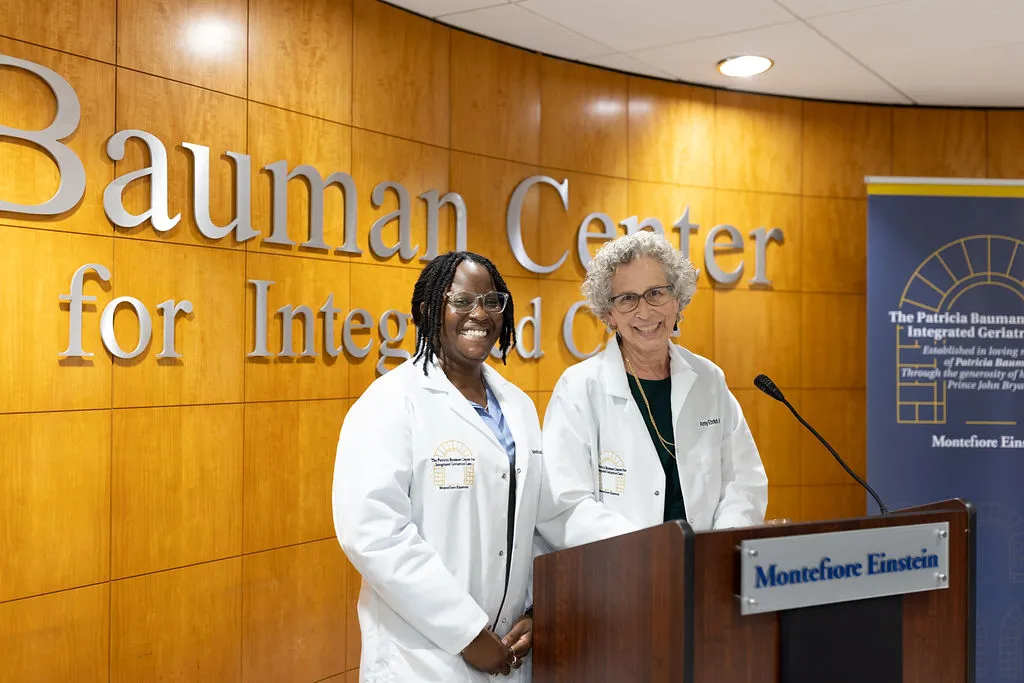
Samantha Johnson, MSW, the first Bauman Geriatric Social Worker (left) and Dr. Amy Ehrlich, chief of the Division of Geriatrics at Montefiore Einstein (right).
By his own account, Bauman opened him up to his creative side. “She was born, educated, and raised in Manhattan and was terrifically cultured, and I was from the northern part of the South, and was not, though I had a great appreciation,” he says looking back. They loved going to museums together, and she taught him to “save his eye for the very best . . . She really gave me the tools to enrich my life, and we enjoyed so many of the same things. She was a truly exceptional person. I try not to talk about her because then I begin to miss her.”
Bryant has now held a leading role in the Bauman family foundations, originally endowed by Patricia’s father, Lionel Bauman, for 37 years. Never one to shy away from a new field of endeavor, he has lent his boundless energy and direction to many initiatives. But contributing to the center that bears his late wife’s name is the most meaningful to him. “We are going to keep this thing going until there's no more to do, because this means so much to me and by extension to Patricia,” says Bryant. “Building a new initiative is always exciting, but nothing has meant as much to me as this.” His current focus is on bringing together likeminded philanthropists to continue to drive research and innovation in medicine and behavioral health, starting with geriatrics at the Patricia Bauman Center.
He is often moved by his fellow patients, whom he sees when he comes to Dr. Ehrlich for care. “The patient base is heroic,” says Bryant. “I see so much courage, so much stamina in people who are bearing terrific burdens. I pray for them, and I'm so grateful to see what Dr. Ehrlich and Dr. George and their team are doing.”
“The need is endless within our network to be able to provide comprehensive patient-centered care for older adults,” says Dr. Ehrlich. “So we are incredibly grateful to be able to launch the Bauman Center, which enables us to grow and attract new clinicians and researchers and members of the interdisciplinary team. It allows us to further improve and build on what we always aspire to do.”