Característica
Meeting the Moment: How Simulated Cardiac Arrests Are Improving Rapid Response Care
Montefiore Einstein’s efforts to provide the best possible response for cardiac arrests that happen in the hospital include unannounced “mock codes” that are a vital part of preparation.
20 de febrero de 2026
“Adult critical medical alert, Northwest 2.” These words, sounding over a hospital loudspeaker, usher in a swift and coordinated response, quickly bringing experts from multiple disciplines to the bedside of a patient experiencing cardiac arrest—a life-or-death moment. While the code team are rushing to the scene, the clinical team who were already caring for that patient begin the process of trying to save his or her life.
For most, it isn’t something they do every day. “It’s a low-frequency, high-acuity event,” explains Ari Moskowitz, MD, MPH, director of the Bronx Center for Critical Care Outcomes and Resuscitation Research and a critical care physician at Montefiore Einstein.
About six times a month at Montefiore’s Moses Hospital, days and nights, the patient being rushed to is actually a mannequin. “You wouldn't know it's a mock code until you get there,” says Maneesha Bangar, MD, director of critical care simulation. “The overhead page is exactly the same as in a real code. The team dynamic and response time, everything is the same.”
Cardiac arrest remains one of the most devastating and time-critical medical emergencies, striking sometimes with little or no warning. At least 300,000 patients in the U.S. go into cardiac arrest while hospitalized every year. “Despite decades of progress in resuscitation science, survival after in-hospital cardiac arrest remains unacceptably low nationally and internationally,” says Dr. Moskowitz. Notably, there is also significant variation in outcomes between hospitals, highlighting the potential for improvement when the right systems and best practices are in place.
Mock codes conducted in actual clinical spaces, also called in-situ cardiac arrest simulations, are a key to hospital team members being prepared for such events, especially for the local teams who step up in the first moments after a patient’s heart stops. Montefiore Einstein has a longstanding commitment to this type of simulation training. In a recent article in the journal CHEST, part of its “How I Do It” series on clinical practice improvements, Dr. Moskowitz and a multidisciplinary team of institutional experts detail the robust mock code training program developed at Montefiore, and the importance of these programs in improving outcomes. “In situ simulations allow teams to practice in their actual environment, making the training more relevant and impactful,” he writes in the article.
Dr. Bangar works together with nursing education and pharmacy to arrange codes throughout the hospital. They conduct them in places where cardiac arrest might be more expected, such as the emergency department and the ICU, but also in units where they are not expected, including inpatient psychiatry, gastroenterology procedure areas, interventional radiology, and others. Partnership across specialties including anesthesia, cardiology, otorhinolaryngology, cardiology, gastroenterology, pediatrics have been instrumental to these efforts.
Even in some places where patients are at high risk, the team found that the chain of command and response protocols for cardiac arrest needed fine-tuning. They have conducted a number of trainings in the cardiac catheterization labs, for instance, where cardiologists must stay focused on placing stents in the heart while the code team leads the emergency response.
A hands-on learning opportunity
Teams across the Montefiore’s hospitals have been extremely receptive to the mock code program. “People always ask for more of them,” says Dr. Moskowitz. Dr. Bangar adds, “The feedback we get is always positive. Recently a resident said to me, ‘It was good went over that rapid response, because we had to perform a difficult airway procedure on a patient, and we just had the simulation yesterday. It was so fresh in our minds, we had even more confidence in exactly what we needed to do.’”
In addition to cardiac arrest mock codes, the most frequent type, Dr. Bangar also arranges in situ simulations for difficult airway, or complex intubation procedures; gastrointestinal bleeding; pregnancy complications, and other scenarios. Even in high volume areas like the emergency department, “the nurses, residents, and physicians are always ready to participate,” she says.
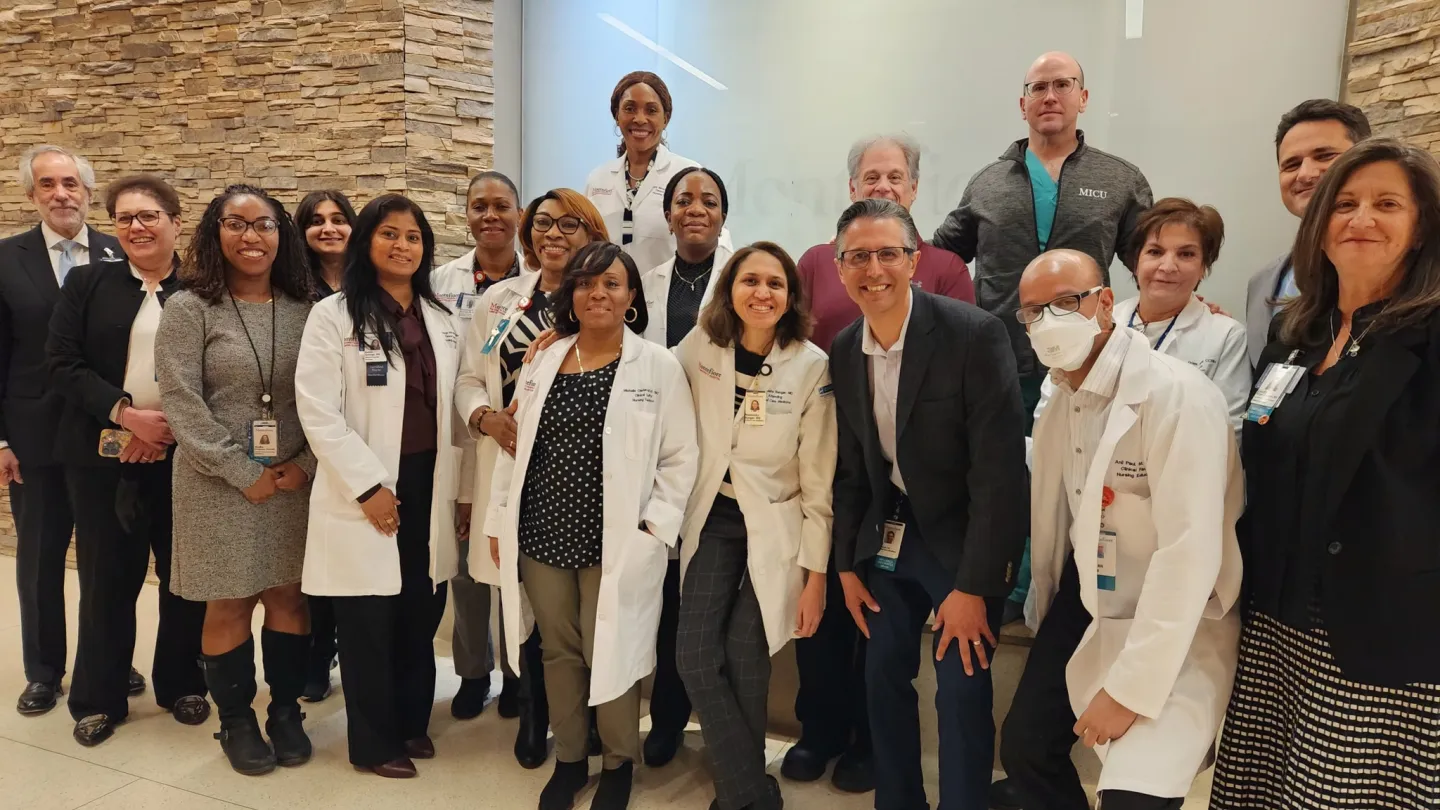
Nursing education is a key collaborator with Dr. Bangar, helping to design training that supports frontline staff across units. Anil Paul, MSN, RN, is a critical care clinical faculty member who works across the medical and surgical intensive care units on the Moses campus, and has been helping to coordinate mock codes since 2023. Anil states, “When we show up unannounced for the mock codes, sometimes nurses initially feel they don’t have the time, due to their regular patient care responsibilities. At the end of our unit debrief, we frequently get asked to return for more mock codes.”
Paul highlights some key learnings from the simulations. “Mock codes provide an important opportunity to remind nurses and providers that during a code, the code leader or another clinician with the necessary certification is required to be able to administer code medications.”
She adds, “Nurses also receive reinforcement about the importance of uninterrupted chest compressions.”
The mock codes last around 5 minutes, followed by a 10-minute debrief to talk about areas for improvement. “As soon as we’ve hit the educational points, we want to get people back to their regular work,” says Dr. Bangar.
Depending on the type, a mock code will include upwards of 15 people from across disciplines. Anesthesia partners contribute critical expertise, particularly for simulations in procedural areas and the PACU, while respiratory therapy and pharmacy colleagues ensure that airway management, ventilation strategies, and medication workflows are fully integrated.
In addition to strengthening teamwork and reinforcing best practices, the simulations also uncover latent safety threats, like equipment updates, that might otherwise go unrecognized. Physicians and hospital and nursing leadership across Moses, Weiler, and Wakefield hospitals have all actively supported these efforts.
Tracking and documenting for constant improvement
Our national leadership in in situ simulation is part of broader quality improvement work on cardiac arrest response across Montefiore. Dr. Moskowitz co-leads the Montefiore Cardiac Arrest Committee with Nicole Amanquanor, RN, MSN, director of nursing quality and professional practice. The committee brings together clinicians, nurses, educators, and operational leaders with a shared focus on improving in-hospital cardiac arrest care. The committee provides a forum for multidisciplinary review, learning, and system redesign, ensuring that lessons from cardiac arrest events translate into safer and more effective care.
Amanquanor has been involved with the committee since joining the nursing quality team in 2018, and became co-leader in early 2025. After starting her career as a nurse in adult medicine and surgery, and then working in the ICU, she had always been drawn to quality improvement. “I always want to understand why any safety issues happen, identify contributing factors, fix the issue if there is a gap, and address it so it doesn't happen again. That constant focus on safety is a critical part of what we do,” she says.
One of the most important practice changes to come out of the committee, she says, is how each code is documented. About five years ago, they switched from hard copy documentation of code events to recording data in Epic, Montefiore’s electronic medical record platform. “It's helped us get a lot of rich data and we base our practice improvements on that,” she explains.
Dr. Moskowitz also initiated participation in the American Heart Association’s (AHA) “Get with the Guidelines” program around resuscitation care. Says Amanquanor, “Having nurses document in Epic has helped us to be able to get the data we need to ensure we’re following those best practices, and provide training so that everyone is adhering to these standards systemwide.”
The basic data needed is represented by a simple mnemonic. “We call it CREDIT,” she says. “We need Compressions—what time compressions were started on a patient, and what was the initial Rhythm? Did we administer Epinephrine? Did we Defibrillate? Did we Intubate, and if we intubated, what size and how did we confirm that it’s correct and in place? And then the last one, the T, is for the amount of Time the response lasted.”
Dr. Moskowitz recently served on the AHA’s 2025 Post-Cardiac Arrest Care Guideline Writing Committee, helping define evidence-based standards that will guide clinicians worldwide. He also serves as vice chair of the International Liaison Committee on Resuscitation Advanced Life Support Task Force, contributing to global resuscitation guidelines.
The recent article in CHEST demonstrates Montefiore Einstein’s national leadership in creating a blueprint for other hospitals who want to use in situ simulations to improve how well they respond to cardiac arrests, regardless of where or when they occur in the hospital. Says Dr. Moskowitz, “Practice makes perfect. This is life-saving work.”