
Característica
Expansion of Montefiore Einstein’s Sleep Medicine Program Brings Better Rest to the Bronx and Beyond
October 31, 2025
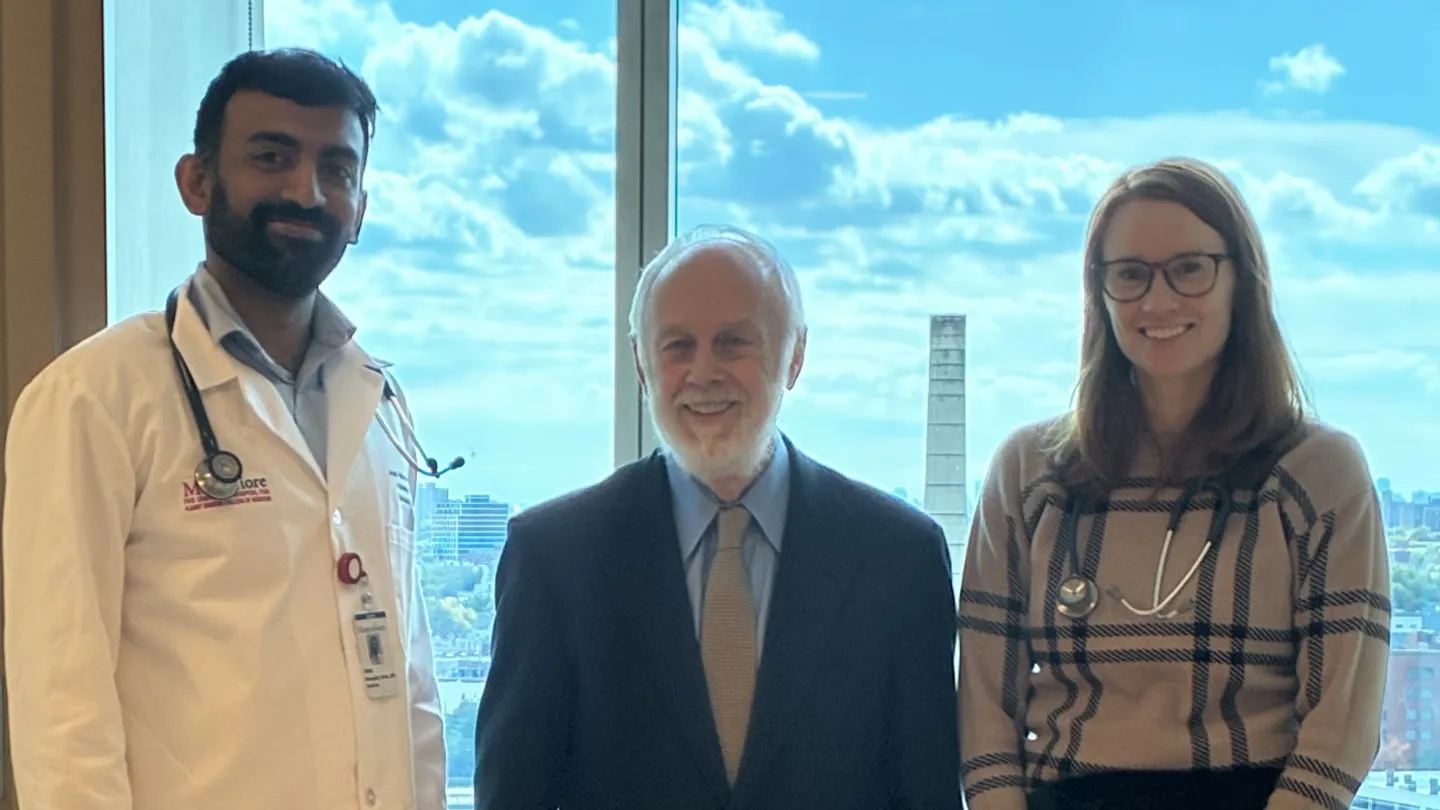
From left: Sleep medicine physicians in our Division of Pulmonary Medicine, including program director Dr. Jose Moonjely Davis, program founder Dr. David Appel, and Dr. Erin Eschbach, one of three new sleep medicine physicians who have recently joined Montefiore Einstein.
Sleep, or the lack of it, affects virtually every system in the body. Aside from not feeling their best, patients who aren’t able to get enough sleep, or high-quality sleep, are at risk for a host of poor health outcomes, from heart complications to obesity.
Nationwide there is more demand than there are experts in sleep medicine who can help diagnose and treat patients suffering from sleep problems. Montefiore Einstein’s Sleep Medicine Program, part of the Division of Pulmonary Medicine, has recently undergone a major expansion, with three new board-certified sleep medicine physicians and three new technicians at our Sleep Lab. “We’re really thrilled to have increased access to this care for our community,” says Jose Moonjely Davis, MD, who became the program director in 2023. “The need is there, and now we are even more ready to meet it.”
The three new physicians include Sarah Bjork, MD, who sees patients at Montefiore Einstein Advanced Care, in Westchester, as well as at the Medical Arts Pavilion, located near Montefiore’s Moses Hospital; Alok Bhatt, MD, who has his practice at the Hutchinson campus and the Medical Arts Pavilion; and Erin Eschbach, MD, who sees patients at the Hutchinson campus. Dr. Davis is located at the Hutchinson campus as well, and oversees clinical operations at the Montefiore Sleep Lab at nearby Westchester Square. David Appel, MD, who founded the program, offers care at the Medical Arts Pavilion and the Hutchinson campus.
The physicians were all drawn to the field by the opportunity to make a major impact on patients’ quality of life and overall health. “The really nice thing about sleep medicine is most of these conditions are very treatable,” says Dr. Bjork. “A lot of my patients come in with a whole barrage of symptoms and they're not really sure what's going on. All they know is they're exhausted during the day. We do tests and come up with a plan and our patients express so much relief. Often they tell me they wished they’d seen a sleep specialist sooner.”
Greater access to sleep studies, in the lab and at home
Thanks to the expansion, Montefiore Einstein’s Sleep Lab will soon be available seven nights a week for patients who need an in-person sleep study. This includes patients preparing to undergo cardiac and bariatric surgery, as well as patients with underlying heart or lung conditions or other known chronic diseases.
“Most patients actually sleep really well in our sleep lab, even though they don't think they will,” says Dr. Bjork. “We place sensors on their head, which gives us an estimate of their brainwaves and what stage of sleep they're in. We hook up sensors to certain muscles to see how they’re moving throughout the night. We evaluate their breathing and monitor their sleep all night long. That can tell us if there are obstructive events, or if their breathing stops because of issues in the brain, and it can also diagnose more brain-based sleep issues, including narcolepsy.”
Our Sleep Medicine program now also provides more patients with the option to undergo a sleep study from home, thanks to the availability of disposable devices that don’t need to be physically returned to the physician’s office. Patients wear a smart watch and disposable probes worn on their finger and chest. Data on their sleep quality is shared remotely with our sleep medicine physicians.
While an at-home test doesn’t provide physicians with the same level of detail, for many patients it’s the best place to start. “When you consider the comfort and ease of doing the test at home, it's lot easier for the patients,” says Dr. Davis. “In some cases, we will need to do a follow-up in the lab, but for many patients the at-home test is all we need.”
In both types of sleep studies, physicians have a follow-up visit with patients to discuss the findings and identify the best potential treatment. Once both the patient and the provider are satisfied with the patient’s progress, additional follow-ups may only be needed once a year.
Getting to the root cause of poor sleep
There are a wide range of conditions that can cause poor sleep quality or insomnia. The most common is obstructive sleep apnea, where a person’s airway closes during sleep. Another form, central sleep apnea, can be caused by the brain failing to send the right signals to the body to breathe. Montefiore Einstein’s Department of Neurology also treats sleep disorders, and the two programs refer patients to each other depending on a patient’s diagnosis and needs.
Other patients have neuromuscular disorders that can greatly impact their sleep. The team also treats patients with narcolepsy and excessive sleepiness, and parasomnias, which include sleepwalking and talking during sleep, acting out dreams, sleep terrors and nightmares.
Given their expertise in pulmonary medicine, around 70 to 80 percent of patients seen at the Sleep Medicine Program have sleep apnea. The gold standard of treatment remains the CPAP, or Continuous Positive Airway Pressure machine. The machines have become more sophisticated. They now can sense when a patient’s airway is becoming obstructed, and add just the right amount of pressure, calibrated to that individual, to open the airway. They also send data to the physician so they can monitor how well the treatment is working.
It's still important, however, for a physician with expertise in sleep medicine to help patients use the CPAP. “There are a significant number of patients who don’t end up using the device,” says Dr. Davis. “And if they don’t use it, or aren’t using it optimally, they aren’t getting the benefits.”
Dr. Bhatt says, “When faced with wearing a CPAP, for some patients, there is immediately a stigma and often some apprehension. There is an idea in their mind of what that means, what they have seen or heard about, and this can bias them against success. And aside from these perceptions, and no matter how well we prepare patients, sometimes the first few nights can feel unsuccessful, or in rare instances, unpleasant.”
He continues, “Despite this, CPAP is still the frontline treatment for sleep apnea, and there is a lot we can do to optimize it for patients. We want to go the extra mile to get patients the results they want from it, because it is extremely effective and comfortable if we take the time and effort to help the patient find what works for them.”
Dr. Bjork adds, “Many patients when they come in, they don't feel great because they haven't been sleeping well probably for years, and then they finally get that good night's sleep and they tell us, ‘I'm never giving up my CPAP machine. This is incredible.’ They didn't believe it at first, and then they're a true believer once it’s working well for them.”
Finding the right treatment for every patient
Prior to joining Montefiore Einstein, Dr. Bhatt also worked with additional treatments for sleep apnea, including collaborating with dental medicine to create oral appliances that can be used in certain patients, as well as working with otolaryngologists to manage Inspire devices. “Both of these can be very good alternative treatments and have their own benefits versus a CPAP,” he says.
Inspire is a relatively new device that is implanted under the skin of the chest and stimulates the hypoglossal nerve to move the throat muscles and open the airway during sleep. For patients who meet certain criteria and who are not able to successfully adjust to the CPAP, the Sleep Medicine team collaborates with Marc Gibber, MD, a surgeon in Montefiore Einstein’s Department of Otolaryngology, who surgically inserts the device.
While she treats all sleep medicine patients, Dr. Eschbach’s clinical interest is in other types of assisted breathing, including mechanical ventilation devices, which can be inside or outside the body, as well as BiPAP (Bilevel Positive Air Pressure) machines. BiPAPs offer two levels of pressure, which is more comfortable for some patients and may be needed for patients with other chronic lung conditions, such as chronic obstructive pulmonary disease (COPD), chronic respiratory failure, or sleep problems due to neuromuscular disease, another interest of hers.
“I originally got into sleep medicine because I really love helping patients with chronic respiratory failure,” she says. “With respiratory failure, everything starts at night. The first manifestations happen during sleep, and so often these patients are referred to our sleep clinic and we manage their care on an ongoing basis.”
She continues, “I'm interested in noninvasive and invasive home mechanical ventilation, including VAPS (Volume Assured Pressure Support system), a more advanced device, which many of these patients require.”
The physicians who recently joined Montefiore Einstein, including Dr. Bhatt, Dr. Bjork, and Dr. Eschbach, all also see some patients with other pulmonary conditions, and spend time caring for hospital patients. Their close relationships with their colleagues in the Division of Pulmonary Medicine benefit everyone. “We work together when they diagnose or suspect someone has a sleep disorder,” says Dr. Bjork. “They're able to bounce ideas off us and have those patients schedule a sleep test and or come see us in clinic. And when we feel someone’s sleep is being impacted by a chronic lung condition we can refer them back to the person on the team with the right expertise. We’re one big family.”
All the physicians are excited to be able to offer more access to their specialty for patients in the Bronx, Westchester, and beyond. “These patients have been so sleepy for their whole lives, they come to think of it as normal, just trying to get through the day. It can also have a negative impact on their relationships, their families, their work, in addition to their physical health,” says Dr. Eschbach. “Once we do testing and begin treatment, their lives are totally different. So it's a really positive way to help people.”