
Característica
Meeting People with Addiction Where They Are, at OnPoint’s Medical Clinic
4 de septiembre de 2025
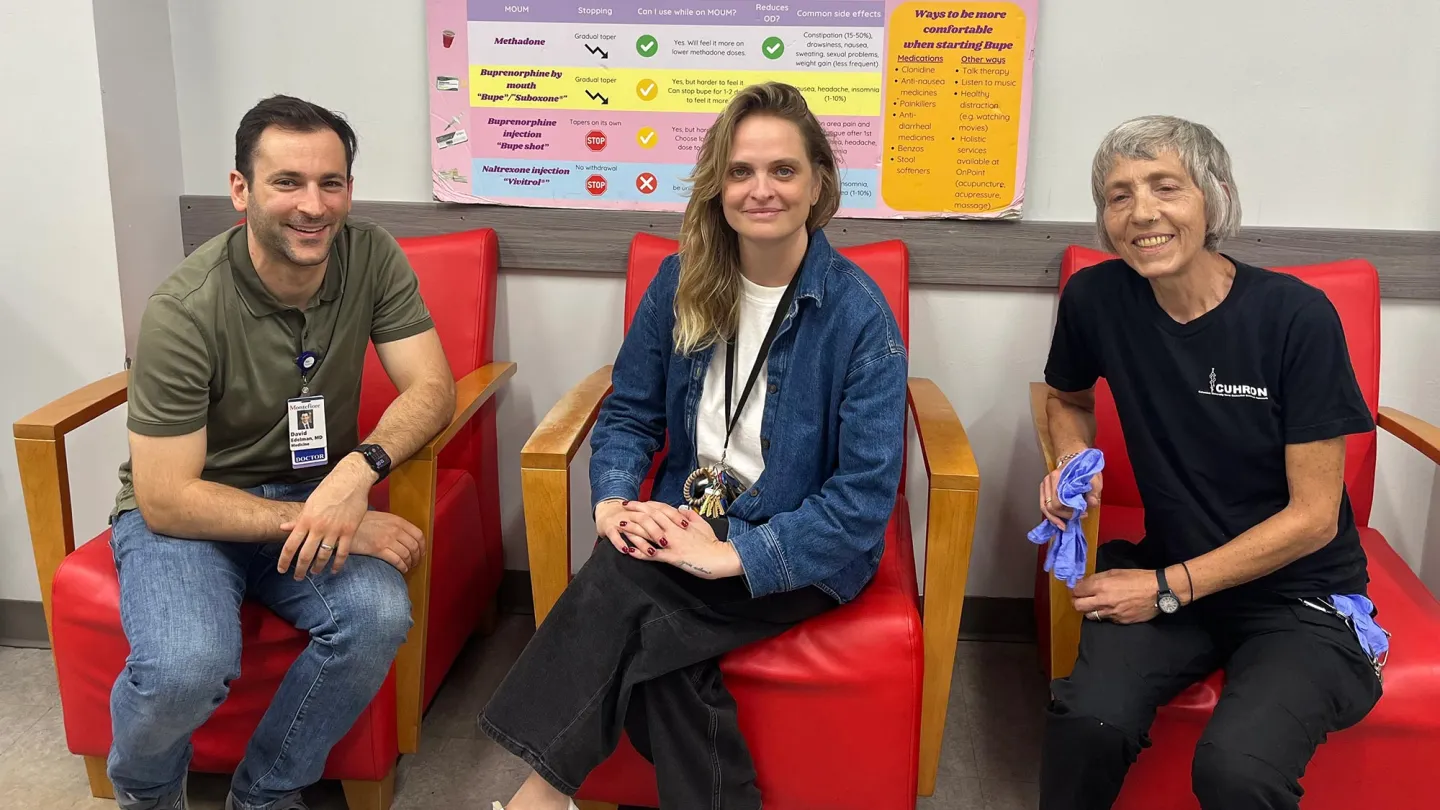
From left, Dr. David Edelman, assistant professor in the Department of Medicine and clinical provider at OnPoint, a harm reduction center, with Susan Spratt, clinic director at OnPoint, and Synn Stern, RN, nurse at OnPoint.
For addiction medicine specialist Matthew Holm, MD, there is no such thing as a typical day at OnPoint. Located in East Harlem and Washington Heights, OnPoint is a leading-edge harm reduction center for people who use drugs. In addition to being a drop-in center, where participants, as people who use the center are called, can do laundry, have a meal, or watch a movie, OnPoint also has an onsite overdose prevention center, where participants can use drugs under supervision. OnPoint is a safe environment in every sense—in terms of preventing overdose, and just as important, safe psychologically, free of the stigma that drug users still overwhelmingly face.
Dr. Holm is among the physicians in the Department of Medicine at Montefiore Einstein who provide medical care at OnPoint. The clinical services offered run the gamut from care for wounds related to drug use, treatment for hepatitis C and HIV, refills of common prescriptions for high blood pressure or diabetes, for instance, and initiation and maintenance of medications to help people overcome addiction. While participants can make appointments if they choose, most care is provided on a walk-in basis.
“It’s a unique care environment,” Dr. Holm says. “I might be stopping by the drop-in center, where participants and staff are just hanging out. Sometimes I will be chatting with a participant and someone will say, ‘Oh, you're the doctor here. Can I maybe come see you?’”
He continues, “Practicing medicine here is much more communal and free flowing. There are plenty of encounters I have, discussions, counseling sessions, that are outside our clinic and are not being documented. But I know that participants appreciate it.”
This gets at one of the key factors about the clinic. Many participants would not, under other circumstances, seek out medical care. Susan Spratt, the clinic director at OnPoint, put it this way. “Most if not all of the people that come through our clinics have had negative experiences in traditional healthcare settings, because they've been stigmatized for their drug use.”
It also highlights one of the reasons the physician team from Montefiore finds it so meaningful to provide care there. “We have an opportunity to really transform people’s relationship with healthcare in general,” says Benjamin Hayes, MD, MPH, MSW assistant professor in the Division of General Internal Medicine and medical director at OnPoint.
A strong partnership
Montefiore’s relationship with OnPoint dates back to around 10 years ago, when members of our Division of General Internal Medicine engaged with the organization to do research on treatment for Hepatitis C, which can be spread when people share needles or syringes. Former faculty member Brianna Norton, MD, now the deputy medical director for the New York State Department of Health AIDS Institute, was among the first to connect with what were then two separate organizations that later merged to become OnPoint. Since she was already working with participants, she was asked to serve as a medical director at the drop-in center so that she could sign orders for naloxone, used for overdose prevention.
Around 2019, New York State offered funding to create an onsite overdose prevention center, and OnPoint wanted to be able to provide more treatment for addiction and hepatitis C. “They built a clinic and invited Brianna to participate, and that is how the partnership with Montefiore began,” says Dr. Hayes. Along with Dr. Norton, he and Andrea Jakubowski, MD, MS, were the first doctors to provide care there.
As part of the arrangement, Joseph DeLuca, MD, associate chair for clinical affairs in the Division of General Internal Medicine, worked to provide access to the Epic electronic medical record system at OnPoint, which enabled physicians to track participants’ care and prescriptions over time. Lab work is also done through Montefiore. “If we had to send participants to Quest, even if it was down the street, even if we had someone go with them, they wouldn’t do it,” says Synn Stern, RN, one of the first clinical team members at OnPoint, who recalls the time before the partnership with Montefiore was formalized.
“When we first started the clinic with Montefiore, initially we thought we would get people stabilized and then send them to Montefiore’s Comprehensive Healthcare Center (CHCC), which is still a community clinic, but with more infrastructure,” Stern says. “We found many of our participants didn't want to go. This is where they felt safe.”
“When people come to see us in the office at Montefiore, they have to take public transportation,” says Dr. Hayes. “They have to get there on time, go through the security, go through the front desk staff, sit in a waiting room, go through a nurse triage. They have to wait for the physician in the exam room, which is a very uncomfortable place for a lot of people.”
He continues, “If you're using drugs, that's very hard because you're out of your community and your support network. And if you're dependent upon a drug that you get withdrawal from and getting to your appointment is taking two to three hours, you're going to feel very uncomfortable.”
Some patients, he adds, have successfully transitioned to receiving primary care at the CHCC, which has far greater ability to manage complex and chronic conditions. But for many, receiving care at OnPoint is the best option. “It’s a very different vibe,” says Dr. Hayes. “We're in their world, instead of them having to come to see us.”
Gradually care has expanded and now a physician is now available at both sites four or five days a week. This is due to the presence of physicians from Montefiore Einstein’s Addiction Medicine Fellowship Program, one of the largest and most sought after training programs in the country, and a model in which the chief resident of Montefiore Einstein’s Primary Care and Social Internal Medicine Residency Program is a regular presence at OnPoint.
“Having that chief resident a full day a week, which started in 2023, was just awesome,” says Dr. Hayes. “It’s also a great training opportunity for residents as there is an enormous need and demand for experience working in addiction treatment. With the addiction medicine fellows also coming one day a week, in just one year we really expanded our treatment capabilities.”
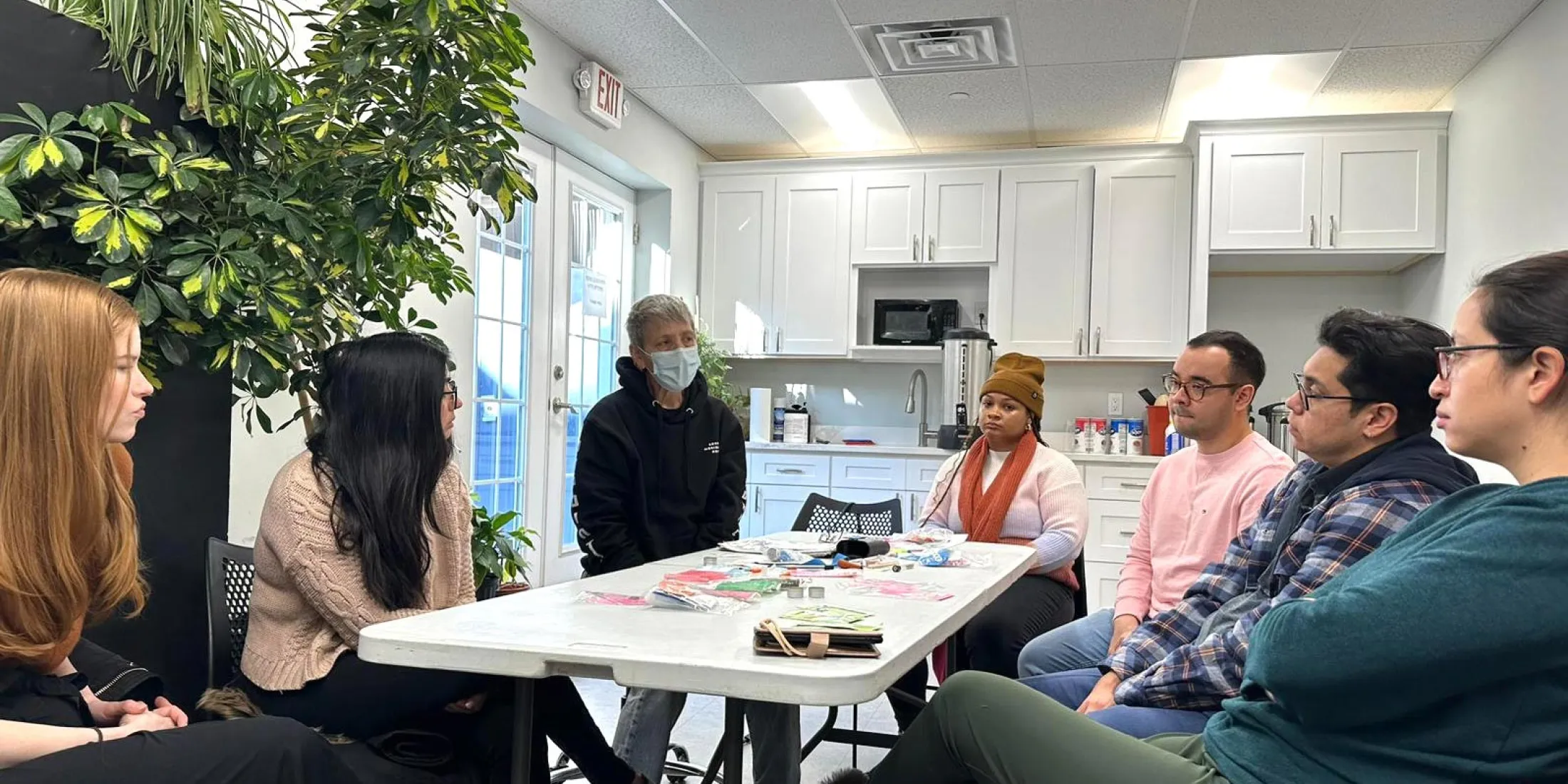
Primary Care and Social Internal Medicine Residents from Montefiore Einstein’s class of 2025 at OnPoint, where they rotate as part of their training.
During this period, Montefiore also launched an addiction medicine inpatient consult service at both Wakefield and Weiler Hospitals. This also benefits participants at OnPoint, who sometimes need emergency or hospital care. “A lot of the same staff who are in our clinic are also on the hospital services,” says Dr. Hayes. “We can send them a message and say, this participant really needs to go to the emergency room. Can you meet them there?”
Clinic director Susan Spratt adds, “It makes it much more likely that they will stay in the hospital and get the treatment they need. I think we all really value that connection.”
A vital training opportunity
Mostafa Elhakim, MD, is currently providing care at OnPoint as part of his role as chief resident in Primary Care and Social Internal Medicine. “It’s a steep learning curve,” he says. “You are meeting people where they're at, which is very important. But as doctors, we are trained to be very focused on surveilling everything, controlling everything, responding to every lab result, methodically working through every complaint. It takes some time to realize that sometimes not fixating on everything is actually better for the patient. And ultimately, that should be the goal.”
“This is people seeking care on their terms,” says David Edelman, MD, MPH, the first chief resident to care for participants at OnPoint. Now as an attending he is a regular presence there, seeing participants in the clinic one day a week. He presented the model of having residents rotate there at the most recent national Society for General Internal Medicine conference in May 2025. “It has a great dual benefit of both offering this experience and training to the residents, but also boosting the services available in a space that really needs that,” he says.
It’s a delicate balancing act, however. “There's a desire to increase services, but there's also a need to provide care that is acceptable to the participants,” Dr. Edelman explains. “Often those go hand in hand, but sometimes there is conflict. It was our job to make sure that residents coming into that space could fill the need and also do it in a way that felt appropriate to everyone.”
For many resident physicians, this is their first exposure to a harm reduction approach to providing care. If people aren’t ready to receive care—including treatment for their addiction—there is no pressure to do so. “People seem to feel and do better, and meet more of their health goals when they feel like they can make their own decisions and do things at their own pace,” says Dr. Hayes.
“That's a real beauty of having long-term relationships with participants in this setting,” he continues. “I know there's always another day. Getting them to their goal of not using heroin and fentanyl may not happen today, but maybe it'll happen in a year.”
The importance of relationships has been another key takeaway for residents. “They see firsthand the mistrust participants can have, and conversely, the trust they have with the long-term clinical staff,” says Dr. Edelman.
Synn Stern, the longtime nurse at the clinic, provided this example. “People might come to see me about a sexually transmitted infection. If I tell them they need to consult with a physician, their first reaction is, ‘I don't want to have to meet a new doctor.’ Then they'll see one of the doctors from Montefiore walk down the hall and say, ‘Oh, I know him.’ Of course you know him, I respond. That makes a big difference. Having that consistency.”
For participants, that level of comfort begins with trust in OnPoint and its staff, many of whom themselves have lived experience with addiction. “We rely so heavily on the wisdom and knowledge of OnPoint staff,” says Dr. Hayes. “They are alongside participants during the ups and downs of their daily lives, and build incredible trust with them. Some of that trust gets transferred to us. We couldn’t do what we do without them.”
Far from care as usual
In addition to not needing an appointment, at OnPoint, instead of 15-to-20-minute increments to see a doctor, physicians try their best to give participants all the time they require. Instead of addressing just one health issue in a visit, participants can bring up everything that is bothering them.
“Sometimes people drop in and they're there for 15, 20 minutes,” says Dr. Hayes, “and then other times I might spend a whole morning trying to sort through someone's issues.”
The goal, again, is for participants to stay engaged at whatever level they’re ready for. “In most of medicine we think about, how do we cure people?” says Dr. Hayes. “But even if I get somebody on medication, it doesn't actually treat the rest of their life. People are coping with homelessness, trauma, and mental health concerns, which are treated by several nurse practitioners who are part of the OnPoint team. It's a whole biopsychosocial model that requires much more than we can do as physicians. And so for me, the treatment is really, will you come and see me again? That's where I stake my success.”
All the providers agree that OnPoint is an especially rewarding place to care for people. “When I first got out of college and was looking around for what I might want to do, nothing like this existed,” says Synn Stern, the longtime nurse there. “The needs were there. People were dying and it was preventable. So now it feels like I'm kind of living the dream here. OnPoint is a syringe service, it's an overdose prevention center, it's a drop-in center. None of this existed, and we fought for such a long time to make it happen.”
“Everyone just belongs,” says Dr. Hayes. “When you're there, you feel like people care about you, and that goes for participants and staff. As a doctor, this is why I got into medicine, to be present with people in a way that they feel like they're being helped.”
“I'm just very thankful that Montefiore and people like Dr. Joe DeLuca and Dr. Julia Arnsten, chief of the Division of General Internal Medicine, saw the value of engaging in community partnerships in order to meet the needs of those that are most marginalized,” says Dr. Holm. “Life is precious. It’s a profound experience helping reverse overdoses, and showing people who are often ostracized that they deserve the best care.”