
Feature
The Power of Pathology to Uncover Answers: A Personal and Professional Journey in Rare Diseases Research
Q&A with J. Justin Mulvey, MD, PhD, assistant professor of pathology and associate director of the hematology laboratory, Montefiore Einstein
March 27, 2025
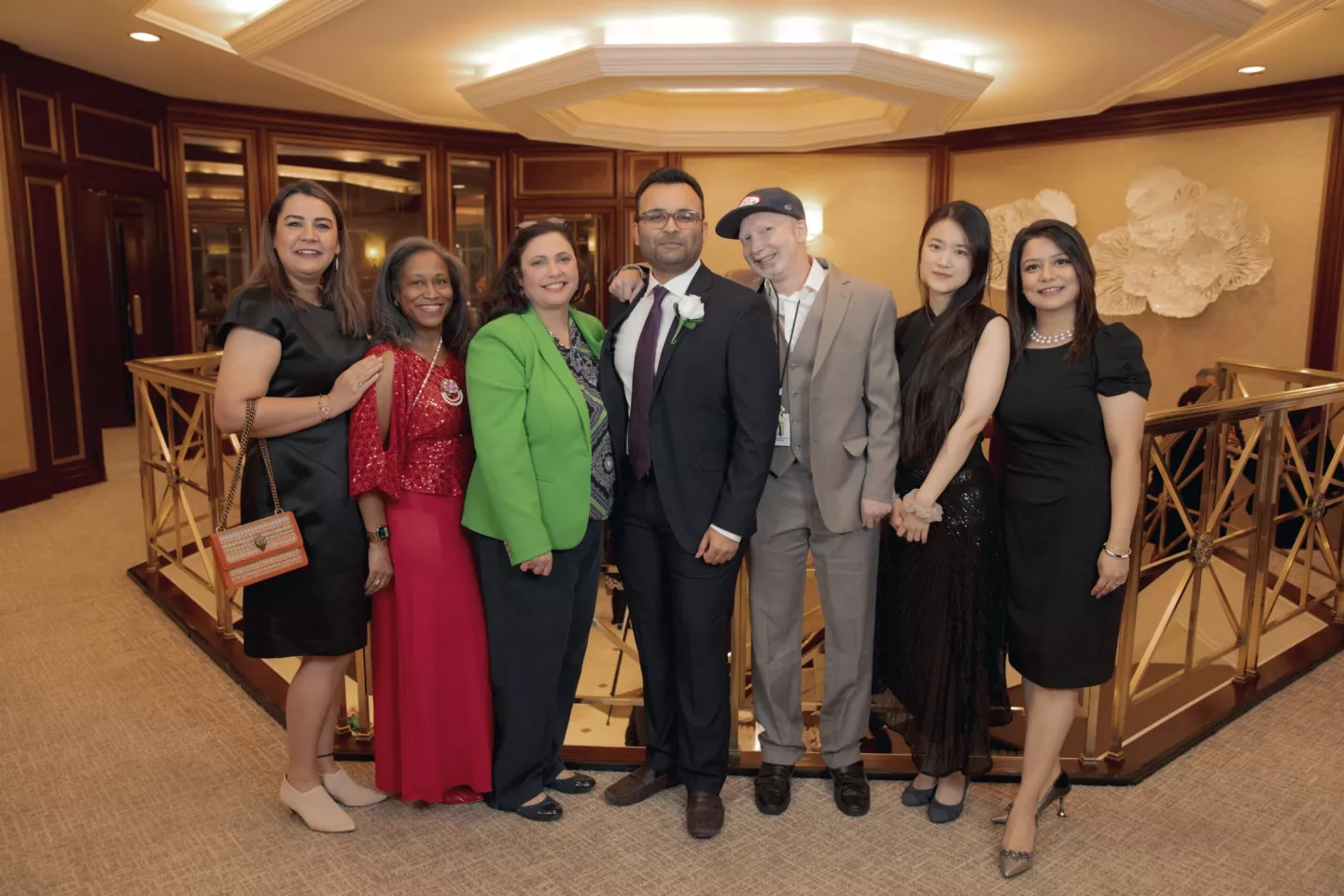
Dr. J. Justin Mulvey, fifth from right, with colleagues at the recent Alumni Association Awards Dinner. From left: Drs. Preeti Malik, Tiffany Hebert, Jennifer Oliver-Krasinski, Fahad Sheikh, J. Justin Mulvey, Xing Li, and Anam Fahad.
Growing up in rural Pennsylvania, Dr. J. Justin Mulvey was an active child who loved riding his bike and competing in wrestling and cross-country running. But when he was eight, his life took a dramatic turn when a swollen left knee refused to heal.
Misdiagnoses followed, and his health struggles fluctuated—easing in middle school, worsening in high school, and ultimately threatening his life during medical and graduate school. Despite undergoing countless treatments, his condition remained a mystery for years.
Throughout his life, Dr. Mulvey has stayed true to his mantra: “Always force yourself to push through.” He continues to move forward, using his medical and research expertise to manage his own health while advocating for others with rare diseases.
In this Q&A, Dr. Mulvey shares his extraordinary medical journey, how being a patient has shaped his career, the challenges of rare disease research and care, his decision to have a child, and more. Read the full Q&A here. (link to website) This conversation has been edited for length and clarity.
What was it like growing up with an undiagnosed disease?
When I was eight, a swollen knee was misdiagnosed as torn cartilage and later as juvenile rheumatoid arthritis. I wore a leg brace but just kept running around and playing sports. My family was very worried about my health, but I hated the constant conversation around it—I didn’t want to be the "sick kid." My disease went into remission during middle school. But in tenth grade, my health took another turn. I woke up with incredible pain in my abdomen and was diagnosed with fulminant ulcerative colitis. The doctor didn’t know the cause but treated it on and off with steroids. I was still doing varsity sports and leading as much normal life as I could into college. I refused to let my illness define me. I doubled down on academics, excelling in my AP classes. I wanted the focus to be on my achievements, not my disease.
Without a definitive diagnosis, how did you manage your disease?
I had accepted that I had some sort of immune disease—probably ulcerative colitis, though it was atypical. After college, I started developing other autoimmune conditions. My hair started falling out, the skin on my legs just lifted off one day, and I had severe atopy at times. I was wasting away. I came to understand was that these were all different aspects of immunity. Mechanistically, they didn’t seem connected, but they were all part of the same underlying dysfunction. At the time, I was in intensive medical training, so I didn’t have much time to focus on getting to the root cause. It was more about managing symptoms—figuring out what worked well enough to keep going.
Did your health challenges influence your decision to become a physician-scientist?
When I started college at Columbia as a chemistry major, a new drug—an anti-TNF antibody, infliximab—came out and my doctor suggested I try it. For the first time, I found a treatment that helped me. It made me realize that it would be useful to understand the blueprint of how the body works and how to treat it so that I could learn to take care of myself better. Medicine felt like the right path because it allowed me to combine science with real-world impact.
I decided to switch from a PhD in chemistry to the MD-PhD route and joined the Tri- Institutional program at Cornell, Rockefeller, and Memorial Sloan Kettering. My thesis in Dr. David Sheinberg’s lab was on using nanotubes to deliver alpha particle radiation to tumors. But during that time, I came up with a drug design for targeted glucocorticoid delivery, also made of nanotubes. My boss let me experiment and be creative, and I loved him for it.
Why did you choose to pursue pathology and hematology?
I wanted people to get the right medications for their illnesses. Precision medicine was interesting to me, especially within the field of immune diseases, and pathology was the best pathway. The immune system is endlessly fascinating and difficult, and I’m particularly drawn to the interplay between immunity and the coagulation system. Ultimately, hematology felt like the right path for me because the bone marrow is where it all starts.
Your condition worsened during your third year of medical school. What happened?
In 2011, I returned from a wedding in Cancun, Mexico, and was having a really bad flare—my joints were swollen, I had bloody diarrhea, my eyes were yellow, and I knew something was wrong. I went to Student Health, where they checked my blood and told me I was severely anemic. At 1 a.m., the clinic called and told me to get to the ER immediately—my hemoglobin and platelets were dangerously low. My friends carried me to the hospital, where they started plasma exchange. But then I started seizing, and I don’t remember anything after that.
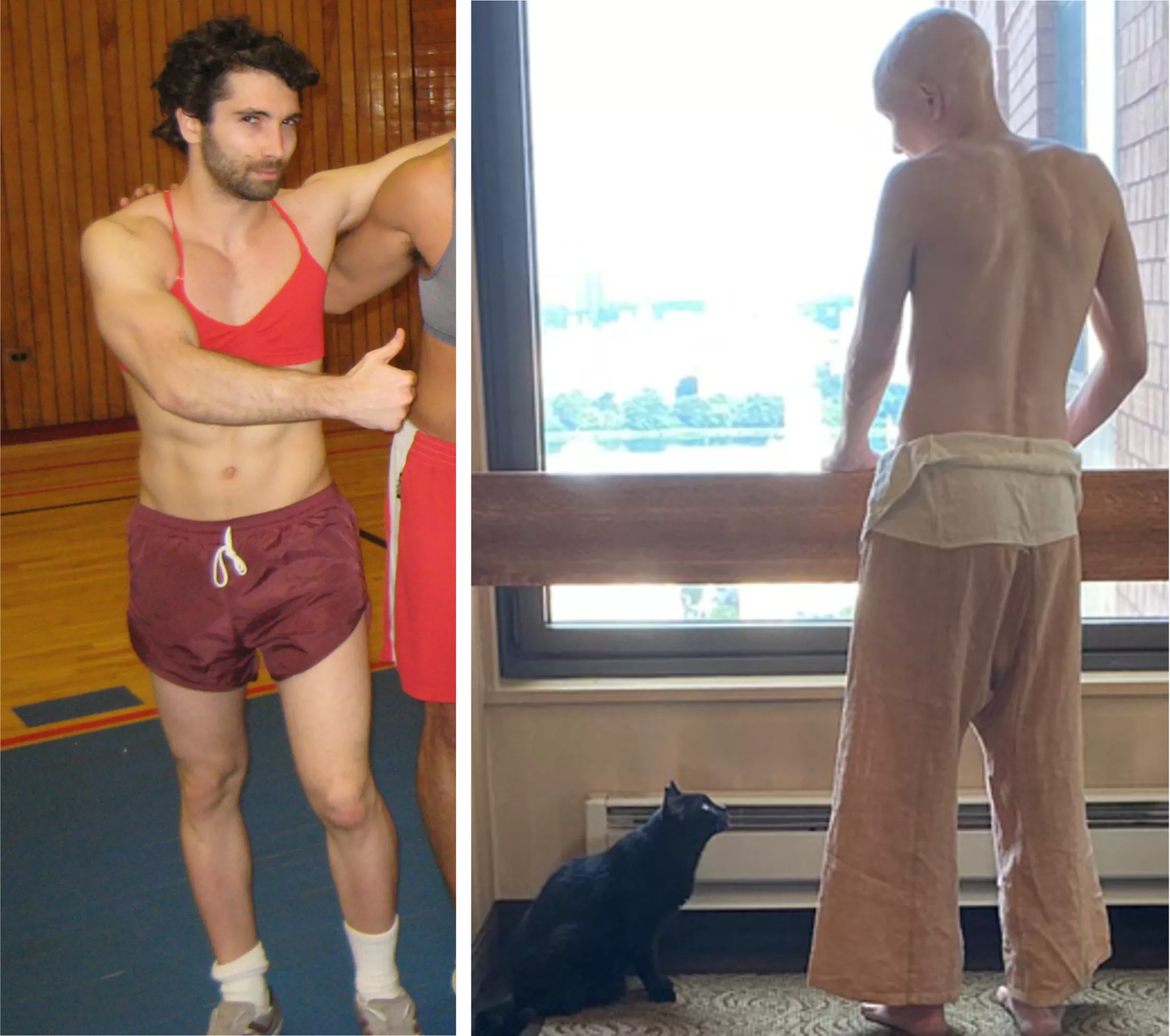
Dr. Mulvey’s undiagnosed rare disease progression over time.
I was in a coma for 10 weeks. During that time, my condition kept deteriorating, and they couldn’t figure out what was wrong. My fever spiked to 40–41°C, my hemoglobin dropped below five, my platelets were at four, and my body was shutting down. They diagnosed me with TTP (thrombotic thrombocytopenic purpura) and treated it, but nothing was working. At one point, they thought I wasn’t going to survive.
You miraculously lived through this ordeal. What changed the outcome?
If I hadn’t been at Cornell, I’d be dead. Dr. Cynthia Magro, the director of dermatopathology at Cornell, had heard about my case and decided to biopsy my leg. She suspected a complement- mediated process (when the immune system’s complement proteins mistakenly attack the body’s own cells, causing inflammation and damage) and tested for complement deposition in my blood vessels. It turned out she was right. Around that time, a new complement inhibitor had just been developed for a different condition. They managed to get the drug for me off- label and gave it a try. I was still unconscious but started to improve. They stopped the drug—I got worse. They restarted it—I got better again. That’s when they realized this was a
complement-driven disease, not just TTP. In fact, I had two incredibly rare diseases at once— TTP and atypical hemolytic uremic syndrome (aHUS), which was complement-mediated.
Without Dr. Magro, my condition would have gone undiagnosed. There’s no one else who stains for complement the way she does—it’s a technique she developed earlier in her career, and it’s not widely used at other institutions. Her work didn’t just save my life; it also reinforced my belief in the power of pathology to uncover answers that other specialties might miss. I continue to collaborate with her on research related to complement disorders and other immune-driven diseases.
What was your health condition after the coma?
When I finally woke up, I didn’t know who I was. I had lost my memory of the past decade—my last clear memories were from high school. I had to reconstruct my identity, piecing together memories through old conversations and photos. Even though I couldn’t recall events, I knew instinctively if someone was a friend, a family member, or someone I loved. Recovery was grueling but I was determined to regain my independence. Even with these neurological challenges, I was committed to continuing my medical education and research.
What did it take for you to make it through school?
My mentor suggested taking time off, but I knew if I didn’t push forward, I might never regain what I had lost. I didn’t remember where I sat in my lab or where my desk was, but I forced myself to dive back in. I finished my PhD on time, published my paper, and somehow made it through my third year of med school, even though I was still weak and anemic. Then, in my fourth year, I developed severe fatigue, a chronic cough, and sky-high eosinophils infiltrating my organs. Nothing was working to suppress them—not even steroids. They were destroying tissue, including my brain. Later, I got a trial of an anti-IL-5 antibody that worked, but insurance denied it because my condition didn’t have an ICD-10 code. I had to establish a Churg-Strauss diagnosis to get access. I got back on the drug and things got better. I finished pathology residency at Cornell and completed a hematology fellowship at MSK.
As the associate director of hematology at Montefiore Einstein, how are you involved in rare disease patient care?
Much of my work takes place in the hematology lab, but I’m involved in rare disease patient care through diagnostic consultations and collaborations with clinicians. My background is in drug design, pharmacology, and organic chemistry and my contributions are largely diagnostic through theranostics. That’s where you use targeted drugs as tools to tease out the underlying mechanism of the disease, especially within the immune space. I work alongside specialists, including on research projects with Eric Bouhassira, PhD, the director of Einstein’s Center for Human Embryonic Stem Cell Research and a professor of medicine and of cell biology, who is interested in TTP and creating non-immunogenic red cells. I also collaborate with Dr. John Greally and his team in the New York Center for Rare Diseases at Montefiore, Einstein.
What are the barriers to rare disease research and patient care?
Every case, especially with undiagnosed diseases, is unique. I’m part of the Undiagnosed Diseases Network (UDN), and I’m an n of one—no drug company is going to fund a trial for a single person. And insurance companies often deny coverage for off-label or novel therapies, forcing patients and physicians into lengthy appeals processes that can delay critical care. There is also a knowledge gap—many clinicians may only encounter a rare disease once in their career, leading to delayed diagnoses. Addressing these issues requires greater collaboration between researchers, clinicians, and policymakers to develop better funding models, streamline regulatory approval processes, and improve public awareness.
How important is access to genetic testing in moving rare disease research forward?
Access to genetic testing is one of the most critical gaps in rare disease research. Right now, insurance doesn’t cover whole genome sequencing, which is essential for diagnosing many rare diseases. Instead, patients are forced to go through expensive, piecemeal genetic panels, often repeating tests at different institutions. This is not only inefficient but also creates major delays in diagnosis. We need a national system for whole genome sequencing—one comprehensive test that could be stored securely and revisited throughout a patient’s life as new genetic discoveries emerge.
How has your personal journey with a rare disease impacted your medical career?
Fighting to understand my own disease has fueled my drive to improve diagnostics and patient care, so others with rare diseases receive faster, more effective treatment. My personal journey with a rare disease allows me to advocate for patients in ways that go beyond the microscope—I understand the struggles they face, from misdiagnosis to accessing proper treatment. There’s no system in place for someone without a medical background to navigate the system. In rare diseases, this kind of advocacy is crucial. I’ve started thinking about writing a book to help patients and families advocate for themselves in the medical system.
How are you doing today? Have you had a breakthrough?
My life is so much better now and I'm happy about that. I’ve been on a JAK inhibitor (baricitinib) for a few years now, and it’s been life changing. This is thanks to my friend and colleague Dr. Xiao Peng, Director of the Genetics of Blood and Immunity Clinic in Montefiore’s Center for Rare Diseases. Over the course of a decade, I had seven vertebrae collapse, costing me three inches, due to continued inflammation, flares, and glucocorticoid drugs. When I came to Montefiore, my tendons and ligaments were inflamed. Dr. Peng suggested a genetic test that is run at Nationwide Children’s hospital, in Ohio. Given the heavy immune suppression I was on, we didn’t expect much, but my results were significantly elevated—I had a hyperactive
inflammasome.
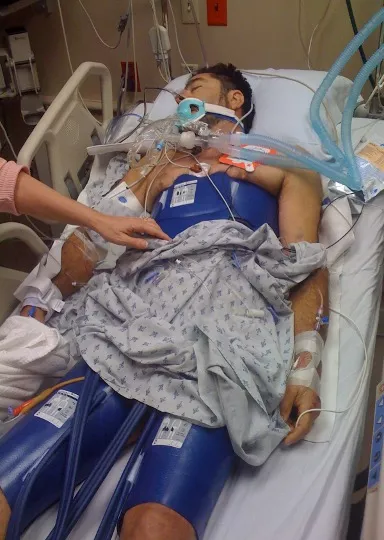
In March 2011, while in medical and graduate school, Dr. Mulvey was placed in an induced coma; he remained unconscious for 10 weeks.
That was a partial breakthrough. Since shifting my treatment, I’ve gained 30 pounds of muscle, my hair started turning black again and I can run without feeling awful. Most importantly, I decided I was healthy enough to have a child.
That’s amazing. How has becoming a parent changed you?
Overcoming the fear of not being enough—not being stable enough, not thinking I’d live long enough to have a child—was a huge moment for me. Despite everything my body has been through, I feel like I’ve slowed the progression of my disease. Now every decision I make— about my health, my career, and my research—is driven by the desire to be present for my son.
What’s the most profound aspect of your job?
Interacting with children who have rare diseases. When I see a young patient struggling with an unknown condition, I can’t help but think back to my childhood and the uncertainty my family faced. I’d like every child to grow up in a way that allows them to be a typical American kid. To come home covered in mud, get scuffed knees, run around with their friends outside, have silly goals, and achieve them. I think that’s what drives our rare disease team here at Montefiore Einstein. Rare disease is never just about a diagnosis—it’s about the child, the family, and their future. Patients aside, my favorite part of my job remains mentoring our trainees. You spend a lot of time with them, and this can significantly impact their personal and professional lives.
A passionate and beloved mentor, Dr. Mulvey’s work with Montefiore Einstein medical students, residents, fellows and PhD candidates earned him the Teaching Award for best pathology faculty in 2021 and 2022.
He shared the details of this arduous medical journey at the recent Rare Disease Day Symposium, held February 28, on the Einstein campus. His talk, Time is Tissue, highlighted the importance of rapid intervention, persistence in diagnosis, and collaboration among specialists when managing rare and complex diseases.